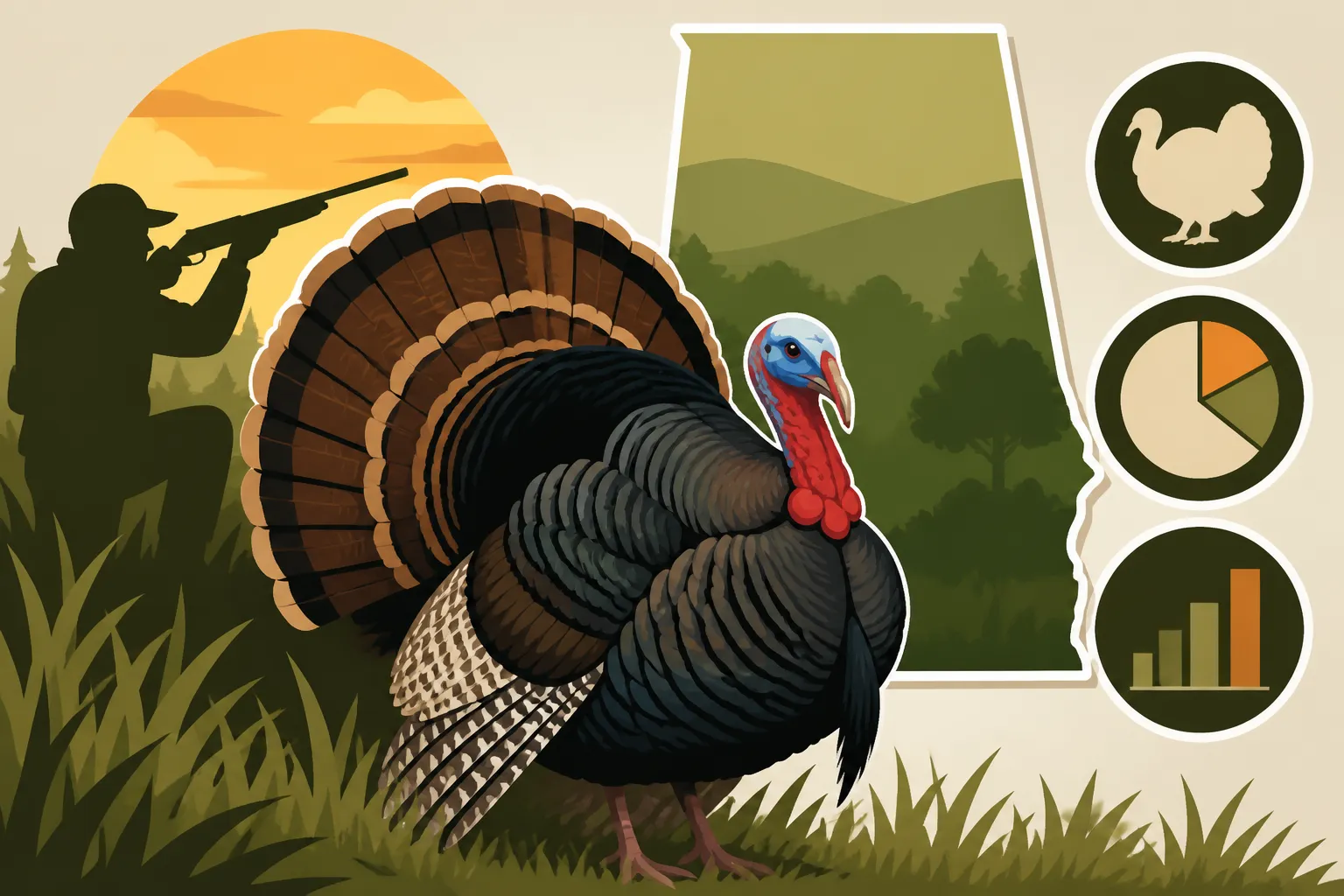
Alabama Turkey Harvest Numbers
Every turkey hunter in Alabama knows that some springs just feel different. One year, gobblers might be hammering on every ridge, and the next, it feels like you're chasing ghosts, struggling to even strike a bird. It's easy to get discouraged and wonder if the wild turkey population is truly on the decline. Understanding Alabama's official turkey harvest numbers helps paint a clearer picture, giving us insight into population health, management efforts, and how we might need to adjust our own strategies to find success in the woods. This guide will break down what these numbers mean, how they're collected, and what trends they reveal about Alabama's cherished gobblers.
Understanding Alabama's Turkey Harvest Data Collection
Before we can even begin to talk about what the harvest numbers tell us, it's crucial to understand how that data is actually gathered. It’s not just a guess; there’s a system in place that relies heavily on hunter participation and the dedicated work of the Alabama Department of Conservation and Natural Resources (ADCNR). When you hear about harvest statistics, they're built on the foundational data provided by hunters like us.
How Game Check Works for Turkey Hunters
The backbone of Alabama’s harvest data collection for deer and turkey is the "Game Check" system. This isn't just a suggestion; it's a mandatory requirement for every hunter who successfully harvests a deer or turkey. When you tag out, whether it's a magnificent gobbler or a jake you decided to take for the pot, you have to report it. You can do this quickly and easily online through the Outdoor Alabama website or via their mobile app, often right there from the field.
The process is fairly straightforward: you log into your account, enter details like the county of harvest, the date, and the type of bird (gobbler, jake). This might seem like a minor administrative task after the excitement of a successful hunt, but these individual reports coalesce into a massive dataset. Each entry is a data point that biologists use to track trends, assess population health, and make informed decisions about future seasons and regulations. Without accurate hunter reporting, the entire system breaks down, and we lose a vital tool for understanding our turkey resource. It’s a collective effort, and every hunter has a part to play in ensuring the accuracy of these numbers.
The Importance of Reporting Your Harvest Accurately
I know, I know. After the adrenaline rush of a successful turkey hunt, the last thing you want to do is pull out your phone and fill out a form. But trust me, taking those few minutes to accurately report your harvest is genuinely critical. Biologists rely on this data to monitor the health of our wild turkey populations across the state. They use it to see which areas are producing more birds, to track the age structure of harvested gobblers, and to identify any counties showing concerning declines or impressive increases.
Consider a scenario where hunters in a specific area consistently fail to report their harvests. The official data for that region would inaccurately suggest a lower turkey population or reduced hunting success, potentially leading to unnecessary regulation changes or misdirected conservation efforts. Conversely, if reporting is robust, biologists can quickly spot issues, like a dip in Alabama Turkey Population Trends, and investigate contributing factors such as disease, habitat loss, or poor reproduction. Platforms like GoHunt can even help hunters cross-reference their own observed activity with reported harvest data, giving them a more complete picture of local turkey dynamics. Your accurate report helps ensure that future generations of Alabama hunters have vibrant turkey populations to pursue, based on sound science, not just anecdotes or guesswork.
Historical Trends in Alabama's Turkey Harvest Numbers
Alabama has a rich history of turkey hunting, but the story of the wild turkey in our state isn't one of constant abundance. It's a tale of near extirpation, incredible conservation efforts, and fluctuating populations that continue to challenge hunters and biologists alike. Looking at the long-term harvest trends gives us invaluable context for what we see today.
Decades of Ups and Downs: A Look Back
Back in the early 20th century, wild turkeys were practically non-existent across much of Alabama, primarily due to unregulated hunting and massive habitat destruction. It’s hard to imagine, but there was a time when hearing a gobble was a rarity. Thanks to dedicated restoration programs, including trap-and-transfer efforts that truly revitalized populations, turkeys made a spectacular comeback. For a period, particularly from the 1970s through the early 2000s, it felt like Alabama was truly the "Heart of Dixie" for wild turkeys, with booming populations and widespread hunting opportunities. This success story led to consistently high harvest numbers, peaking in the early 2000s, where annual harvests often exceeded 40,000 birds.
However, the last couple of decades have seen a more sobering trend. While still robust in many areas, statewide harvest numbers have generally experienced a gradual decline. It's not a catastrophic crash, but rather a slow, steady reduction that has prompted concern among hunters and wildlife managers. This shift is often attributed to a confluence of factors, including habitat changes, increased predation, and possibly even the effects of disease in certain local populations. Understanding this historical context helps us appreciate both the incredible recovery and the ongoing challenges facing Alabama's wild turkeys.
Recent Season Summaries and What They Indicate
Focusing on the more recent past, let's look at what the last few turkey seasons have shown us. For many hunters, the anecdotal evidence of fewer birds, less intense gobbling, and harder hunts has been backed up by the official harvest reports. While there can be year-to-year fluctuations due to various immediate factors, the overall trend in statewide turkey harvest for Alabama in recent years has often been flat or slightly down compared to the peak years of two decades ago.
For instance, looking at data from the past five to ten years reveals that annual harvests have settled into a lower, though still significant, range. We're generally seeing statewide totals in the low to mid-20,000s, a notable drop from the 40,000+ birds harvested during the golden age of Alabama turkey hunting. This trend isn't unique to Alabama; many Southeastern states have reported similar observations. These numbers aren't necessarily a sign of imminent doom, but they do indicate a need for vigilance and adaptive management strategies. They prompt biologists to delve deeper into poult recruitment rates, disease prevalence, and the impact of evolving habitat landscapes. For hunters, it means adapting our expectations and refining our techniques, perhaps focusing more on Scouting Alabama Public Land Before Season or becoming more proficient with Run-and-Gun Turkey Tactics on Public Land.
Here's a simplified look at recent Alabama turkey harvest trends:
| Year (Spring Season) | Reported Harvest (Approx. Gobblers) | General Trend | Key Observations |
|---|---|---|---|
| Early 2000s | 40,000+ | Peak | "Golden Age" of Alabama turkey hunting |
| Mid-2010s | 30,000 – 35,000 | Moderate Decline | Early signs of population leveling/reduction |
| Recent Seasons | 20,000 – 25,000 | Stabilized Lower | Consistent numbers but below historic highs |
| Current Year | To be determined | Ongoing monitoring | Focus on poult production and habitat impact |
Note: These numbers are generalized for illustrative purposes and actual annual figures may vary.
Factors Influencing Annual Turkey Harvest Totals
Wild turkey populations and, consequently, harvest numbers, are incredibly sensitive to a myriad of environmental and ecological factors. It’s rarely just one thing; rather, it's usually a complex interplay of weather, habitat quality, reproductive success, and even hunting pressure that dictates how many birds end up in our vest.
Weather's Impact on Spring Gobbling and Hunter Success
Ask any seasoned turkey hunter, and they'll tell you that weather plays a monumental role in their success. A warm, dry spring often means an abundance of gobbling, as birds are more active, visible, and responsive to calls. This generally translates to higher hunter participation and, usually, a better chance of harvesting a bird. When the conditions are just right, with sunny mornings and calm winds, it feels like the whole woods comes alive, making it easier to locate and work a gobbler.
Conversely, a cold, wet, or unusually windy spring can significantly depress harvest numbers. Wet conditions can make birds less inclined to fly down from the roost, and heavy winds can make it nearly impossible to hear distant gobblers or accurately pinpoint their location. Think about a spring where a late cold snap hits just after the opener. Gobbling activity can plummet, frustrating hunters and making birds less predictable. These immediate weather patterns don't necessarily reflect the actual turkey population, but they can dramatically influence hunter effort and success rates, ultimately affecting the reported harvest for that particular season. This is especially true during the critical Alabama Legal Turkey Hunting Hours at dawn.
Poult Production and Its Lagging Effect on Harvest
While weather might influence a single season's success, poult production is the long-term engine driving turkey populations and future harvests. Poult production refers to the number of young turkeys (poults) that successfully hatch and survive to maturity each year. A strong hatch means more jakes the following spring, and more two-year-old gobblers the year after that. This is where the long-term health of the flock truly lies.
Poor poult production, often due to cold, wet springs during nesting season, high predation on nests or poults, or inadequate brood-rearing habitat, can have a noticeable lagging effect on harvest numbers two to three years down the road. If you have several consecutive years of poor hatches, you'll eventually see fewer mature gobblers available for harvest. Biologists keep a close eye on Poult-to-Hen Ratios and What They Mean during summer brood surveys, as this data is a key predictor of future turkey abundance. Hunters can often feel this firsthand; a season with few jakes usually means a tougher hunt for older birds a couple of years later, regardless of how good the immediate spring weather might be. If you're struggling to find birds, it might be worth considering Nest Predation and Alabama Turkey Hatches as a factor in your local area.
Habitat Changes and Their Influence
Habitat is the foundation of any wildlife population, and wild turkeys are no exception. Changes in habitat—both positive and negative—have a profound impact on their numbers and distribution, directly affecting where and how many birds hunters can find. Prime turkey habitat includes a mosaic of mature hardwood forests for roosting, open woodlands with diverse understories for foraging, and dense cover for nesting and brood rearing.
Unfortunately, factors like urbanization, intensive timber harvesting practices that don't consider wildlife needs, and the conversion of diverse forests into monoculture pine plantations can degrade turkey habitat. When crucial elements like mature mast-producing trees or dense nesting cover disappear, turkey populations suffer. On the flip side, managed timber operations that incorporate prescribed burns, thinning, and maintaining diverse age classes of timber can create excellent turkey habitat, improving forage, reducing disease vectors, and enhancing overall flock health. Understanding Alabama Longleaf Pine and Quail Habitat often gives insights into turkey habitat too, as many principles overlap. Hunters using apps like GoHunt can use satellite imagery to identify crucial habitat features that might attract turkeys, adapting their scouting to areas showing better potential.
Regional Differences in Alabama Turkey Harvest
Alabama is a large and diverse state, and it would be a mistake to assume that turkey populations and harvest success are uniform from north to south, or east to west. Different regions, with their distinct ecologies, land uses, and hunting cultures, often tell very different stories when it comes to wild turkey abundance and harvest numbers.
Harvest Variation Across Alabama Spring Turkey Zones
Alabama is divided into two distinct turkey hunting zones, Zone 1 and Zone 2, each with its own opening and closing dates for spring season. These zones were established to account for the biological differences in turkey breeding cycles across the state, ensuring that hunting seasons align with peak gobbling activity in each region. Historically, Zone 1, which covers the northern counties, often sees slightly higher overall harvest numbers due to its extensive mature hardwood forests and historically strong turkey populations. This is often where hunters plan to be for the Alabama Zone 1 Spring Turkey Opening Day.
However, the "best" zone can vary from year to year, influenced by local conditions, weather, and previous poult production. Some years, the southern counties in Zone 2 might experience a better hatch, leading to increased gobbler numbers a couple of seasons down the road. Hunters need to pay attention to these regional nuances. For example, the rich agricultural lands of the Black Belt might hold dense turkey populations in certain pockets, while the rugged, mountainous terrain of northeast Alabama could have more dispersed birds, requiring different hunting tactics. These zone splits are a crucial part of Why Alabama Splits the State Into Turkey Zones.
Public Versus Private Land Harvest Disparities
The difference in turkey harvest success between public and private land in Alabama is often stark, and it's a reality every hunter should acknowledge. Private lands, particularly those under active wildlife management or those with limited hunting pressure, typically boast higher turkey densities and, consequently, higher harvest rates. Landowners or leaseholders can implement habitat improvements, control predator populations, and manage harvest pressure to cultivate thriving turkey populations. This often translates to more consistent gobbling and greater success for hunters who have access.
Public lands, while offering invaluable access to all hunters, often face significant challenges. Higher hunting pressure, coupled with less intensive habitat management in some areas, can lead to lower turkey densities and tougher hunting. Birds on public land are often more call-shy, more prone to "going quiet," and generally require more effort and skill to harvest. Hunters venturing onto public land might need to walk farther, hunt deeper, and be more strategic in their approach. This disparity is why a hunter might experience a fantastic season on a well-managed private lease in the Black Belt, while another hunter on nearby public land struggles to even hear a gobble. Understanding Hunting Pressure on Alabama Public Land is key to setting realistic expectations.
The Role of Regulations and Management in Harvest Success
Regulations aren't just arbitrary rules; they are tools that wildlife agencies use to manage game populations, ensure sustainability, and provide fair hunting opportunities. For wild turkeys in Alabama, regulations play a significant role in influencing overall harvest numbers and the quality of the hunting experience.
Bag Limits and Their Effect on Overall Harvest
One of the most direct ways regulations impact harvest is through bag limits. Alabama has specific rules regarding the number of gobblers a hunter can take per day and for the entire spring season. For example, Alabama allows hunters to harvest one gobbler per day, with a total seasonal limit of three gobblers. This Alabama Spring Turkey Bag Limit is designed to ensure that enough breeding birds remain in the population to sustain future generations.
If the bag limit were higher, say two birds a day and five a season, the overall harvest numbers would undoubtedly increase in the short term, but it could put unsustainable pressure on local populations, especially if combined with low poult production years. Conversely, a lower bag limit might reduce overall harvest, but could potentially allow populations to rebound. These limits are not set in stone and can be adjusted by the ADCNR based on harvest data, population surveys, and biological assessments. They aim for a balance: allowing for meaningful hunting opportunities while safeguarding the long-term health of the wild turkey resource. It’s a delicate dance between hunter satisfaction and conservation.
Decoy Restrictions and Hunter Behavior
Another regulation that subtly shapes hunter success and, by extension, harvest numbers, is the decoy restriction. For the first ten days of Alabama's spring turkey season, using artificial decoys is prohibited. This rule, often debated among hunters, is in place to reduce harvest pressure on gobblers during the very early part of the breeding season when they are most vulnerable and aggressive. When Alabama Turkey Decoys Become Legal it changes hunting dynamics.
Without decoys, hunters must rely more heavily on calling prowess, scouting, and positioning, which can make the hunt more challenging. This restriction can naturally reduce early-season harvest numbers compared to what they might be if decoys were allowed from day one. Once the ten-day restriction lifts, decoys become a potent tool, and many hunters will switch tactics, often seeing an increase in success. This change in regulation aims to spread out the harvest, give gobblers a bit of a reprieve during the initial peak of the breeding season, and potentially allow more birds to breed before being taken. It's an example of how a seemingly small rule can influence hunter behavior and the aggregate harvest data.
Applying Harvest Data to Your Next Turkey Hunt
So, you've absorbed all this information about harvest numbers, trends, and influencing factors. Now what? The real value of this data lies in how you, the individual hunter, can use it to improve your chances of success and gain a deeper appreciation for the turkeys you pursue. It's not just about statistics; it's about smarter hunting.
Scouting Smarter with Harvest Information
Armed with knowledge about Alabama's turkey harvest numbers, you can become a more effective scout. Instead of just blindly walking the woods, start by looking at county-level harvest data, which the ADCNR often makes publicly available. If a certain county or WMA consistently reports higher turkey harvests, that's a good indicator of a healthier, more robust population. This doesn't guarantee you a bird, but it certainly increases your odds of encountering one.
However, don't just chase the highest numbers. Dig a little deeper. Are those high numbers coming from private land, or is there significant public land harvest contributing? This can help you refine your focus. You might use platforms like GoHunt's mapping tools to identify areas within those high-harvest counties that possess optimal habitat — a mix of mature timber, open fields, and water sources. Combine this with insights from Reading Aerial Photos for Piedmont Deer (which often correlates with good turkey habitat) and you're building a truly informed scouting plan. You'll spend less time in dead zones and more time in high-potential areas, even if it means putting in more miles initially.
Adapting Tactics Based on Population Insights
The harvest data and population insights can also guide your hunting tactics, helping you adapt to the conditions you're likely to face. If statewide or regional harvest numbers have been trending down, and poult production has been low, it suggests you might be dealing with a sparser population of older, more cautious gobblers. In such a scenario, aggressive calling might be counterproductive. Instead, consider more subtle approaches, focus on Roost Hunting Alabama Gobblers at first light, or employ patience by Sitting a Field Edge in Late Season where birds might be feeding.
Conversely, if harvest numbers show a strong influx of jakes from a good hatch year, you might encounter more vocal, less wary birds. This could be a good time to try more assertive calling or cover more ground with a Run-and-Gun Turkey Tactics on Public Land approach. Understanding Alabama Turkey Gobbling Activity Timing in relation to previous year's harvest data can also inform when you prioritize your hunting days. By connecting the dots between official data and your observations in the field, you move beyond mere luck and become a more strategic and adaptable turkey hunter, respecting the ebb and flow of nature.
Disclaimer
This guide is for informational purposes only and does not constitute legal advice. Hunting regulations, seasons, and bag limits are subject to change. Always consult the official Alabama Department of Conservation and Natural Resources (ADCNR) regulations booklet or website before engaging in any hunting activities. Ensure you have the proper licenses and permits. Safety should always be your top priority in the field.