Wind and Thermals on a Piedmont Ridge
Oh, the infamous Alabama Piedmont ridge! If you've spent any time chasing whitetails in our beautiful state, you know the frustration of setting up what feels like the perfect stand, only to have the wind inexplicably swirl and bust you. It’s enough to make you pull your hair out! Those rolling hills, mixed timber, and deep draws create a dynamic, often unpredictable air current dance that can make or break a hunt. This guide is all about demystifying those tricky winds and thermals on a Piedmont ridge, helping you understand their patterns, and giving you actionable strategies to turn that frustration into success.
Understanding Alabama's Piedmont Topography and its Influence
Alabama's Piedmont region is a unique blend of rolling hills, hardwood bottoms, and pine plantations, offering a different set of challenges than the vast flatlands of the Black Belt or the rugged mountains further north. To truly master hunting here, you first have to grasp how this specific landscape dictates air movement. It's not just about knowing the general wind direction; it's about understanding the subtle, yet powerful, influence of every dip, rise, and timber stand.
The Unique Challenges of Piedmont Ridges
When you picture a "ridge" in the Piedmont, it’s rarely a towering, sharp peak. Instead, think of long, undulating fingers of higher ground, often dissected by steep draws and smaller drainages. This isn’t the open, predictable plains, nor the sheer faces of truly mountainous terrain. Here, the subtle elevation changes, even just 20 or 30 feet, can have a profound impact on how air moves. A gentle breeze that seems consistent at your truck might be swirling wildly just a hundred yards up a hillside. These microcurrents are the bane of many a hunter.
The mixture of hardwoods and pines also plays a significant role. Dense pine thickets can block and channel wind, creating corridors and dead air zones. Mature hardwood stands, with their open understories, allow for more consistent air flow but can also be subject to sudden shifts as thermal activity changes. Deer, being masters of their environment, instinctively understand these air currents and use them to their advantage, often bedding on leeward sides of ridges where their scent is carried away or using thermal drafts to detect predators. This means we, as hunters, need to be just as savvy, if not savvier, than the deer themselves.
How Thermals Interact with the Landscape
Thermals are essentially columns of air that rise or fall due to temperature differences. Think of it like this: warm air rises, and cool air sinks. This principle is constantly at play on a Piedmont ridge, and understanding its rhythm is crucial.
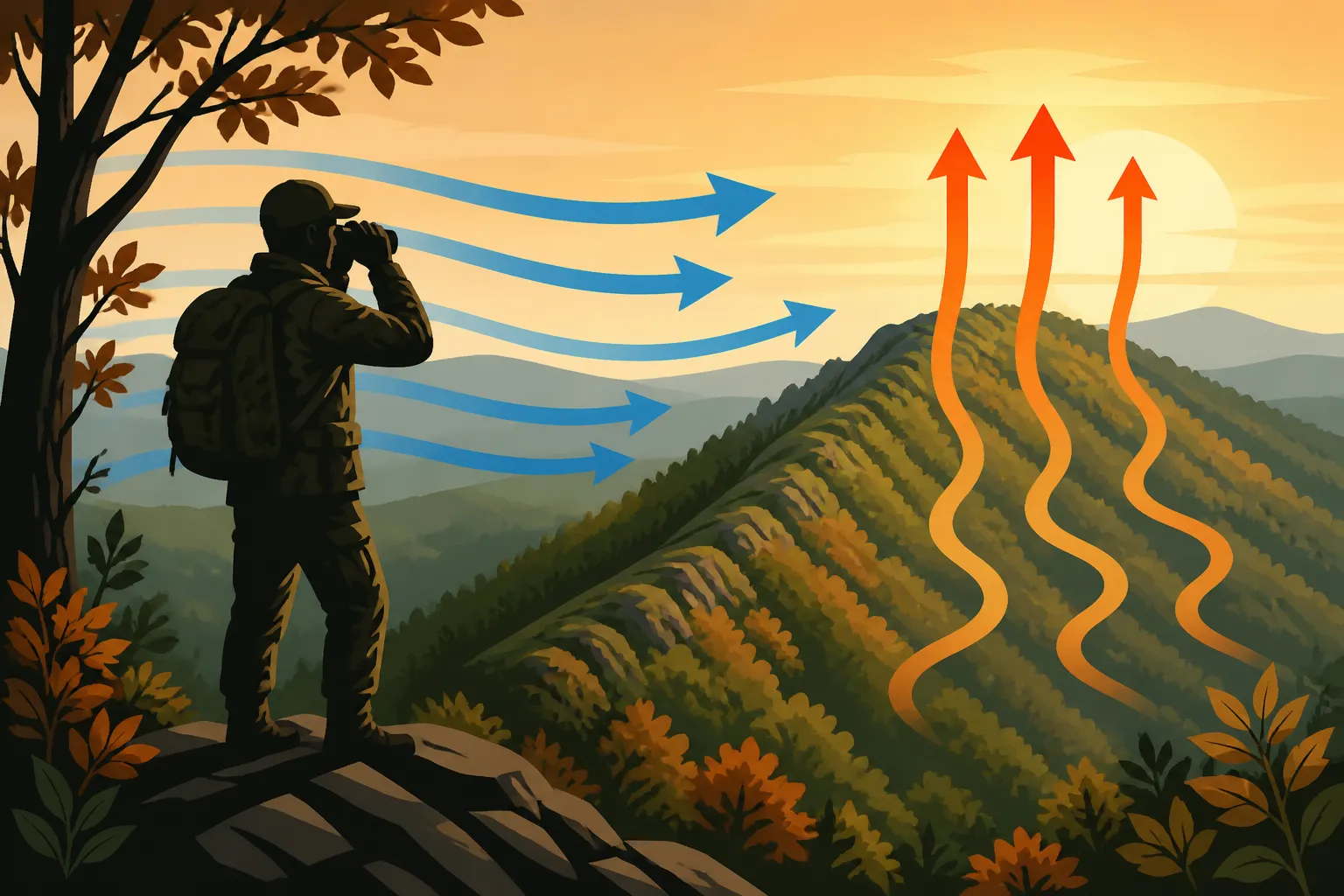
During the daytime, as the sun heats up the ground, especially south-facing slopes, fields, or clearings, the air warms and begins to rise. This creates an uphill thermal draw, pulling your scent up the ridge and into the surrounding timber. If you're set up on the top of a ridge mid-day, your scent might be lifted and dispersed, but if you're lower down, that rising air will carry your scent directly to deer above you. Conversely, cooler, shaded areas like north-facing slopes or deep creek bottoms will experience less rapid heating, and air may remain still or even be pushed downhill for longer.
As evening approaches and the sun begins to set, the ground cools much faster than the air above it. This causes the cooler, denser air to sink, creating a downhill thermal flow. Your scent, which was being pulled uphill earlier, will now be pushed down into the creek bottoms and low spots. This transition from rising daytime thermals to falling nighttime thermals is a critical period for deer movement and hunter strategy. If you're still on top of the ridge with falling thermals, your scent could be funneling right into a bedding area below. Being aware of these natural air conditioners and heaters, and how they change throughout the day, is vital for predicting deer movement and planning your approach.
Decoding Wind Patterns on a Piedmont Ridge
While the general weather forecast gives you a "prevailing wind" direction, any seasoned Alabama hunter knows that this is often just a suggestion on a Piedmont ridge. The real game is played in the microcurrents and eddies created by the terrain.
The Prevailing Wind vs. Microcurrents
The forecast might say a steady 10 mph wind from the west, and you might set up your stand accordingly. But the moment you get on a Piedmont ridge, especially one with varying elevation and timber density, you'll likely find that "steady west wind" is anything but. The prevailing wind is the general atmospheric flow, but the terrain acts like a series of baffles and funnels, twisting and redirecting that air.
Imagine a west wind hitting a steep eastern slope of a ridge. Instead of flowing straight over, it can be deflected upwards, creating a localized updraft, or it might be pushed down into a draw, creating a swirling eddy. Then, combine this with the rising or falling thermals we just discussed, and you've got a complex air movement system. For example, a west wind might be blowing generally, but a strong morning thermal rising up an east-facing slope could actually pull your scent east and uphill, counteracting the prevailing wind for a time. This is why you always need to be checking the wind at your stand location, not just relying on the forecast or what it felt like at your truck. A small puff of milkweed or a delicate piece of thread can be your best friend in these situations.
Identifying Wind Funnels and Eddies
Deer use topography to their advantage, and so should you. Ridges are full of natural wind funnels and eddies that can either give you an edge or betray your presence.
Wind funnels are often found in saddles, deep draws, or narrow gaps in a ridge line. Just like water finds the path of least resistance, wind will often channel itself through these openings, creating a more consistent, accelerated flow. A saddle between two ridge points, for instance, can act as a highway for both deer and wind. Setting up on the downwind side of such a funnel can be a deadly tactic, as deer moving through it are less likely to detect you. However, you need to be acutely aware of which direction that wind is actually being funneled.
Eddies, on the other hand, are spots where the wind swirls unpredictably, often on the leeward side of a ridge or behind dense cover like a cedar thicket or a particularly gnarly pine stand. Here, the air might move in circles, making scent control incredibly difficult. You might have wind hitting the north side of a ridge from the north, then as it crests, it creates a vacuum on the south side, causing the air to swirl back up or around. These are generally areas to avoid, or at least approach with extreme caution, unless you have a very specific, short-term plan that accounts for the instability. Learning to read a ridge for North Alabama deer means not just looking for sign, but understanding how those terrain features influence the wind.
Observing natural indicators is key to identifying these patterns. Watch how smoke rises from a distant chimney, how distant tree branches sway, or even how leaves rustle in different parts of the woods. Sometimes, the smallest spiderweb strand dancing in an imperceptible breeze can tell you more than a weather app.
Strategies for Hunting Piedmont Ridges with Tricky Air Currents
Now that we've dug into why the wind and thermals act the way they do, let's talk about how to use this knowledge to our advantage on those Alabama Piedmont ridges. It's all about timing, positioning, and constant awareness.
Morning Hunts: Hunting the Transition
The morning hunt on a Piedmont ridge is all about managing the transition from falling nighttime thermals to rising daytime thermals. Typically, through the night, cool air settles into the lowest elevations, pushing scent downwards. As the sun begins to climb and warm the slopes, those thermals start to reverse.
For a morning hunt, your entry and stand placement are critical. You want to approach your stand while the thermals are still falling, ensuring your scent is carried away from potential bedding areas. This usually means approaching from above the deer, or at least along the same elevation, avoiding pushing your scent into low-lying areas where deer might be feeding or heading back to bed. Once the sun is up and warming the ground, particularly south-facing slopes, the thermals will begin to rise. This means your stand should ideally be positioned in the lower to middle third of the ridge, or along a bench, where the rising air will carry your scent up and away as the morning progresses. This allows you to hunt deer moving uphill from bottoms, or crossing the ridge, without your scent being pushed directly into them.
One great tip is to use a mapping tool like GoHunt or OnX Hunt to study the topography before you even leave the house. Look for those subtle benches, draws, and saddles. Pay attention to which slopes will get the first sun, as these will be the first to generate rising thermals. If you can visualize the terrain and anticipate the thermal shift, you're already ahead of the game. Considering your treestand setups in Talladega National Forest and other public lands requires this kind of detailed analysis.
Afternoon Hunts: Capitalizing on Falling Air
The afternoon hunt is the reverse scenario. As the day progresses, and especially as the sun begins its descent, the air cools, and thermals begin to fall, pushing scent downhill and into the drainages and creek bottoms. This is when a stand placed higher on the ridge can be incredibly effective.
Think about deer moving from bedding areas higher up on the ridge, often on shaded, north-facing slopes, down towards food sources in the bottoms or field edges as evening approaches. Setting up on the upper third of a ridge, or on a bench that overlooks a key travel corridor or funnel, can be highly advantageous. With falling thermals, your scent will be carried downhill, away from deer that are likely still above you or moving along the ridge. This also gives you an excellent advantage for catching deer that might be using a ridge-top saddle for rutting bucks as a crossing point.
However, a crucial consideration for afternoon hunts is your exit strategy. As thermals continue to fall deep into the evening, you need a plan to get out of your stand without blowing deer out of the bottoms below you. This might mean climbing down earlier than you'd like, or having a route that keeps you parallel to the downhill flow, but far enough away from active deer trails to minimize disturbance.
Mid-Day Lulls and Shifting Winds
Let's be honest, sometimes the wind on a Piedmont ridge seems to do whatever it wants, especially in that mid-day period when thermals are fully active and prevailing winds might be light. This can be the most frustrating time to hunt, with your wind checker showing swirls and unpredictable movements.
When faced with a truly confused wind, you have a few options. The first is often the hardest: patience. Sometimes, the best move is to simply sit tight, be absolutely motionless, and wait for a more consistent pattern to emerge. Deer are often bedded down during this time anyway, so movement is less likely.
Another option is to make small adjustments. If you're in a mobile setup, like a climber or saddle, you might be able to shift your position slightly to take advantage of a momentary, favorable microcurrent. This is where those constant wind checks with a powder bottle are invaluable. If you're in a fixed stand, consider a strategic move to a ground blind if you have one brushed in and ready, especially if you understand how the terrain might offer better wind protection or channeling in that specific spot. Using a ground blind on Alabama public land can offer a lot of flexibility when the winds are shifty.
Above all, never underestimate the value of scent control. While no product will make you invisible to a deer's nose in swirling wind, meticulous scent control – showering with scent-free soap, washing clothes in scent-free detergent, storing them in airtight bags, and wearing rubber boots – will significantly reduce your scent footprint. This gives you a wider margin for error when the wind isn't cooperating perfectly.
Gear and Scouting for Wind and Thermal Advantage
Success in hunting Alabama's challenging Piedmont ridges often boils down to preparation, the right tools, and an intimate knowledge of your hunting grounds. It's not just about what you carry, but how you use it to interpret the invisible forces of wind and thermals.
Essential Gear for Air Current Analysis
You wouldn't head into the woods without your weapon, and you shouldn't head out without your wind analysis tools either. These simple items can make a world of difference:
- Wind Indicator: This is non-negotiable. Forget spitting or tossing leaves – you need something that gives you a continuous, precise reading of air movement. A small squeeze bottle of odorless powder (like milkweed seed pods or commercial wind detectors) is perfect. Use it often, in multiple directions, to paint a real-time picture of the wind around you.
- Good Binoculars: Beyond spotting deer, quality binoculars allow you to observe distant tree branches, flags, or even pollen moving on the air, giving you clues about larger wind patterns or the direction of thermal drafts far from your stand.
- Topographic Maps and Apps: Digital mapping applications like GoHunt, OnX Hunt, or BaseMaps are absolute game-changers. They allow you to study contour lines, identify saddles, draws, and subtle elevation changes, and visualize how thermals might behave on specific slopes. You can drop pins at potential stand sites and plan your approach and exit routes based on prevailing winds and thermal predictions. The ability to overlay property lines and public land boundaries while simultaneously viewing elevation contours is invaluable when planning your strategy.
- Scent Control Products: While not a magic bullet, a thorough scent control regimen is your best defense against unpredictable winds. This includes scent-free laundry detergent, body wash, antiperspirant, and storing your hunting clothes in carbon-lined bags or airtight containers. Remember, scent control reduces your scent, it doesn't eliminate it. It buys you precious seconds or minimizes the distance at which a deer might detect you, which can be enough to get a shot off or reposition.
Scouting for Thermal Hotspots and Cold Zones
Effective scouting extends beyond finding deer tracks and rubs; it involves understanding the landscape's thermal characteristics. You need to identify where thermals are most active and where air tends to settle.
- Thermal Hotspots: Look for areas that receive direct sunlight for much of the day, especially south-facing slopes, open clearings, recently harvested timber areas, or agricultural fields. These spots will heat up fastest in the morning, generating strong rising thermals. Deer often use these areas for sunning themselves in cooler weather, but they can also be great morning feeding spots if you can manage the rising wind.
- Cold Zones: Conversely, north-facing slopes, deep river or creek bottoms, and dense, shaded timber tend to stay cooler longer. Cold air will pool in these low-lying areas during the night and into the early morning. Deer often bed in these cooler, shaded spots during warmer parts of the day. Knowing these cold zones helps you anticipate where falling thermals will carry your scent in the evening.
- Sign and Thermal Movement: Pay attention to where you find deer sign. Are rubs and scrapes concentrated along a particular bench or ridge line? This might indicate a travel corridor where deer are using a specific thermal edge. Are tracks more prevalent in creek bottoms in the morning, suggesting deer are moving through falling thermals? Understanding these patterns through active scouting Alabama public land before season will help you place your stands more effectively.
Playing the Long Game: Adjusting to Weather Fronts
Major weather systems, especially cold fronts, can dramatically impact regional wind and thermal patterns, and understanding these shifts is key to consistent success.
- Before a Front: Often, the day or two before a strong cold front moves in, winds can be erratic and unstable. However, deer often sense the approaching change and may feed heavily in anticipation. This can be a challenging time to hunt due to the unpredictable winds, but if you can get your scent right, you might catch deer moving.
- During a Front: As a cold front passes, winds typically shift dramatically, often becoming stronger and more consistent, blowing from a new direction (e.g., from the west/northwest after a warm southern flow). Temperatures drop significantly, and this is often when deer movement truly picks up. These post-front conditions, with stable, strong winds, can be some of the most predictable hunting conditions you'll find. Your job is to have multiple stand options that account for different wind directions. For more insights on this, check out our guide on hunting deer after a cold front.
- After a Front: Once the front has settled, the winds usually remain consistent for a few days, often from the north or west. This can be prime hunting time. The consistent wind allows for more predictable stand setups, and the cooler temperatures often mean deer are on their feet longer. However, remember that even with a strong prevailing wind, local thermals will still be at play on your Piedmont ridge, so always double-check those microcurrents.
By combining an understanding of local topography with real-time wind and thermal awareness, and adapting your strategy to broader weather patterns, you’ll be well on your way to outsmarting those wily Alabama whitetails on our tricky Piedmont ridges.
Morning vs. Evening Thermals on a Ridge
Understanding the daily shift in thermal activity is paramount for successful hunting on a Piedmont ridge. Here's a quick summary to help you visualize the movement.
| Characteristic | Morning Hunt (Sunrise to Mid-Morning) | Evening Hunt (Mid-Afternoon to Sunset) |
|---|---|---|
| Thermal Direction | Rising (Up-hill): As sun warms slopes, air rises, pulling scent uphill. | Falling (Down-hill): As ground cools, air sinks, pushing scent downhill. |
| Air Movement | Gradually shifts from falling night thermals to rising day thermals. | Gradually shifts from rising day thermals to falling night thermals. |
| Scent Dispersal | Scent is pulled up the ridge and away from low areas. | Scent is pushed down the ridge into bottoms and drainages. |
| Ideal Stand Placement | Lower to middle third of the ridge, catching rising air later. | Upper third of the ridge, near bedding, with scent pushed below. |
| Deer Movement | Often moving from feeding areas in bottoms to bedding higher up. | Often moving from bedding areas high on ridge to feeding in bottoms. |
| Approach/Exit | Approach from above/parallel to avoid detection by falling thermals. | Exit carefully, allowing scent to fall away from deer in bottoms. |
Disclaimer
Hunting is an inherently dangerous activity. Always prioritize safety, adhere to all Alabama hunting regulations, and ensure you have the appropriate licenses and permits. The information provided in this guide is for educational and informational purposes only and should not replace professional guidance or personal judgment. Be aware of your surroundings, understand local laws, and never take unnecessary risks in the field.