Trapping Alabama Feral Hogs
If you've spent any time at all on a piece of land in Alabama, especially one with woods and fields, you've probably seen the absolute destruction feral hogs can wreak. From rooted-up food plots and decimated crops to torn-up creek bottoms and destroyed timber stands, these animals are a persistent, frustrating, and rapidly growing problem for landowners and hunters alike. This guide dives deep into the most effective method for long-term control: trapping Alabama feral hogs.
Why Trapping is Essential for Feral Hog Control
Let's be honest, hunting feral hogs with a rifle or a bow can be a blast, and it certainly accounts for some animals. But when you're facing a population explosion, simply shooting a hog or two during a hunt barely scratches the surface. Feral hogs reproduce at an alarming rate, often having two litters a year with an average of four to eight piglets per litter. Without a concerted effort, their numbers can quickly overwhelm a property, making trapping not just a good idea, but an absolute necessity for real population control.
The Escalating Problem of Feral Hogs in Alabama
Alabama's mild climate and abundant food sources create the perfect environment for feral hogs to thrive, and thrive they do. Their destructive rooting behavior disrupts soil structure, damages agricultural crops like corn, peanuts, and soybeans, and even destroys native plant communities. We're not just talking about a few overturned clods of dirt; entire fields can be laid waste overnight. This isn't just an inconvenience; for farmers, it can mean significant financial losses. Beyond agriculture, they compete directly with native wildlife, including our deer and turkeys, for food resources. The sheer number of hogs present across the state, and their ability to quickly recover from localized hunting pressure, means we have to be smart and relentless in our efforts. The problem is so widespread that understanding How Many Feral Hogs Alabama Has is a constant focus for wildlife managers.
Limitations of Other Control Methods
While traditional hunting is exhilarating, it often educates hogs, making them nocturnal or pushing them into thicker cover, which can reduce its effectiveness for true population reduction. Spot-and-stalk or stand hunting usually only removes a few individuals from a sounder, and the remaining hogs quickly learn to avoid danger. Similarly, Running Dogs on Alabama Feral Hogs can be effective for a quick harvest, but it's labor-intensive and also doesn't provide the sustained, systemic pressure needed to control breeding populations across a large area. Aerial gunning is highly effective but expensive and not always practical or accessible for every landowner. Snaring can be effective but requires careful placement to avoid non-target animals and often has limited success with larger sounders. This is why trapping, especially large-scale corral trapping, stands out as the most efficient and cost-effective method for removing multiple hogs at once, targeting the entire sounder, and putting a real dent in the problem.
Understanding Feral Hog Behavior for Effective Trapping
To successfully trap feral hogs, you first have to think like one – or at least understand how they operate. These aren't dumb animals; they're incredibly intelligent, adaptable, and suspicious. Trying to outsmart them without knowing their habits is an uphill battle you're likely to lose.
Hog Social Structure and Group Dynamics
Feral hogs typically live in family groups called "sounders," which consist of several sows and their offspring across multiple generations. These sounders can range from a few individuals to more than twenty or even thirty hogs. Mature boars often travel alone or in small bachelor groups, but the core of the problem lies with the breeding sows and their young within these sounders. When you set a trap, your ultimate goal should be to capture the entire sounder, including the dominant sows. If you only catch a few, the remaining hogs will often become trap-shy, making future efforts much harder. Knowing this helps you understand why large, well-designed traps are so critical.
Identifying Hog Sign and Travel Routes
Before you even think about setting up a trap, you need to scout your property thoroughly. Look for clear signs of hog activity:
- Rooting: This is the most obvious sign – overturned soil where hogs have dug for roots, tubers, and insects. Look for fresh rooting, indicating recent activity.
- Wallows: Muddy depressions where hogs cool off and coat themselves in mud to deter parasites. These are often near water sources.
- Rub Marks: Hogs will rub against trees, fences, or utility poles, leaving mud and hair. Look for these at various heights.
- Tracks: Distinctive cloven hoof prints. Pay attention to their size and freshness.
- Droppings: Look for fresh scat.
- Travel Corridors: Hogs will often use the path of least resistance, creating trails through thick brush, along fencelines, or between cover and food sources. These natural funnels are prime locations for trap placement.
Using a tool like GoHunt with its mapping features can be incredibly helpful for marking these observations, tracking hog movement patterns over time, and identifying the best strategic locations for your traps. The more you understand their daily routines and preferred routes, the better your chances of intercepting an entire sounder.
Types of Traps and How to Choose Them
When it comes to trapping, there's no one-size-fits-all solution. The type of trap you choose will depend on your budget, the number of hogs you're dealing with, and the terrain you're working in. The goal is to maximize your capture rate while minimizing stress and potential injury to the animals, and always keeping safety for yourself and non-target species in mind.
Corral Traps and Panel Traps
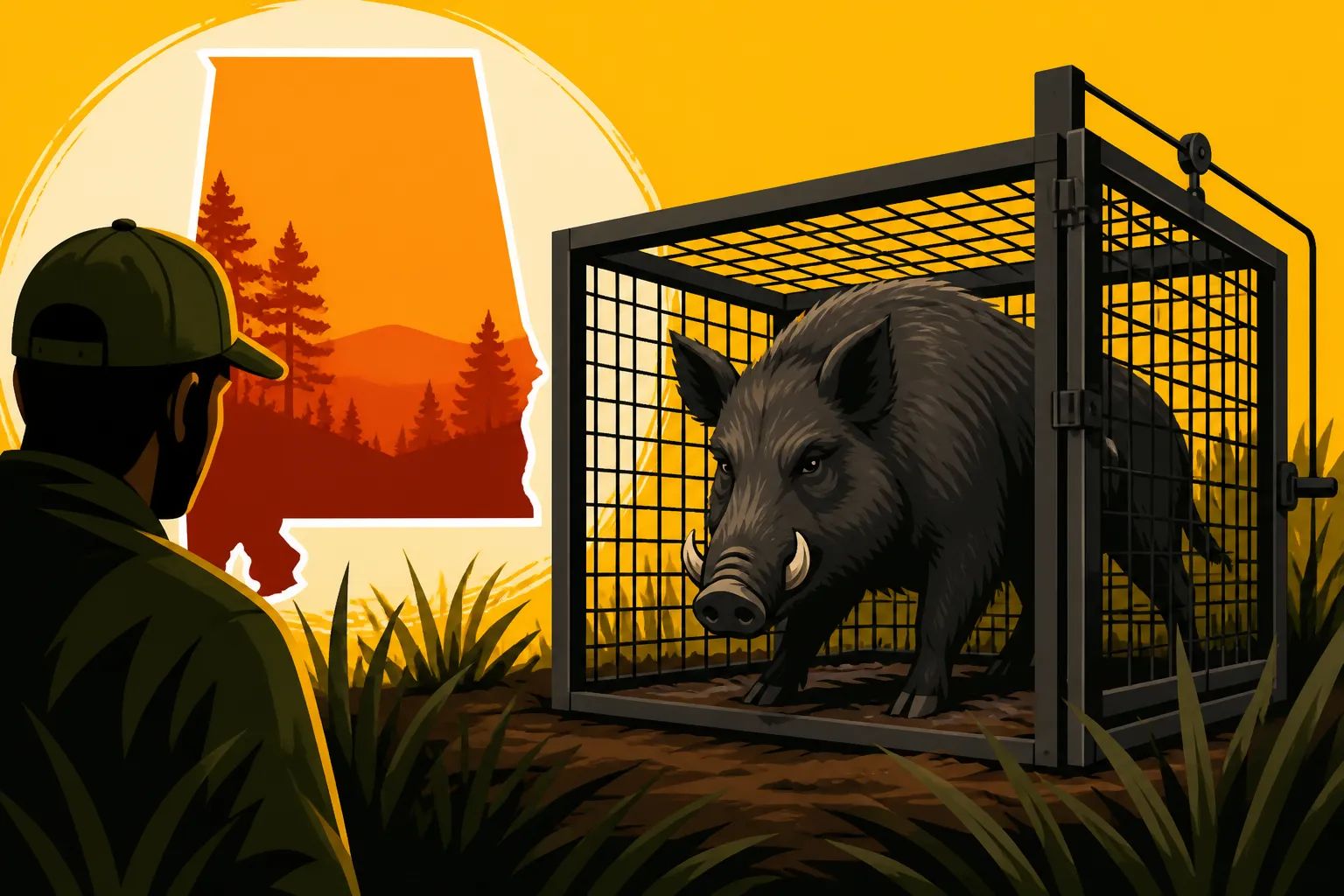
Corral traps are by far the most effective for catching entire sounders of feral hogs. These are large enclosures, typically round or square, made from heavy-duty livestock panels (usually 4- to 6-gauge wire, 4-6 feet tall). A typical corral might be 15-20 feet in diameter. The key is to have a robust, one-way gate system that allows hogs to enter but prevents them from escaping. Common gate designs include:
- Rooter Gates: Hogs push up on a gate to enter, and it falls back into place behind them. These are simple but can sometimes fail.
- Saloon/Swing Gates: Two gates that push inward and swing shut behind the hog.
- Drop Gates (Guillotine Gates): These are often associated with remote trigger systems. A gate is held open and then dropped once hogs are inside. This method allows you to wait until the entire sounder is in the trap, which is crucial for maximizing your catch.
Building a good corral trap requires an investment in materials and time, but it pays off in spades. You can find pre-fabricated panel traps or purchase panels and build your own. Many landowners swear by the strength and reliability of these larger setups. When considering materials or even pre-built options, reputable suppliers who understand What Hog Trappers Use in Alabama can guide your choices for local conditions.
Snare Traps and Box Traps
While less effective for large-scale population control compared to corrals, snares and box traps still have their place.
- Snare Traps: These consist of a cable loop placed in a known hog trail. When a hog passes through, the loop tightens around its neck or body. Snares are inexpensive and can be deployed in remote, hard-to-access areas where larger traps aren't feasible. However, they are non-selective and can accidentally catch non-target animals like deer or domestic pets. If you use snares, regular checking (at least daily, preferably twice a day) is absolutely critical to minimize suffering for any trapped animal and to release non-target species. Always check Alabama Feral Hog Regulations regarding snare use, as there can be specific restrictions on cable size, break-away points, and placement to mitigate non-target captures.
- Box Traps: These are smaller, cage-like traps, typically around 3x3x8 feet, that are designed to catch one or two hogs at a time. They work using a trip plate or trip wire that triggers a spring-loaded door when a hog enters. Box traps are more selective than snares and are easier to transport and set up than corral traps. They're excellent for smaller properties, for targeting nuisance hogs, or as supplemental traps around a larger corral. However, their limited capacity means they're not ideal for significantly reducing a large sounder. They can also be challenging if hogs are wary, as they often get spooked by the enclosure.
For serious control, a large corral trap with a remote triggering system is usually the gold standard. But understanding these other options means you have more tools in your kit for different scenarios.
| Trap Type | Pros | Cons | Ideal Use |
|---|---|---|---|
| Corral/Panel Trap | Catches entire sounders, highly effective | High upfront cost, time-consuming setup, less portable | Large properties, serious hog infestations, population control |
| Box Trap | More selective, portable, safer for non-target species | Low capacity (1-2 hogs), hogs can be trap-shy, less effective for sounders | Small properties, nuisance hogs, supplemental trapping |
| Snare Trap | Inexpensive, deployable in remote areas | Non-selective (risk to non-targets), requires frequent checks, potential for injury | Targeted hogs in remote trails, specific problem areas where other traps aren't feasible |
Setting Up Your Trap Site for Success
You can have the best trap in the world, but if it's in the wrong spot or set up incorrectly, it won't catch a thing. Hog trapping is as much about psychology and patience as it is about equipment. The goal is to make the trap a familiar, safe, and desirable place for hogs before you ever even think about closing a gate.
Strategic Placement for Maximum Catch
Location, location, location! When choosing your trap site, think about where hogs naturally spend their time and where they feel secure.
- Natural Funnels: Look for bottlenecks in the landscape where hogs are naturally channeled, such as between a thick bedding area and a food source, along a creek bottom, or at the intersection of several game trails. These are high-traffic areas.
- Near Water Sources: Hogs need water daily, especially in Alabama's warm climate. Placing a trap near a pond, creek, or swamp can be highly effective.
- Field Edges: If hogs are rooting up a field, place the trap along the edge, preferably near some cover where they feel less exposed.
- Secluded Areas with Cover: Hogs generally prefer to feed and feel safe where there's overhead cover or dense vegetation nearby. A trap in the middle of a wide-open field might make them wary. Look for a small woodlot adjacent to a field or a dense thicket near a water source.
- Avoid High Human Activity: If possible, choose a site away from frequent human disturbance to allow hogs to become comfortable with the trap's presence.
Once you've identified a promising spot, clear out enough space for your chosen trap type. For corral traps, ensure the ground is relatively level and that there are no obstacles that could prevent the gate from closing properly.
The Importance of Pre-Baiting and Acclimation
This is perhaps the most critical step in successful hog trapping and often where beginners get impatient. You do not want to set your trap and immediately close the gate the first time hogs show up. Instead, you need to "pre-bait" the site for an extended period, allowing hogs to become completely comfortable entering and exiting the trap freely.
- Start Outside the Trap: Begin by scattering bait (more on this in the next section) outside the trap, leading into it. Don't even set the trap panels up yet. Let them get used to the bait in that specific area.
- Set Up the Trap, Keep Gate Open: Once they're regularly hitting the bait, set up your trap panels, but secure the gate wide open. Continue to bait heavily inside the trap, making sure there's enough for the entire sounder to feed comfortably.
- Monitor Regularly: Use a trail camera to monitor activity. You want to see pictures of all the hogs in the sounder, including the wary older sows, confidently entering the trap and feeding. This phase can take days, weeks, or even a month, depending on how trap-shy the hogs are. Patience here is paramount. Don't rush it.
- Gradually Reduce Bait Outside: Once they are consistently entering, start placing almost all the bait inside the trap, perhaps just a small amount leading to the entrance. The goal is to condition them to associate the trap itself with a reliable food source.
The idea is to eliminate their suspicion of the trap. It becomes their local buffet. Only when you're consistently seeing the entire sounder comfortably feeding inside the trap, day after day, should you consider activating your gate or setting it to close. If you close it too soon and only catch a few, the remaining hogs will be incredibly difficult to trap in the future.
Baiting Strategies to Lure Hogs In
Once your trap is set and the pre-baiting phase is underway, the next critical element is your bait. Hogs are opportunistic omnivores, but certain baits are undeniably more effective than others. The key is to use something highly attractive, readily available, and that holds their interest long enough to get them in the trap.
Proven Baits and Attractants for Alabama Hogs
You don't need fancy, expensive commercial attractants every time, though some can certainly boost your efforts. Here are some tried-and-true baits:
- Fermented Corn: This is the gold standard for many trappers. The fermentation process creates an alcohol smell that hogs seem to find irresistible. To make it, simply soak shelled corn in water in a sealed container (like a 55-gallon drum) for several days to a week. Some people add a packet of yeast, sugar, or even a cheap fruit drink mix to accelerate fermentation and enhance the smell. Just be mindful of how strong the smell gets!
- Dry Corn: While fermented corn often works better, plain shelled corn is also very effective and easier to manage. It's affordable and hogs love it.
- Sweet Feeds/Pellets: Livestock feeds that are high in molasses or other sugars can be very appealing. Sometimes mixing these with corn can create a potent combination.
- Overripe Fruit and Vegetables: Old fruit, pumpkins, melons, or anything else rotting and sweet can attract hogs due to the strong odor.
- Commercial Attractants: Products like Hog Wild, Hog Stop, or other liquid attractants can be sprayed around the trap site or mixed with corn to boost appeal. These often have a strong, sweet, or musky scent designed to draw hogs from a distance.
Remember, what works in one area might not be as effective in another, especially if hogs have access to abundant natural food sources. You may need to experiment. For more detailed guidance, consider checking out resources on Building and Freshening a Hog Bait Site.
Baiting Schedules and Techniques
Consistency is key when it comes to baiting. You want hogs to learn that your trap site is a reliable, never-ending source of food.
- Heavy Baiting: Especially during the pre-baiting phase, don't skimp on the bait. You want enough for every hog in the sounder to get a full meal, so they associate the trap with abundance.
- Consistent Schedule: Try to bait at the same time each day or every other day. Hogs are creatures of habit.
- Spread it Out (Inside the Trap): Once hogs are comfortable entering, spread bait throughout the entire trap, not just at the entrance. This encourages the entire sounder to enter fully and spend more time inside, reducing the chance of them tripping the gate and only catching a few.
- Bait "Piles" and "Lines": Create a small pile of bait in the center of the trap, and perhaps a line leading from the entrance to this pile. This guides them in and keeps them preoccupied.
- Use a Feeder (Optional): Some trappers use automatic feeders set on timers inside the trap to ensure a consistent bait supply, especially if they can't visit daily. This can be great for creating that reliable food source.
- Re-Evaluate if Activity Drops: If hog activity at your trap site suddenly drops, consider why. Did you change bait? Did something spook them? Did you close the trap too soon and educate them? Sometimes, changing bait or moving the trap slightly can help if they've become wary.
One often overlooked aspect is scent control. While hogs aren't as scent-sensitive as deer, minimizing human scent around the trap site can still be beneficial. Wear rubber boots and gloves, and approach the trap from a consistent direction if possible.
Monitoring and Managing Your Trapping Efforts
Once you've got your trap set and baited, your work isn't done. Effective trapping requires continuous monitoring, careful management, and a plan for what to do once you've successfully caught hogs. This isn't just about catching them; it's about making sure the process is as efficient and humane as possible.
Remote Monitoring and Smart Trapping Systems
Modern technology has revolutionized hog trapping, making it far more efficient and less labor-intensive. Gone are the days of driving out to your trap every single morning to check it.
- Trail Cameras: These are indispensable. Place them facing the trap entrance and inside the trap. They allow you to:
- Confirm hog activity and identify sounder size during pre-baiting.
- Monitor when the entire sounder is inside the trap, which is crucial for remote trigger systems.
- Identify if non-target animals are entering the trap.
- Verify if your trap is working correctly.
- Some modern cellular trail cameras can send photos directly to your phone, giving you real-time updates without needing to visit the site.
- Remote Trigger Systems: For corral traps, these are game-changers. Systems like Jager Pro, Pig Brig, or even DIY setups using cellular trail cameras and solenoid-activated gates allow you to trigger the gate closure remotely from your phone. This means you can wait until every hog in the sounder is safely inside before dropping the gate, maximizing your catch and preventing trap-shyness in escapees. The investment in a quality remote trigger system can drastically increase your success rate and save you countless hours of checking. When looking for the best gear for this, online platforms or specialized stores mentioned by
GoHuntusers might offer comprehensive kits and advice.
Regularly checking your monitoring equipment is crucial, whether it's physically checking an SD card or refreshing your cellular camera app. You want to be responsive to hog activity.
Handling Trapped Hogs Safely and Humanely
Once you've successfully trapped hogs, you have a responsibility to handle the situation safely, ethically, and in accordance with Alabama Feral Hog Trapping Rules.
- Safety First: Feral hogs, especially large boars, can be dangerous. They are strong, can move surprisingly fast, and have sharp tusks. Always approach a trap with extreme caution. Never enter a trap with live hogs.
- Ethical Dispatch: The most humane and widely accepted method for dispatching trapped hogs is a quick, clean shot to the head. A .22 long rifle or handgun can be effective for this at close range. The goal is instant incapacitation to prevent suffering. Know your firearm, be proficient with it, and always consider your backdrop for safety. The specific angle and aim are critical for Shot Placement on a Feral Hog.
- Carcass Removal: After dispatching, you need a plan for carcass removal. Hogs can be heavy, so bring help or equipment like an ATV or tractor if you're dealing with multiple large animals. Options for disposal include burying them deeply, hauling them to a designated animal disposal site, or utilizing them if you plan to process the meat. Always check local regulations regarding carcass disposal.
- Processing for Meat: Many hunters process feral hog meat for consumption. It's lean, flavorful, and makes excellent sausage, pulled pork, or chops. If you plan to eat the meat, ensure proper field dressing and cooling, especially in warm Alabama weather. Learn the ins and outs of Handling a Hog After the Shot if you plan to harvest the meat. Always cook feral hog meat thoroughly to an internal temperature of at least 160°F (71°C) to kill any potential parasites like trichinosis.
Legal Considerations and Ethical Practices in Alabama
Hunting and trapping any wild animal comes with rules and responsibilities. While feral hogs are often considered an invasive nuisance species, it's still important to operate within the bounds of the law and maintain ethical practices.
Alabama's Feral Hog Regulations and Permitting
The great news for landowners and hunters frustrated by these destructive animals is that Alabama generally has very liberal regulations regarding feral hogs.
- Year-Round Hunting/Trapping on Private Land: On private land, feral hogs can be hunted or trapped year-round, day or night, with no bag limit. This makes them an excellent target for consistent management efforts. This is thanks to Alabama's Year-Round Hog Rule on Private Land.
- Public Land Regulations: Public lands, such as Wildlife Management Areas (WMAs) and National Forests, typically have more restrictive rules. Hog hunting or trapping on public land usually falls within open deer or small game seasons, and specific methods (e.g., night hunting, trapping) may be prohibited or require special permits. Always check the specific regulations for the WMA or National Forest you plan to hunt or trap in. The Outdoor Alabama website and app are invaluable resources for this information.
- No License Required (Sometimes): If you are a resident landowner, your spouse, or dependent children, and you are hunting or trapping hogs on your own property, a hunting license is generally not required. However, for anyone else (including non-resident landowners or anyone hunting on land they don't own), a valid Alabama hunting license is typically required.
- Reporting: There are no mandatory reporting requirements for harvested feral hogs in Alabama, unlike deer and turkeys.
Always consult the current Alabama Hunting & Fishing Digest or the Outdoor Alabama website for the most up-to-date and specific regulations. Laws can change, so staying informed is crucial to avoid any potential issues.
Ethical Trapping and Dispatch Methods
Beyond the letter of the law, ethical considerations should guide all your trapping efforts. The goal is to control a pest species, not to cause undue suffering.
- Check Traps Frequently: If you are not using a remote camera and trigger system, you must check your traps at least once every 24 hours, and preferably more often. This minimizes the time an animal spends in the trap, reduces stress, and allows for prompt dispatch or release of non-target animals.
- Minimize Stress: When hogs are trapped, they will be stressed. Avoid approaching the trap unnecessarily or making loud noises. Get in, take care of business efficiently, and get out.
- Humane Dispatch: As mentioned, a quick and clean shot to the head is the most humane method of dispatch. If you're unsure of shot placement, practice with targets until you're confident. Always prioritize safety for yourself and others around the trap.
- Avoid Non-Target Animals: While some traps are more selective, it's always possible to catch a non-target animal like a deer, raccoon, or even a domestic dog. If this happens, release them carefully and unharmed. Adjust your trap type, placement, or baiting methods if you're consistently catching non-targets.
- Carcass Disposal: Dispose of carcasses responsibly and hygienically. This prevents the spread of disease, avoids attracting other scavengers to unwanted areas, and keeps your property clean.
By adhering to these ethical principles, you ensure that your trapping efforts are not only effective but also responsible and respectful of the animals and environment.
Disclaimer
This article is intended for informational purposes only and does not constitute legal advice. Hunting and trapping regulations can change frequently. Always consult the official Alabama Department of Conservation and Natural Resources (ADCNR) regulations and local ordinances before engaging in any hunting or trapping activities. Safety should always be your top priority.