Alabama Firearms Discharge Setback Rules
It's a common and incredibly frustrating scenario: you're out enjoying the peace of the Alabama woods, maybe even on your own private property, and a nagging worry sets in. Are you too close to that new house? Is this gravel road truly public? The rules around where you can legally discharge a firearm in Alabama can feel like a tangled mess, and nobody wants to inadvertently break the law or, worse, endanger someone. This comprehensive guide is designed to untangle Alabama's firearms discharge setback rules, helping you hunt responsibly, safely, and legally without constantly second-guessing yourself.
Deciphering Alabama's State Firearms Discharge Laws
Many hunters just want to get out there and enjoy the tradition, but the official rules about shooting too close to a home or a road are often passed down through word-of-mouth, creating confusion rather than clarity. Alabama's state law actually provides foundational, clear guidelines on a couple of key distances that every hunter needs to internalize. Understanding these basic tenets is your first line of defense against potential legal issues or neighborly disputes.
The Foundational State Setback Requirements
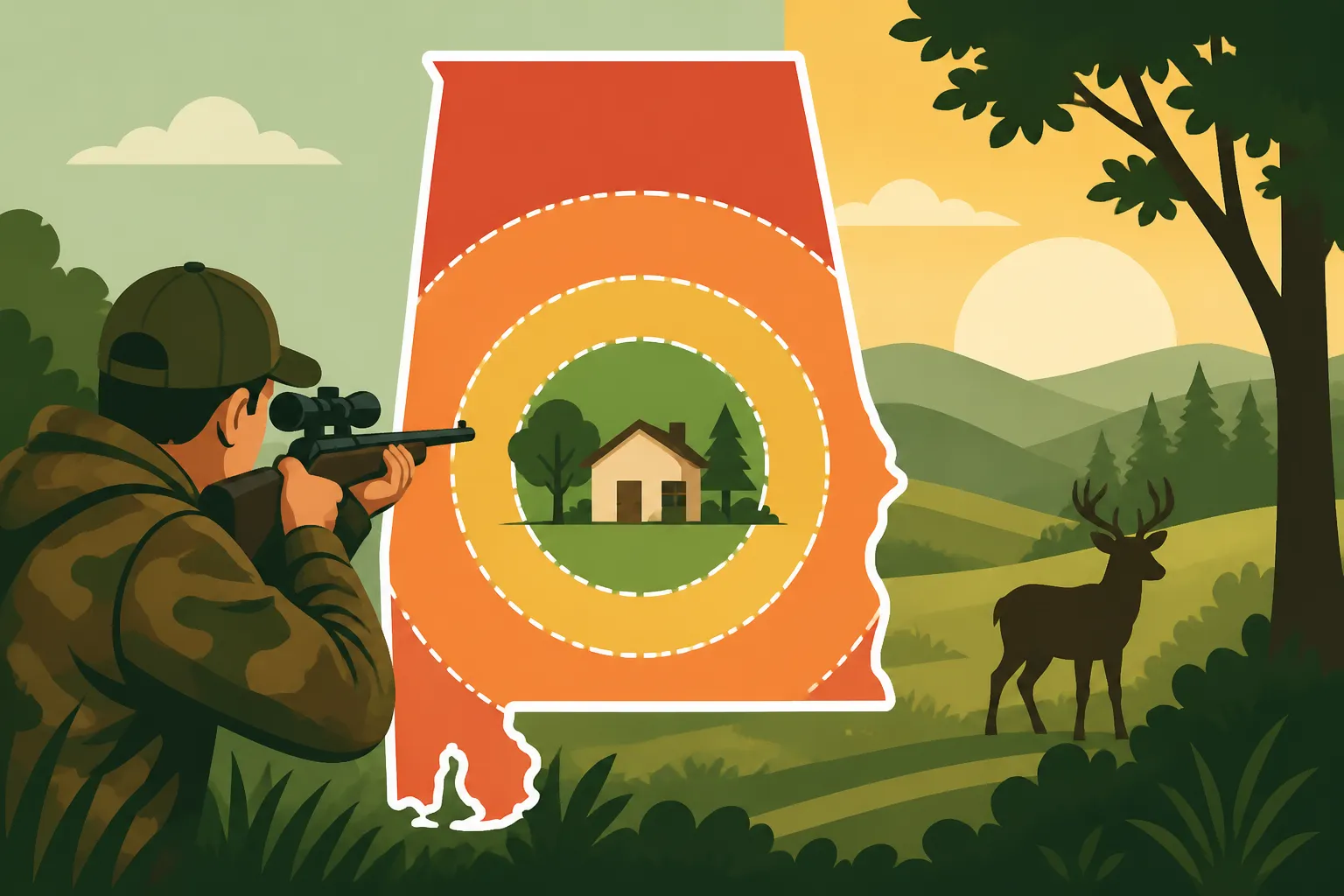
The primary state law dictates that you cannot legally discharge a firearm within 150 yards of an occupied dwelling without explicit permission from the owner or leaseholder. To put that in perspective, that's roughly one and a half football fields – a significant distance to consider, especially in areas where suburban sprawl meets rural hunting grounds. This rule isn't just about avoiding direct harm; it's about respecting the privacy and safety of residents. Furthermore, when it comes to public roads or highways, the general setback is 100 yards. This applies to any public thoroughfare, ensuring that errant shots don't pose a risk to passing vehicles or individuals.
Imagine you've been hunting a fantastic piece of private land for years, maybe during Alabama's Gun Deer Season by Zone, and suddenly, a new house goes up next door. Your once-favorite stand might now be within that prohibited 150-yard zone. Even if the woods feel deep and isolated, new developments can dramatically alter your legal hunting boundaries. Similarly, what you might consider a quiet dirt path on public land could actually be a legally designated public road, making that 100-yard rule applicable to your chosen Squirrel and Small Game Hunting in Alabama spot. It’s easy to get complacent on familiar ground, but changes in the landscape demand vigilance.
To stay on the right side of these regulations, always carry a rangefinder, not just for gauging shot distances to game, but for checking setbacks to potential problem areas like dwellings or roads. Before you even think about setting up your stand or deciding on a hunting spot, use a detailed mapping tool to get a rough idea of property lines and structures nearby. Then, physically verify those distances on the ground to be absolutely certain you're within the legal limits. A few minutes of careful measurement can save you a world of trouble down the line.
Understanding What Constitutes a "Public Road" and "Occupied Dwelling"
The terms "public road" and "occupied dwelling" can cause significant head-scratching and lead to unnecessary risk if misinterpreted. Many hunters wonder if an old, rarely used dirt path qualifies as a public road, or if a rustic hunting camp, only visited a few weekends a year, counts as an occupied dwelling. For public roads, the general rule of thumb is whether it's maintained by the county or state, or if it's officially designated as a public right-of-way. Just because a road isn't paved or well-traveled doesn't mean it's not legally public. If a road appears on a county map as a public thoroughfare, it's safer to assume the 100-yard rule applies.
Consider a scenario where a county road, perhaps unpaved and meandering, cuts through a section of public land. Even if it sees minimal traffic, it remains a public thoroughfare. If you're Still-Hunting Bankhead Forest Ridges, you might be close to one of these less-traveled routes. An "occupied dwelling" is also quite broad; it's any structure where people live or could reasonably be expected to be living, even if only temporarily. This includes permanent houses, mobile homes, hunting cabins, or even a travel trailer set up for a weekend stay. The key isn't necessarily whether someone is inside at the exact moment of your shot, but whether it's a place designed for or actively used for habitation.
To avoid ambiguity and stay safe, it's always best to err on the side of caution. Treat any road that appears on a public map or that you're unsure about as a public road. For dwellings, if you see a structure that could be occupied, even if it looks vacant, maintain that 150-yard buffer. Digital mapping tools, especially those with satellite imagery and property line overlays, can be incredibly helpful for identifying potential dwellings and public access points. While these tools, such as the ones offered by GoHunt, provide excellent preliminary data, always remember to verify distances on the ground.
Special Considerations for Public Lands and Waterways
When you venture onto Alabama's extensive public lands, like a Wildlife Management Area (WMA) or one of the National Forests, the state setback rules still apply, but often with additional layers of complexity. While you might be far removed from private dwellings, public roads, hiking trails, and designated recreational areas are abundant within these vast tracts. It's not uncommon to find primitive campsites, picnic areas, or even active timber operations within these boundaries, all of which require careful consideration of your shooting lanes and surroundings.
Many WMAs, for instance, have their own specific regulations that go beyond basic state law, especially concerning safety zones around designated camping areas, administrative buildings, or popular hiking and equestrian trails. Some WMAs might even prohibit firearm discharge altogether in certain high-use zones or near campgrounds to ensure public safety. It is absolutely crucial to consult the specific WMA regulations available on the Outdoor Alabama website, or easily accessible through the GoHunt app, for the exact area you plan to hunt before heading out. A general understanding of state law isn't enough when dealing with these tailored management plans.
Don't overlook waterways either. If you're hunting along a major river or lake, such as when Waterfowl Hunting Alabama's River Deltas, the setback rules can become even trickier. A boat might be considered a temporary dwelling if occupied, and public boat ramps or fishing access points clearly count as public areas. Always ensure your shot will safely impact a solid backstop, like a hillside or thick woods, and not travel across open water where you can't definitively see what's beyond. Shots over water carry inherent risks because of the unpredictable trajectory and potential for unseen hazards.
Navigating Local Ordinances and Their Stricter Rules
Here’s where the legal landscape for hunters in Alabama can become genuinely challenging and catch even experienced outdoors enthusiasts off guard: local ordinances. While the state sets the minimum legal boundaries for firearm discharge, cities, towns, and sometimes even individual counties in Alabama can—and frequently do—enact their own, stricter rules. This dynamic means you might be perfectly compliant with state law, only to discover you're violating a city or county ordinance you didn't even know existed. This discrepancy is a significant source of frustration for hunters who genuinely strive to do everything right.
When Local Laws Trump State Guidelines
It's critical to understand that local ordinances almost always trump the state's minimum setback requirements when they are more restrictive. For example, state law mandates 150 yards from an occupied dwelling, but a municipality might have expanded its city limits, or a county might have adopted a "no discharge within city limits" rule. Alternatively, they could simply have an even larger setback, such as 200 or 300 yards from any structure or road within their jurisdiction. This is particularly relevant if you hunt smaller, private tracts that are on the expanding outskirts of towns or rural communities.
Consider a scenario where you're hunting private land just outside what you thought were the city limits, only to find the municipality has annexed the area, imposing a blanket "no discharge of firearms" rule. Before hunting in any new area, especially those near urban or suburban boundaries, it’s not just recommended but absolutely imperative to check with the local sheriff’s office or city clerk's office. Their websites often publish municipal codes, or a quick phone call can provide clarity. This pro-active step can save you from citations, fines, or even having your hunting privileges suspended. The burden of knowing these hyper-local rules falls squarely on the hunter, and ignorance is rarely a valid excuse.
The Rise of Archery-Only Zones and Managed Hunts
As Alabama's population continues to grow and urban and suburban areas expand, traditional firearm hunting can become increasingly challenging in many locations due to safety concerns and public proximity. In response to this evolving landscape, some municipalities and landowners are implementing Alabama Suburban Archery-Only Zones. These zones typically allow for deer management through archery where the discharge of firearms would be deemed too risky or disruptive to nearby residents. It's a pragmatic compromise that enables hunters to continue participating in wildlife management while effectively addressing legitimate public safety concerns.
Beyond formal "archery-only" zones, many public and even some private lands are also seeing an increase in specific managed hunts that might come with their own unique rules regarding weapon types or discharge. For instance, some local parks, nature preserves, or large corporate properties might host special draws for archery hunting only, often with even more stringent safety parameters than standard state law. If you're participating in any managed or quota hunt, always review the specific rules and regulations for that event very carefully, as they can override general guidelines. Information about these specific opportunities can often be found through the Outdoor Alabama app or by contacting the specific land manager directly.
Embracing archery in these tighter, more populated areas can significantly open up new hunting opportunities, allowing you to pursue White-Tailed Deer Across Alabama closer to home without violating firearms discharge rules. While the challenges of archery hunting are different from those of firearm hunting, it represents a smart and adaptable way to navigate increasing land-use conflicts. Always ensure you understand not only the discharge rules but also the specific weapon requirements for these unique hunting situations, as adherence is key to success and continued access.
Property Lines, Permission, and Preventing Conflict
Even when hunting on private land where you have explicit permission, a comprehensive understanding of property lines and a respectful attitude toward adjacent landowners are absolutely paramount. Many disputes, and even legal issues, arise not from direct violations of state law, but from perceived safety risks or disturbances by neighbors who feel too close to the action. It's an uncomfortable situation for everyone involved, often stemming from a lack of clear boundaries, insufficient communication, or a simple misunderstanding.
This is precisely where detailed mapping tools become indispensable. Utilizing features like property line overlays, which are often found in apps like GoHunt, can provide a clear visual representation of where your hunting ground ends and a neighbor's begins. Always strive to maintain a generous buffer, extending beyond the legal minimum setback, from property lines, especially if a dwelling is close by, even if it's technically on your side of the line. If you're hunting near a property line, consider strategic stand placement or using a ground blind that effectively directs your shots away from potential problem areas, a smart tactic often employed when Using a Ground Blind on Alabama Public Land.
The most effective defense against neighborly conflict is proactive communication. If you know you'll be hunting near an adjacent landowner, especially if they are non-hunters, a friendly conversation beforehand can prevent a great deal of stress and misunderstanding. Inform them of your plans, assure them of your unwavering adherence to safety protocols, and genuinely listen to any concerns they might have. Remember, ethical hunting extends far beyond mere legality; it's about being a good steward of the land and a considerate member of the community. Establishing clear boundaries, both physically and through open dialogue, helps protect your hunting access and fosters positive community relations.
Best Practices for Safe and Lawful Firearm Discharge
Beyond simply knowing the rules, applying best practices for safe and lawful firearm discharge is paramount for every hunter in Alabama. It's not enough to be technically compliant; true responsibility means taking every possible measure to ensure safety for yourself, other people, and your surroundings. This proactive approach helps prevent accidents, avoids legal troubles, and upholds the positive image of hunting.
Diligent Pre-Hunt Scouting and Mapping
The absolute cornerstone of safe and lawful firearm discharge in Alabama is diligent pre-hunt scouting. Many hunters, even seasoned ones, rush into a spot they've used for years, or a new place quickly scouted for game sign, without truly assessing the surrounding human landscape. This oversight is a common pitfall that can lead to unintended consequences. Before you even think about setting up a stand or planning a still-hunt, you need a comprehensive understanding of the topography, roads, dwellings, and property lines, especially in unfamiliar territory.
Start by using detailed maps, both online and physical. Aerial and topographic maps, such as those available through reputable apps, can reveal a wealth of crucial information. Look specifically for houses, barns, clearings, roads (paved and unpaved), and established trails. Pay close attention to how sound might carry in the terrain, particularly if you're engaging in activities like Rattling Volume in Thick Pine Cover or using a firearm with a louder report. Even if you're on a large tract of land, identifying potential hazards before opening day is critical. Mark potential problematic areas on your map, creating mental or physical "no-shoot" zones where you will absolutely not discharge a firearm.
Don't just rely on maps alone; physically walk the boundaries, especially near dwellings and roads, with a good rangefinder. Verify the 100-yard and 150-yard setbacks. Look for blind spots, sudden dips in terrain, or dense cover that might obscure structures or roads you missed on a map. For example, when Scouting Alabama Public Land Before Season, it’s imperative to walk the perimeter and identify any potential conflicts. This meticulous approach is not "fluff"; it's a necessary safety and legal precaution that ensures you're always making an ethical shot and abiding by the letter of the law, whether you're targeting Feral Hogs Across Alabama or a trophy buck. Utilizing tools like Reading Aerial Photos for Piedmont Deer can also help in identifying safe shooting lanes.
Responsible Shot Placement and Backstop Awareness
Beyond adhering to setback rules, the fundamental principle of firearm safety remains paramount: always know your target and what is beyond it. This isn't just a courtesy; it's a legal, ethical, and moral imperative that every hunter must internalize. A bullet, especially from a high-powered hunting rifle (even within Alabama Legal Firearms for Deer Hunting guidelines), can travel a significant distance, often far exceeding the 100 or 150-yard setbacks. Ensuring a solid, natural backstop that will safely absorb your bullet is crucial, every single time you pull the trigger.
Consider a common scenario: you're hunting from a treestand overlooking a food plot. You spot a deer, but the land beyond your target drops away sharply into a valley, with a public road or even another dwelling potentially out of sight beyond that dip. In such a situation, even if the deer is well within legal shooting distance from your stand to any visible dwelling, your bullet's trajectory might be unsafe. Always aim for shots where the ground or a substantial hillside is directly behind your target. This might mean passing up an otherwise tempting shot, which is always the right decision if safety is in question. There's no trophy worth risking another person's safety.
Furthermore, be incredibly mindful of potential ricochets. Shooting at hard surfaces like rocks, frozen ground, or even tree stumps can cause bullets to deflect unpredictably and dangerously. Always consider the terrain carefully. For example, when Hunting a Ridge-Top Saddle for Rutting Bucks, ensure your shot will safely impact the opposite side of the ridge or a soft earth bank. Responsible hunters understand that their actions can have far-reaching consequences and prioritize safety above all else, ensuring that every round fired is controlled, accounted for, and directed with a clear understanding of its ultimate destination.
Consequences and Protecting Your Hunting Privileges
Understanding and adhering to Alabama's firearms discharge setback rules isn't just about avoiding a temporary inconvenience; it's about protecting your right to hunt, maintaining a positive public image for the sport, and safeguarding yourself from serious legal repercussions. The consequences of violating these rules extend far beyond a simple slap on the wrist.
Serious Legal Ramifications of Violations
Violating Alabama's firearms discharge setback rules or local ordinances is not a minor infraction; it carries genuinely significant legal consequences. Depending on the severity of the violation—whether it's merely being too close, causing property damage, or, tragically, injuring someone—the penalties can range widely. For less severe infractions, you could face hefty fines, have your hunting license suspended, or even face confiscation of your firearms. These penalties are often applied under Alabama Wildlife Violation Penalties, which are designed to deter unsafe and irresponsible behavior.
If a bullet causes property damage or, tragically, injures an individual, the charges escalate dramatically. You could face charges of reckless endangerment, assault, or even more serious felony charges, potentially leading to substantial jail time. Imagine losing your ability to hunt in Alabama, or worse, facing criminal charges that dramatically impact your life, your record, and your future access to the outdoors, all because you misjudged a distance or failed to check local regulations. The state of Alabama, along with local municipalities, takes these safety regulations very seriously, and ignorance of the law is never an acceptable defense.
Consider a real-world scenario: a hunter sets up too close to a neighbor's property line, and while no one is hurt, the neighbor hears the shot and feels unsafe. Even without an actual incident, a complaint to local authorities can trigger an investigation. If you are found to be within the prohibited setback, you are in violation of the law. It’s not just about hitting something; it's about being too close. These regulations are designed to provide a critical buffer of safety and peace of mind for everyone, and infringing upon that buffer comes with severe, often life-altering, penalties.
The Broader Impact on Hunting's Public Image
Every single time a hunter is cited for an unsafe discharge, or, even worse, causes an incident due to reckless firearm use, it casts a profoundly negative shadow over the entire hunting community. In an increasingly urbanized society, where many people have no direct connection to hunting, the public image of our sport is incredibly fragile. Non-hunters often don't understand the nuances of safe hunting practices and may view any incident as irrefutable proof that hunting is inherently dangerous, irresponsible, or unnecessary. This negative perception significantly fuels anti-hunting sentiment and can ultimately lead to even more restrictive regulations for all hunters.
As hunters, we are not just participants; we are stewards, not only of the land and its wildlife but also of our cherished traditions and rights. It is incumbent upon us to demonstrate unwavering responsibility and respect for safety in all our actions. This means not just following the letter of the law, but also embracing its spirit, and often going above and beyond the minimum requirements to ensure safety. Ignoring setback rules, or being careless with firearms, directly jeopardizes the future of hunting for the next generation. We must collectively act as ambassadors for our sport, ensuring that our actions reinforce a positive, responsible image.
Continued violations due to negligence or a lack of awareness can lead to increased public pressure on lawmakers to enact even stricter, statewide rules, potentially reducing hunting opportunities for all of us. Protecting your Alabama Hunting Licenses and What They Cost and preserving the ability to hunt freely in the future means adhering to these rules meticulously. Our collective responsibility is to ensure that hunting remains a respected, safe, and viable outdoor pursuit in Alabama for generations to come.
Proactive Steps to Secure Your Hunting Future
The most effective way to protect your personal hunting privileges and, by extension, the future of hunting across Alabama, is to be proactively engaged and informed. This means consistently taking the time to understand all applicable laws—state, county, and local. It means making wise investments in essential tools like quality rangefinders and reliable mapping applications. Furthermore, it demands a commitment to educating yourself on every regulation, from the general Alabama Deer Season Structure Explained to specific, often overlooked rules such as these critical setback requirements.
Regulations are not static; they can and do change. New developments can spring up, dramatically altering what was once a perfectly safe and legal hunting spot. Make it a regular habit to periodically review local ordinances and check for any updates, especially if you hunt near growing communities or areas experiencing significant land-use changes. Joining local hunting clubs or conservation groups is an excellent way to stay informed about regulatory changes and actively participate in discussions that help shape future hunting policy. Never be afraid to ask questions of game wardens or more experienced hunters; knowledge is your best defense against unintended violations.
By consistently demonstrating a strong commitment to safety and unwavering adherence to all regulations, you become an invaluable advocate for hunting. Encourage safe practices among your hunting partners and, if necessary, politely correct those who might be cutting corners or acting irresponsibly. Your responsible actions contribute to the collective goodwill and public trust that allows hunting to thrive. Remember, every time you step into the woods, you represent the entire hunting community, and ensuring safe firearm discharge is one of the most visible and impactful ways to uphold that profound responsibility.
Alabama Firearms Discharge Setback Overview
To help clarify the various rules and distances, here’s a quick overview of Alabama’s typical firearms discharge setback requirements. Remember, local ordinances can always be more restrictive.
| Rule Category | Setback Distance | Applies To | Key Considerations |
|---|---|---|---|
| State Law | 150 Yards | Occupied Dwellings | Requires owner's permission if closer. This includes houses, cabins, occupied campers, or any structure used for habitation. |
| State Law | 100 Yards | Public Roads/Highways | Includes paved, gravel, and unmaintained county roads that are legally public rights-of-way. |
| Local Ordinances | Varies (often >150-100 yards) | City/County Limits | Can be much stricter. Always check with local sheriff's office or city clerk for specific regulations. May include blanket "no discharge within city limits" rules. |
| Public Lands (WMAs, National Forests) | Varies | Designated Areas | Specific rules often apply around campgrounds, administrative sites, and high-use recreational trails. Always consult WMA or National Forest specific regulations. |
| Ethical Buffer | >150 Yards | Property Lines/Sensitive Areas | Go beyond the minimum legal requirements to foster good neighbor relations and ensure an even greater margin of safety. |
Disclaimer
The information provided in this guide is for general informational purposes only and does not constitute legal advice. Hunting regulations, including firearms discharge setback rules, can change. It is the responsibility of every individual hunter to verify all current state, county, and local laws and regulations with the appropriate authorities before engaging in any hunting activities. Always prioritize safety and legal compliance in the field.