Hunting a Funnel Between Two Creek Bottoms
Hunting deer in Alabama often feels like trying to find a needle in a haystack, especially on public land or larger private tracts where deer aren't concentrated around food plots. Many hunters get frustrated walking miles and seeing little action, or they just set up randomly hoping for the best. This guide is all about simplifying that search by focusing on a high-percentage, often overlooked terrain feature: the funnel created between two creek bottoms. It will walk you through how to identify, scout, and effectively hunt these natural pinch points, turning your frustrations into successful hunts.
Understanding Creek Bottom Funnels
When we talk about hunting funnels, most folks immediately think of saddles on ridges or narrow strips of timber connecting two larger woodlots. While those are certainly effective, a funnel created by two converging or parallel creek bottoms offers a unique and often overlooked advantage, especially in Alabama’s diverse topography. These aren't just random spots; they're natural highways deer use to travel, often feeling secure due to the cover and the slightly lower elevation.
Why Deer Gravitate to Creek Bottoms
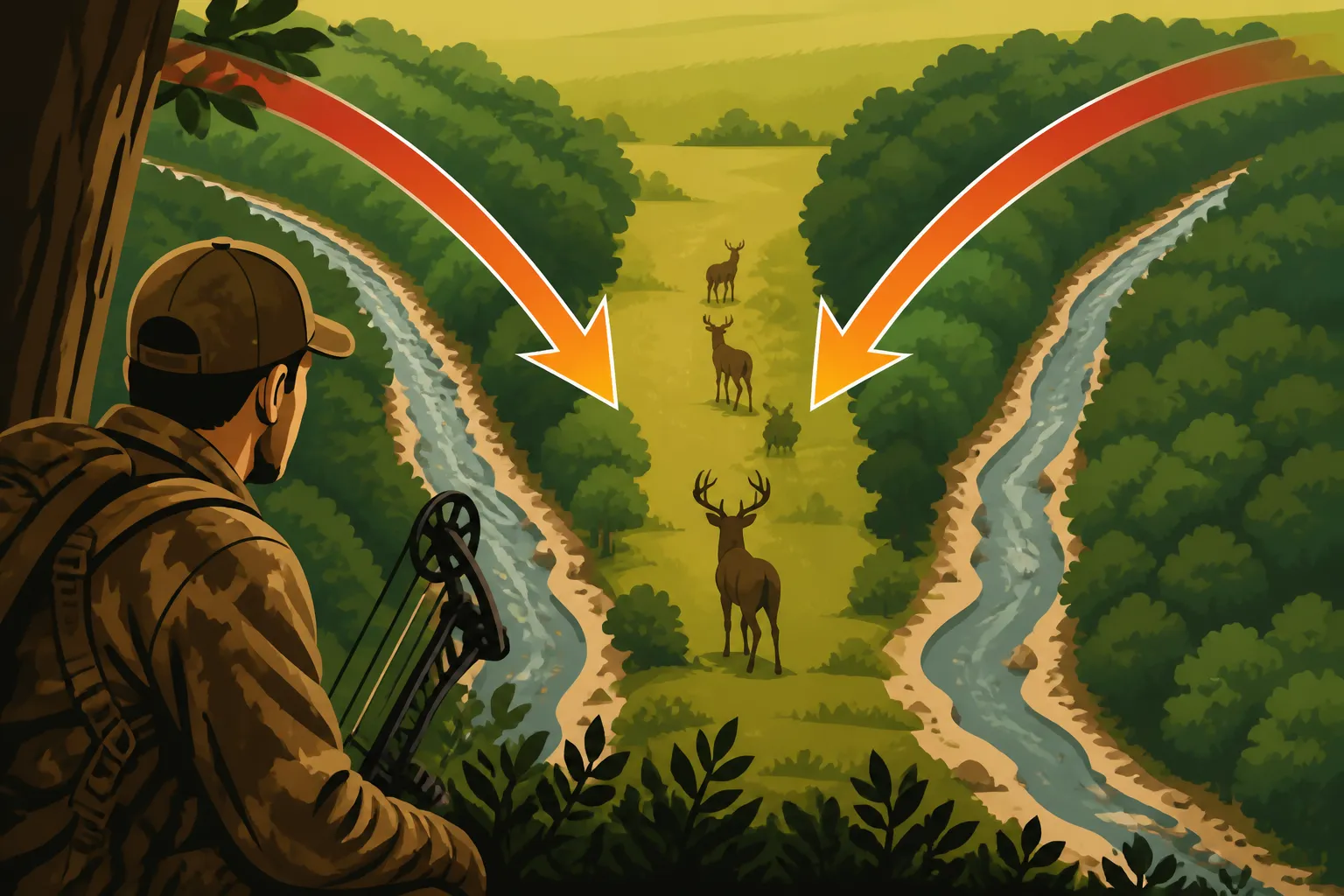
Deer are creatures of habit and efficiency. They prefer to travel the path of least resistance while simultaneously seeking security. Creek bottoms, with their denser cover, often slightly cooler temperatures, and proximity to water sources, provide exactly that. Imagine a deer needing to move from one bedding area to another, or from bedding to a feeding area. If there are two distinct creek drainages running somewhat parallel, the strip of land between them becomes a natural corridor. It's often drier than the immediate creek banks, yet offers more protection than an open ridge top.
Think about it: A deer doesn't want to slog through a muddy creek bed if it doesn't have to, nor does it want to expose itself on a wide-open hillside. The land between two creek bottoms creates a natural "squeeze play" that channels deer movement. This is especially true during the rut when bucks are cruising for does, or even in late season when deer are looking for secure travel routes between dwindling food sources. It’s like a hidden trail system that deer trust, making your job much easier if you can find and interpret these signs.
The Dynamics of Natural Barriers
Creek bottoms, particularly those with steep banks, thick undergrowth, or even areas that hold water during wet periods, act as natural barriers. Deer, while agile, prefer to avoid unnecessary obstacles. If you have two such creek bottoms, perhaps a hundred yards or less apart, the terrain subtly guides deer into that narrow band of land between them.
This phenomenon is amplified by the varying types of cover often found in these areas. The immediate creek banks might be choked with briars, cane thickets, or dense young pines, while the slightly elevated ground between them offers mature hardwoods or mixed timber that’s easier to navigate. Deer will exploit these subtle differences, using the thicker cover along the banks for security while moving more freely in the less obstructive corridor. Identifying these natural barriers on a topographic map or aerial photo, and then verifying them on the ground, is the first step to unlocking these prime hunting locations.
Scouting the Perfect Creek Bottom Funnel
Finding these prime creek bottom funnels isn't always obvious from the road. It takes a combination of map reconnaissance, understanding deer behavior, and good old-fashioned boot-leather scouting. In Alabama, where we have countless small drainages and winding creeks, knowing what to look for can save you a lot of time and effort.
Map Reconnaissance for Key Terrain Features
Before you even step foot in the woods, pull out your maps. Whether you're using a physical topo map, a digital mapping app like onX Hunt, or even the Outdoor Alabama App, start by looking for drainage patterns. Identify creeks, streams, and wet weather seeps. You're looking for areas where two drainages run relatively close together before either converging or diverging significantly. The "funnel" is that narrow strip of higher ground between them.
Focus on contours that indicate changes in elevation. Even a subtle rise of 5-10 feet between two wet areas can be a significant travel corridor for deer. Look for areas where the contour lines are tighter on the creek banks, indicating steeper slopes, and then spread out slightly in the middle, suggesting easier travel. Think about the overall landscape too – are these creeks connecting a large timber block to an agricultural field? Are they between two known bedding areas? The context of the funnel within the larger landscape is critical. Using aerial imagery can help you identify different types of cover that might enhance the funnel effect. Thicker cover along the creek edges and slightly more open timber in the middle is a good sign.
Reading the Ground for Deer Sign
Once you've pinpointed some potential funnels on your map, it's time to hit the ground. This is where you confirm your theories and find the exact pinch points. Walk the entire length of the suspected funnel, paying close attention to every detail.
Look for heavily used deer trails. These trails are often more distinct and worn in funnels because deer are concentrated in a smaller area. Pay particular attention to fresh tracks, especially if you're out after a rain. Reading Alabama Mud for Fresh Deer Movement can tell you not only that deer are using the area, but when they are using it and in what direction.
Scrapes and rubs are also major indicators. Bucks will often leave sign within these funnels, marking their territory and checking for does. A line of rubs or a well-used scrape line running through the funnel tells you that bucks are actively traveling and pausing there. Bedding areas nearby, perhaps on a slightly higher knoll overlooking the funnel, or in thickets along the creek banks, are also crucial discoveries. If deer are bedding close, they'll be using that funnel for daily movement. Don't forget to look for droppings; fresh droppings are a clear sign of recent activity. The more sign you find, the higher your confidence in that particular funnel.
Strategic Stand Placement in Creek Bottom Funnels
Finding a killer funnel is only half the battle; knowing where and how to set up your stand is equally important. Unlike hunting a wide-open timber block, funnels require precise placement to capitalize on the concentrated movement without alerting the deer.
Accounting for Wind and Thermals
Wind is king, and in creek bottoms, thermals play an even more significant role than on flat ground or ridge tops. Cool air sinks, and warm air rises. In the morning, as the sun warms the earth, thermals will typically rise out of the creek bottoms. In the evening, as the air cools, thermals will fall into the creek bottoms. This means your scent can be carried in unpredictable directions.
When setting up, always consider the prevailing wind direction for your planned hunt. However, in creek bottoms, you also need to factor in thermal currents. If you're hunting a morning hunt, set up on the downwind side of where you expect deer to approach, but also consider how rising thermals might carry your scent up and out of the bottom. A stand placed slightly up the hillside from the absolute bottom, on the side opposite the most likely deer approach, often gives you a better scent cone. For evening hunts, as thermals fall, you might need to adjust and set up a bit higher to keep your scent from pooling in the funnel. Always try to pick a stand site that offers multiple wind options, or be prepared to move if the wind isn't perfect. For more on this, check out Wind and Thermals on a Piedmont Ridge, as similar principles apply.
Entry and Exit Routes
This is arguably the most critical aspect of hunting any high-traffic deer area. A perfect stand placement means nothing if you spook deer on your way in or out. Your entry and exit routes must be as stealthy as possible, ideally using terrain features to mask your approach and keep your scent away from the funnel.
Consider approaches that utilize the wind to your advantage, or at least neutralize its impact. Can you walk in along a ridge top that keeps you above the thermal currents until you drop into your stand? Or perhaps a deep ditch or an old logging road that runs perpendicular to the funnel, allowing you to get in unnoticed? Always plan your route beforehand, preferably scouting it in daylight. Your ideal entry should allow you to reach your stand without crossing major deer trails or walking directly through the funnel itself. The same goes for your exit; you don't want to bump deer out of their bedding or feeding areas. Sometimes, a slightly longer, more circuitous route is worth the effort to ensure you don't compromise your spot. Using a good mapping app like GoHunt can help you plot these routes with precision, marking potential obstacles and approach paths.
Stand Types and Placement
The type of stand you use will depend on the available trees, cover, and your hunting style. For creek bottom funnels, both ladder stands, hang-ons, and ground blinds can be effective.
- Tree Stands (Hang-on or Ladder): These offer the advantage of height, getting your scent above a deer's nose and providing a better vantage point. Look for mature, straight trees that offer good cover for concealment. Don't just pick the tallest tree; pick the one that breaks up your outline best and allows for a clear shot at the trails. When setting up a hang-on, consider using multiple climbing sticks or sections to get to your desired height, keeping in mind the Treestand Setups in Talladega National Forest principles of safety and concealment.
- Ground Blinds: If suitable trees are scarce, or you prefer to hunt from the ground, a well-brushed-in ground blind can be incredibly effective. Deer in funnels often feel secure due to the surrounding cover, so a blind that blends naturally into the environment can work wonders. Ensure your blind is set up far enough in advance for deer to get used to it, and use natural vegetation to break up its outline. For tips on deployment, consider tactics found in Using a Ground Blind on Alabama Public Land.
When placing your stand, think about shot angles. You'll likely have deer moving in both directions, so ensure you have clear lanes for bow or gun shots without having to make excessive movement. A good setup often involves positioning yourself just off the primary trail, perhaps 20-30 yards, to catch deer as they are comfortable and moving naturally.
Timing Your Hunt for Maximum Success
Even the best-scouted and set-up funnel can be a bust if you're not there at the right time. Deer movement is highly influenced by various factors, and knowing when to capitalize on a creek bottom funnel can make all the difference.
The Role of the Rut
The rut is prime time for hunting funnels. During this chaotic period, bucks are constantly on the move, searching for does. Does, in turn, are trying to avoid persistent bucks and may use funnels as secure travel routes. This increased movement, especially by older, wiser bucks, makes funnels an absolute hotspot.
Bucks will cruise these corridors, scent-checking, rubbing, and scraping as they go. A funnel between two creek bottoms gives them a secure, efficient path to cover a lot of ground. During the peak of the rut in your specific region of Alabama, which varies by zone (see Hunting the Alabama Rut by Zone for details), these funnels can be magical. If you've got a funnel identified near a doe bedding area or a known feeding spot, you can bet bucks will be checking it regularly. Be patient, as bucks might be following a scent trail with their nose to the ground, moving slowly through the funnel. This gives you extra time to identify and prepare for a shot.
Weather Patterns and Pressure
Deer movement is heavily influenced by weather. A sudden cold front pushing through Alabama can trigger significant deer activity, especially following a period of warm weather. After a cold front, deer often get up and move, feeding more actively and covering more ground. This makes creek bottom funnels excellent places to intercept them.
Conversely, periods of high pressure, especially with clear skies and mild temperatures, can often lead to less daytime deer movement. In these conditions, deer might move more at night. However, even during slower periods, deer still need to travel between bedding and feeding, and they will often do so using the most secure routes available—which is exactly what a creek bottom funnel provides. If hunting pressure is high in surrounding areas, deer will naturally seek out quieter, more secure travel corridors. A well-hidden creek bottom funnel, away from commonly accessed trails or roads, can become a refuge for deer under pressure. Being aware of the local hunting pressure and adjusting your timing accordingly can increase your chances of encountering a deer using your funnel.
Early Season to Late Season
Creek bottom funnels are effective throughout the entire Alabama deer season, though the specific deer behavior you'll observe might change.
- Early Season (Archery): In the warmer early season, deer are often still on predictable patterns, moving between summer bedding and feeding areas. Water sources within or near creek bottoms are also highly attractive. Bowhunters can capitalize on deer using these funnels for daily routines.
- Mid-Season (Gun & Rut): This is often the most productive time. As discussed, the rut brings increased movement, and the gun season can push deer into more secure travel corridors like funnels.
- Late Season: When food sources dwindle and temperatures drop, deer become highly focused on remaining food and thermal cover. Many creek bottoms retain green browse longer, and the thicker cover provides shelter from cold winds. Deer might use these funnels to travel to and from remaining Late-Season Food Sources for Alabama Whitetails like natural browse, hard mast (if any remains), or agricultural fields. A well-located funnel can intercept deer moving to a standing cotton field or a winter green plot.
By understanding these dynamics and timing your hunts strategically, you can maximize your success in these fantastic natural choke points. Remember, consistency is key; the more you observe and learn from these spots, the better you'll become at predicting deer movement.
Table: Creek Bottom Funnel Hunting Strategy at a Glance
| Factor | Early Season (Warm) | Rut (Peak Activity) | Late Season (Cold) |
|---|---|---|---|
| Deer Behavior | Predictable bedding-feeding | Bucks cruising, does evading | Food/thermal cover focused |
| Wind/Thermals | Mornings: rising; Evenings: falling. Play the prevailing wind carefully, use app data. | Crucial; bucks are less cautious but still scent check. | Stable winds, thermals less pronounced than early season. |
| Stand Placement | Focus on main trails, closer to water/food. | Position for broad funnel coverage, near rubs/scrapes. | Near secure cover and remaining food sources. |
| Entry/Exit | Extremely stealthy, avoid trails. | Stealth still vital, but deer may tolerate slight disturbance. | Very stealthy; deer are wary and jumpy. |
| Scouting Sign | Fresh tracks, browsed plants. | Rubs, scrapes, fresh tracks, heavy trails. | Tracks in mud/snow, browse lines, concentrated droppings. |
| Best Time of Day | First/last light, midday for water. | All day movement, especially midday cruising. | Midday movement during warmest part of day. |
| Recommended Gear | Lightweight, bug spray. | Grunt calls, rattling antlers. | Warm layers, insulated boots. |
Final Thoughts on Creek Bottom Funnels
Hunting a funnel between two creek bottoms offers a unique blend of challenge and reward. It demands meticulous scouting, careful consideration of the elements, and precise execution, but the payoff can be incredibly satisfying. These aren't always the easiest spots to get to, and they often require a deep understanding of how deer use the landscape, but that's exactly what makes them so productive. The deer feel safe, the pathways are natural, and with a little preparation, you can be right there waiting for them. So, the next time you're planning a hunt in Alabama, don't just look for the obvious ridge top saddles; take a closer look at those winding creek systems. You might just uncover your new favorite honey hole. Remember to always check the Alabama Deer Season Structure Explained for regulations and dates before heading out.
Disclaimer
The information provided in this guide is for informational purposes only and is not a substitute for official hunting regulations. Always consult the Alabama Department of Conservation and Natural Resources (ADCNR) official guidelines and local laws before engaging in any hunting activities. Hunting involves inherent risks, and safety should always be your top priority.