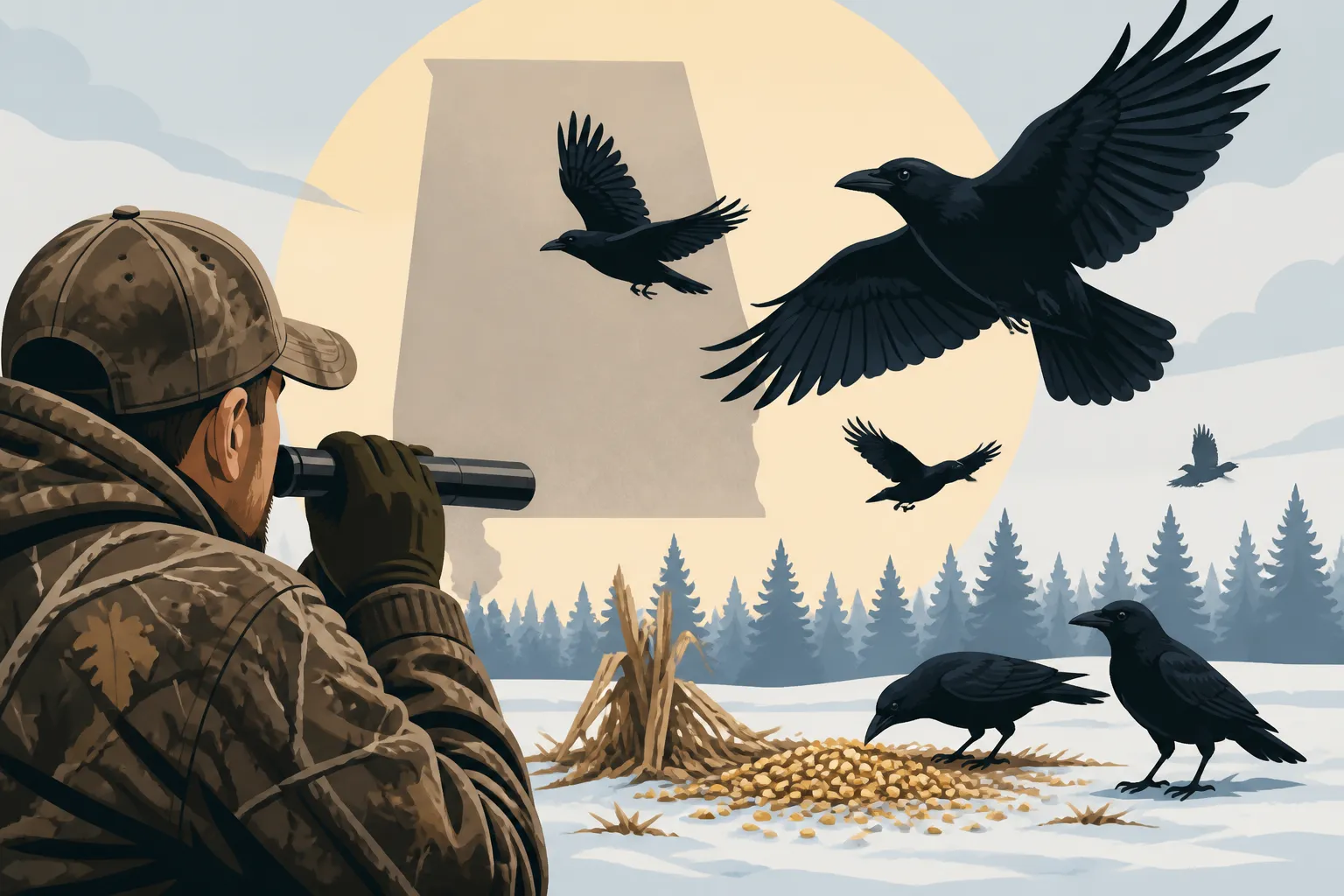
Calling Crows Over a Winter Feed Site
There’s nothing quite like the sight and sound of a large flock of crows descending on a winter field, cawing and chattering as they feast on forgotten crops. While some folks might see them as a nuisance, for us, it's an exciting opportunity. If you've ever tried to call crows and felt like you were just yelling into the wind, you know the frustration. This guide is all about changing that, digging deep into the tactics and understanding you need to successfully call crows over their favorite winter feed sites right here in Alabama.
Understanding Crow Behavior at Winter Feed Sites in Alabama
Crows are incredibly intelligent birds, and their behavior shifts significantly with the seasons. During the colder months, their focus narrows to survival, primarily finding consistent food sources and safe roosting areas. If you want to consistently bring them into range, you’ve got to think like a crow.
Why Crows Gravitate to Winter Food Sources
As the landscape in Alabama changes from lush green to dormant brown, many of the natural food sources that crows rely on in warmer months become scarce. Insects burrow deep, berries are gone, and many wild seeds are depleted. This scarcity drives crows to more concentrated and reliable food sources, and in Alabama, that often means agricultural fields.
Think about it: after the harvest, fields of corn, peanuts, and soybeans leave behind a significant amount of waste grain. For a crow, this is like hitting the buffet jackpot. They need a lot of calories to maintain body temperature during chilly winter nights and to fuel their long flights from roost to feeding grounds. These agricultural leftovers provide that essential energy. They'll also forage for any remaining acorns in hardwood bottoms, especially after a good mast year. Understanding this need for readily available, high-calorie food is the first step in predicting their movements and setting up your hunt.
Identifying Productive Feed Sites and Roosts
Finding the right winter feed site isn't just about spotting a field; it's about observing patterns. Crows are creatures of habit. They'll often fly the same routes, hit the same fields, and return to massive communal roosts night after night. Your job is to become a detective. Start by looking for areas where crops like corn, soybeans, or peanuts have been harvested. The richer the waste grain, the more appealing it is.
Drive slowly down rural roads, especially in counties known for agriculture, like those in the Black Belt region or parts of the Tennessee River Valley. Watch for large concentrations of crows. Are they actively feeding in a field? Are they circling overhead, indicating a potential roost nearby, or perhaps an aggregation point before flying to a larger roost? Look for signs like droppings on fence posts or power lines, which can indicate regular perching or staging areas. Winter roosts are typically in dense pine thickets, often near water like a river bottom, offering protection from predators and the elements. These roosts can hold hundreds, even thousands, of crows. Observing these flight patterns can give you clues about where they'll be headed during the day for feeding. The Outdoor Alabama App can also be a valuable tool for understanding the landscape and identifying potential agricultural areas.
The Importance of a Good Setup Location
Once you've pinpointed a promising winter feed site, your setup is paramount. Crows have incredibly keen eyesight, perhaps even better than a wild turkey's. You can't just walk into a field and start calling. Concealment is absolutely non-negotiable. This means using natural cover like fencerows, thick brush lines, or the edge of a timber stand. If natural cover is sparse, a pop-up ground blind becomes your best friend.
Consider the sun's position – you want it at your back, blinding the approaching crows as much as possible. Wind direction is also critical; you want the wind in your face or quartering, carrying your calling sounds downwind and away from the crows, preventing them from catching your scent (yes, crows can be sensitive to unusual odors, especially human scent near a distress call scenario). Ensure you have a clear shooting lane over your decoys and the anticipated approach path. A good setup minimizes your profile, breaks up your outline, and gives you the advantage. Remember, even though it's crow hunting, thinking about your Treestand Setups in Talladega National Forest principles of concealment and wind can apply here for your ground setup.
Essential Gear for Calling Crows in Winter
Having the right gear makes all the difference between a frustrating morning and a pile of crows. From the visual appeal of your decoy spread to the nuanced sounds of your calls, each piece plays a vital role.
Decoys and Concealment Strategies
Crows are highly social birds, and seeing other crows feeding or in distress is a huge draw. Decoys are incredibly effective. You'll want a mix of full-body decoys and possibly some silhouette decoys. A typical spread might include a dozen or more decoys, positioned as if they're feeding naturally in the field. Some hunters even add an "owl" or "hawk" decoy with a few crow decoys positioned aggressively around it, simulating a mobbing scenario, which can infuriate real crows and bring them in on a string. Place your decoys within shotgun range of your chosen shooting position, usually 20-30 yards.
For concealment, dark clothing is a must. Crows notice bright colors instantly. Camouflage patterns that blend with winter fields and bare trees are ideal. If you're using a ground blind, ensure it's brushed in thoroughly with local vegetation. Even a little exposed skin or a shiny gun barrel can flare wary crows. If you're hunting near a fencerow, consider wearing a headnet and gloves. The more you blend into your surroundings, the better your chances.
The Right Calls and Calling Sequences
This is where the magic happens. You'll need a good set of calls, and for winter hunting over feed sites, variety is key.
- Hand Calls: These are fantastic for realism and control. You can produce a wide range of sounds from excited feeding calls to frantic distress calls. Brands like Faulk's and Primos make excellent crow calls. Practice is essential to master the various tones.
- Electronic Calls: These are game-changers, especially if you're hunting alone or want to produce complex, sustained calling sequences. Electronic calls can replicate a full flock's worth of caws, fighting calls, and distress cries from other animals like a coyote, which can bring crows in looking to mob the predator. When looking for effective electronic call units, keep an eye out for models that allow for custom sound mixing and volume control. The GoHunt platform, while primarily focused on big game, often has discussions or articles related to general hunting gear, and sometimes includes reviews of electronic calls that could be adapted for crow hunting.
Here's a breakdown of common calls and when to use them:
| Call Type | Purpose | Situation |
|---|---|---|
| Assembly Call | Gathers distant crows, expresses contentment. | Start of a hunt, when crows are far off, or to encourage approach. |
| Distress Call | Signals danger or a struggling crow. | When crows are within sight, brings them in aggressively. |
| Fight Call | Simulates a fight over food or territory. | To pique curiosity or challenge wary crows. |
| Fly-in Call | Chatter and caws as crows arrive at a feed site. | Mimics other crows landing, making the area seem safe. |
| Mobbing/Owl Call | Aggressive calls, often combined with distress. | When crows are reluctant, to draw them in to harass a 'predator'. |
A good sequence often starts with assembly calls to grab attention, transitions to fly-in calls as they get closer, and then switches to distress or mobbing calls to bring them into range for a shot. Don't be afraid to experiment!
Firearm Selection and Ammunition
For crow hunting, a shotgun is king. A 12-gauge is the most popular choice, offering a great balance of pattern density and knockdown power. A 20-gauge can also be effective, especially for younger hunters or those sensitive to recoil.
- Choke: A modified choke is a versatile choice, providing a good pattern out to 35-40 yards. If you expect longer shots or want a tighter pattern, a full choke can be useful.
- Ammunition: Standard field loads with shot sizes of 7.5 or 6 are perfect for crows. Lead shot is effective where legal, but many areas now require non-toxic shot. Steel shot in size 6 or 4 will also do the job. You don't need heavy magnum loads; the objective is dense patterns at moderate ranges. Make sure you have plenty of shells – crow hunting can be fast-paced, and you don't want to run out of ammo just when the action heats up.
Advanced Tactics for Consistent Success
Getting a few crows is one thing, but consistently calling them in and having successful hunts requires a deeper understanding and adaptability. Crows are quick learners, and what worked yesterday might not work today.
Reading the Crows' Reaction and Adjusting Your Calling
This is probably the most crucial skill in crow hunting. Every flock is different, and every day brings new challenges. When you start calling, pay close attention to how the crows react.
- Circling High and Wide: This often means they're wary. Your calls might be too aggressive, your setup might be too exposed, or they've been hunted recently. Dial back the intensity of your calling, switch to softer assembly or feeding caws, and reassess your concealment.
- Hesitant Approach, Landing Out of Range: They're interested, but still cautious. This is a good time for a short, sharp distress call or a rapid series of agitated caws, as if a struggle is happening. This can push them over the edge and commit to flying closer. Sometimes, adding a "fight" sequence from an electronic call can also make them commit, as they want to see what the commotion is about.
- Aggressive Diving and Mobbing: This is what you want! If they're coming in hard, diving at your decoys or circling low, you've got them. Maintain the calls that got them there, but be ready to shoot. They'll often try to get above whatever they perceive as a threat (like an owl decoy) or to investigate the source of a distress call.
The key is to adapt. If your aggressive distress calls are flaring them, back off. If soft assembly calls aren't drawing enough attention, try a more urgent sequence. It's a constant dialogue between you and the flock. Even when Rattling and Grunting in Alabama for deer, you're reading the deer's reaction to your call; the same principle applies here.
Dealing with Educated Crows and Pressure
Crows are smart. After just a few hunts in an area, they can become "educated" – meaning they associate certain calls or sounds with danger. This is where patience and cunning come into play.
- Change Up Your Routine: Don't use the exact same calling sequence every time. Vary the length of your calls, the intervals between them, and the types of calls you employ. If you've been using distress calls heavily, try a day of mostly assembly and feeding caws.
- Move Locations: If a particular feed site becomes too pressured, move to another. Alabama has a vast amount of agricultural land, and you can often find other productive fields. Even moving a few hundred yards can make a difference.
- Hunt Different Times: Crows are often most active in the early morning as they leave the roost, and in the late afternoon as they return. However, midday can also be productive, especially on cold, overcast days when they need to feed continuously.
- Utilize Natural Sounds: Sometimes, less is more. If crows are particularly wary, let natural sounds be your guide. A single caw from a distant crow can be enough to start your sequence.
Remember that crows on public land, especially those near frequently hunted areas, will be much warier than those on private property with less pressure. Consider looking into Hunting Pressure on Alabama Public Land to get a sense of how birds in certain areas might react.
Safety and Ethical Considerations
Crow hunting, like all hunting, demands adherence to safety and ethical standards.
- Backstops: Always know what's beyond your target. Shotgun pellets can travel further than you might think. Ensure you have a safe backstop, especially when hunting near roads, homes, or livestock.
- Target Identification: While it might seem obvious, always confirm your target is a crow. Other black birds, like grackles or starlings, are much smaller and not typically the target species.
- Respect Private Property: Always ensure you have permission to hunt on private land. If hunting near the edge of a field, be mindful of property lines. The rules around Do Feral Hogs Need Landowner Permission? are different, but for crows, permission is vital if you're not on public land.
- Regulations: While Alabama typically has very generous crow seasons and no bag limits, always double-check the current Alabama Department of Conservation and Natural Resources (ADCNR) regulations. Seasons for migratory birds can change, and while crows are often treated differently, it's always best to be informed.
Post-Hunt Strategies and Continued Success
Your hunt doesn't end when the shooting stops. What you do after the fact can influence your future success and contribute to ethical hunting practices.
Scouting for Future Hunts
Take a moment after your hunt to observe any remaining crows. Which direction did they fly off? Did they regroup nearby? Are new crows coming into the area, drawn by your calling or the commotion? These observations provide invaluable data for your next outing. Not all crows that respond to your calls will commit to flying into range, and watching their escape routes or how they circle can inform your next setup.
Note the weather conditions, time of day, and how many birds you harvested. Keeping a small hunting journal, perhaps on your GoHunt profile if you use it for other species, can help you identify patterns over time. This continuous scouting is much like Scouting Alabama Public Land Before Season for deer; it's about building a mental map of animal movements and preferences.
Keeping Hunting Pressure Low
This goes hand-in-hand with dealing with educated crows. To maintain productive winter feed sites, you need to manage your hunting pressure.
- Rotate Your Spots: Don't hit the same field day after day. If you have access to multiple feed sites, rotate them. This allows the crows in a particular area to relax and forget about the recent disturbance.
- Avoid Over-Hunting: While there isn't a bag limit, harvesting too many crows from a specific area too frequently can disperse the flock, making future hunts less productive. Sometimes it's better to get a few good opportunities and then move on.
- Leave Some "Educators": If you wipe out an entire flock, there's no incentive for new crows to come in, responding to the calls of the "locals." Leaving a few can help keep the population in the area and, in a strange way, train new crows to respond to your calling.
- Clean Up: Always pick up your spent shells and any trash. Leave the area cleaner than you found it. This respects the landowner (if on private land) and ensures continued access.
By understanding crow behavior, using the right gear, adapting your tactics, and practicing ethical hunting, you'll find that calling crows over a winter feed site in Alabama can be one of the most exciting and rewarding small game pursuits. It's a fantastic way to sharpen your calling skills and enjoy the outdoors when deer season might be winding down or between Alabama Gun Deer Season by Zone hunts.
Disclaimer
Hunting is an inherently dangerous activity. Always prioritize safety, understand and follow all local, state, and federal hunting regulations, and ensure you have the appropriate licenses and permits. The information provided in this guide is for informational purposes only and should not replace professional instruction or official regulations.