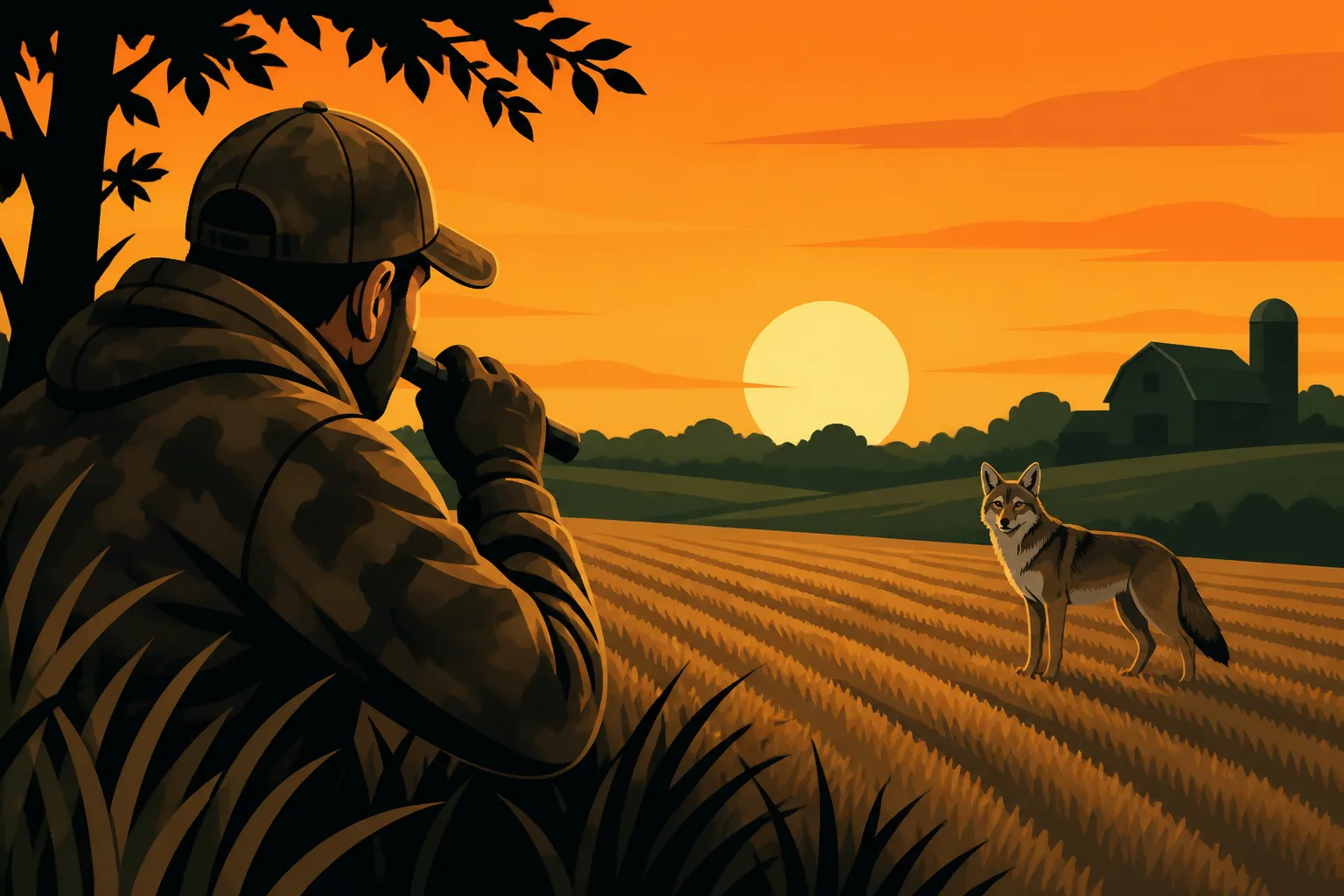
Coyote Calling in Alabama Farm Country
There's nothing quite like the sight of a healthy Alabama deer herd, or the sound of contented cattle grazing in a pasture. But if you're like many landowners and hunters across the state, you've probably seen firsthand the growing challenge that coyotes present, often feeling frustrated as these cunning predators impact fawn survival or even threaten small livestock. This guide is all about equipping you with the knowledge and tactics to effectively call coyotes in Alabama's diverse farm country, helping you manage their populations and protect the wildlife you cherish.
Understanding the Alabama Coyote in Farm Country
Coyotes are incredibly adaptable animals, and nowhere is this more evident than in Alabama's agricultural landscapes. They've figured out how to thrive alongside us, making them a significant factor in local ecosystems. To effectively call them in, you first need to think like a coyote living in a farming environment.
Coyote Behavior and Habitat Preferences in Agricultural Areas
Alabama's farm country isn't just open fields; it's a mosaic of habitats that coyotes exploit with impressive efficiency. They love those edges where cultivated fields meet dense timberlines, overgrown fencerows, and brushy creek bottoms. These transition zones offer them the perfect blend of concealment, travel corridors, and abundant food sources. You'll often find them working these edges, using the cover to stalk prey or simply to move unseen from one area to another.
Think about it: a coyote can spend its day bedded down in a small thicket or a grown-up ditch line, completely out of sight. As dusk approaches, they'll emerge to hunt mice and voles in the cut hayfields, or perhaps patrol the perimeter of a standing peanut field, looking for rabbits or even deer fawns. They are masters of using whatever cover is available, whether it's a patch of kudzu, a brush pile, or even a standing crop like corn or soybeans. Knowing these patterns helps you anticipate where they might be and, more importantly, where they might come from when you start calling.
Their diet in these areas is incredibly varied, which is why they do so well. They'll readily feast on insects, wild berries, and carrion, but they also prey heavily on rabbits, squirrels, and small rodents. Unfortunately, deer fawns are a significant part of their diet during spring and early summer, and it's a huge frustration for deer hunters seeing those fawn recruitment numbers drop. For farmers, the concern often extends to young calves, poultry, or other small livestock, leading to genuine economic hardship and heartache.
The Impact of Coyotes on Alabama Wildlife and Livestock
While coyotes certainly have their place in the natural world, their unchecked proliferation in many Alabama regions has created noticeable imbalances, particularly in agricultural settings. For hunters and wildlife managers, the most prominent concern often revolves around the white-tailed deer population. Extensive research, including studies right here in the Southeast, has shown that coyotes can be major predators of fawns, sometimes accounting for a significant percentage of fawn mortality within their first few weeks of life.
This direct predation can lead to lower fawn recruitment rates, which ultimately means fewer deer for hunters and a potentially less robust deer herd overall. If you've been seeing fewer young deer on your trail cameras or during your hunts, coyotes might be a major contributing factor. It's not about eradicating them entirely, but rather about effective population management to help other wildlife populations thrive. For more insights on this larger issue, you might want to read our article on Predator Hunting in Alabama.
Beyond deer, coyotes are opportunistic hunters that can impact other ground-nesting birds like turkeys, and small game populations like rabbits and quail. For farmers, the impact is often more direct and financially painful. Reports of coyotes preying on newborn calves, lambs, or chickens are far too common. Imagine the despair of a farmer waking up to find losses in their livestock, a direct hit to their livelihood. This is where active predator management, including calling, becomes not just a recreational pursuit, but a necessary form of wildlife and livestock protection. If you're encountering issues with livestock, understanding Alabama Coyote Attacks on Livestock might offer further context.
Essential Gear for Successful Coyote Calling
You wouldn't show up to a duck blind without your waders, right? The same goes for coyote calling. Having the right tools for the job can make a huge difference in your success, especially when you're dealing with such a notoriously wary animal.
Calls: Electronic vs. Mouth Calls
When it comes to bringing in coyotes, your primary tool is the call itself, and you've got two main avenues: electronic calls and mouth calls. Each has its strengths and weaknesses, and many seasoned callers carry both.
Electronic Calls: These are the workhorses for many coyote hunters, especially in farm country where you often need to project sound over long distances and open fields. Brands like FOXPRO and Lucky Duck dominate the market, offering units preloaded with dozens, sometimes hundreds, of sounds. The beauty of an e-caller is its versatility: you can instantly switch between a dying rabbit, a fawn distress, a bird in trouble, or even a coyote howl, all with the push of a button on a remote. This hands-free operation allows you to keep your rifle shouldered and your eyes scanning for an approaching coyote. Plus, you can place the caller some distance away from your position, drawing the coyote's attention to the sound source and away from you. This is a huge advantage when a coyote is coming in hot.
Mouth Calls: For a more intimate, hands-on calling experience, or as a backup to an e-caller, mouth calls are fantastic. They come in various forms:
- Open Reed Calls: These are incredibly versatile, allowing you to produce a wide range of distress sounds by varying pressure and bite on the reed. They can be very realistic but take practice.
- Closed Reed Calls: Easier to learn than open reeds, these typically produce one or two specific sounds, often a rabbit distress. They are a great starting point for beginners.
- Diaphragm Calls: Similar to turkey calls, these fit in your mouth and are operated with your tongue. They allow for very realistic, subtle sounds and hands-free operation once mastered, but they have a steeper learning curve.
The biggest advantage of mouth calls is their raw realism, especially for subtle vocalizations, and the fact that they don't rely on batteries. In a pinch, or for a quick, close-range setup, a good mouth call can be deadly. Many hunters find that a combination of an e-caller for initial long-range attention and a mouth call for subtle, close-in adjustments is the ultimate setup.
Optics and Firearm Selection for Open Terrain
Hunting coyotes in farm country often means longer shots across fields, so good optics and a suitable firearm are non-negotiable.
Optics: First and foremost, you need quality binoculars. Coyotes are notorious for "hanging up" at a distance, observing the scene before committing. You'll need to be able to scan field edges, treelines, and brush piles for any subtle movement or a flash of fur. Magnifications like 8×42 or 10×42 are excellent all-around choices. A spotting scope can also be incredibly useful if you plan on setting up overlooking vast tracts of land, allowing you to pick apart distant cover. Remember, the better you can see them, the better your chances of getting a shot.
Firearms: The typical ranges in open Alabama farm country lend themselves well to accurate, flat-shooting rifles.
- Rifles: Calibers like .223 Remington (5.56 NATO), .22-250 Remington, and .243 Winchester are immensely popular for coyote hunting. They offer excellent velocity, minimal recoil, and the accuracy needed for coyotes that might hang up at 100-300 yards. An AR-platform rifle is a great choice for quick follow-up shots if you're dealing with multiple coyotes, or if your first shot doesn't connect perfectly. Bolt-action rifles provide superb accuracy and are a classic choice. Equipping your rifle with a good quality scope with appropriate magnification (e.g., 3-9x or 4-12x) is crucial. Suppressors are also becoming increasingly common and are a fantastic tool for coyote hunting, reducing noise disturbance and allowing for quicker second shots without alarming other coyotes in the area.
- Shotguns: Don't count out a shotgun, especially if you anticipate close-range encounters in brushy areas or tighter field edges. A 12-gauge shotgun loaded with heavy loads like BB or buckshot can be devastating at 40-60 yards. This is particularly effective if you're hunting in areas where coyotes might come charging in quickly or if you're hunting at night when ranges are compressed.
Camouflage and Concealment for Farm Fields
Coyotes have incredible eyesight, and in the often-open landscapes of farm country, blending in is paramount. Your camouflage isn't just about color; it's about breaking up your outline and disappearing into your surroundings.
For Alabama farm fields, you'll want patterns that mimic the local vegetation. Consider patterns with greens, browns, and tans that blend with fallow fields, harvested crops, or the mixed wood lines. Brands like Mossy Oak and Realtree offer patterns that are well-suited to the varied terrain. Don't forget a face mask or face paint and gloves – exposed skin is a dead giveaway.
Concealment goes beyond your camo pattern. It's about how you position yourself. Hay bales, brush piles, the base of a large oak tree along a field edge, or even the natural folds and dips in a pasture can provide excellent cover. The goal is to set up with a solid background behind you to break up your silhouette, and hopefully some foreground cover to help you disappear. Using a ground blind can also be incredibly effective, providing total concealment and allowing for more movement, especially if you're hunting with a partner or introducing a new hunter. Remember, the less a coyote can pick you out, the more likely it is to commit to your call. When you're scouting potential call locations, tools like GoHunt can be invaluable for analyzing topography and identifying key concealment features from an aerial perspective.
Mastering the Art of Coyote Calling
Calling coyotes is less about just making noise and more about telling a story. You're trying to convince a wary predator that there's an easy meal or a rival in its territory. It takes practice, patience, and a good understanding of what sounds trigger their instincts.
Mimicking Prey and Distress Sounds
The bread and butter of coyote calling revolves around distress sounds. Coyotes are hardwired to respond to the cries of an animal in trouble – it signals an easy meal.
Rabbit Distress: This is arguably the most universal and effective coyote call. Every coyote in Alabama has likely encountered a rabbit, and the sound of one in distress is a primal trigger. Start with short, sharp, high-pitched squalls, mimicking a rabbit caught by a predator. Vary the intensity and duration. Imagine a rabbit struggling, then pausing, then struggling again. Don't be afraid to get loud, especially if you're trying to reach coyotes across a big field. A common mistake is to be too timid with the volume. However, as the coyote gets closer, you'll want to soften your calls to keep them from pinpointing your exact location too early and potentially "hanging up."
Fawn Distress: Especially potent during late spring and early summer when fawns are prevalent, a fawn distress call can be incredibly effective. These sounds often mimic a young deer crying for its mother or after being injured. They can also draw in protective does, which can sometimes bring a coyote along with them. These calls tend to be longer, more drawn-out bleats compared to the sharp squalls of a rabbit. It's a reminder of the constant pressure coyotes put on deer, a reason many hunters take up Hunting Alabama's Year-Round Feral Hogs and coyotes.
Bird Distress: While not as common as rabbit or fawn calls, a bird in distress can sometimes be the ticket, especially if coyotes in your area have grown wary of other sounds. These can be sharp, piercing calls that mimic a crow, crow, or other bird caught by a predator. Sometimes, a change-up call is all it takes to pique the interest of a call-shy coyote. The key with all distress sounds is realism and varying the sequence – a wounded animal doesn't scream non-stop at a constant volume.
Incorporating Howls and Challenge Calls
While distress calls are your primary tool, incorporating coyote vocalizations can add another layer of effectiveness to your calling sequence, especially for locating distant animals or challenging dominant individuals.
Locating Howls: If you're setting up in a new area or hunting a large property, a single, drawn-out locator howl can be extremely useful. It's like asking, "Is anyone home?" Coyotes are territorial, and a distant howl might elicit a response from a pack advertising their presence. This allows you to pinpoint their general direction and adjust your setup accordingly. Don't overdo it; one or two howls are usually enough. Listen intently for a response, as it might be faint and distant.
Challenge Howls: Once you've located a coyote or know there's one in the area, a more aggressive challenge howl can sometimes bring them in aggressively. This mimics a rival coyote encroaching on their territory. Follow up a challenge howl with some barks and yips, which sounds like a small group of coyotes. This can trigger a dominant male or female to come investigate and defend its turf. Be prepared, because when they come to a challenge call, they often come in fast and looking for a fight.
Barks and Yips: These shorter, sharper vocalizations often accompany howls or can be used independently to signal alarm or excitement within a pack. A series of barks and yips can mimic a group of coyotes, which might make a lone coyote feel more confident in approaching, or conversely, challenge a lone coyote to come investigate the "newcomers." Mastering the cadence and volume of these different vocalizations is key. Practice with your calls – mouth or electronic – to get a feel for the different sounds you can produce and how to blend them into a convincing sequence. Remember, the goal is to sound like the real deal, not just a random noise maker.
Scent Control and Wind Awareness
No matter how expertly you call, if a coyote smells you, the game is over. Coyotes have an incredibly keen sense of smell, far superior to ours, and they use it constantly to detect danger. This makes scent control and, more importantly, understanding wind direction, absolutely paramount.
The Wind is Your Friend (or Foe): Always, and I mean always, hunt with the wind in your favor. This means the wind should be blowing from the area you expect the coyote to approach from, towards you, or ideally, across your setup in a way that keeps your scent out of the coyote's approach path. A common and effective strategy is to set up with the wind quartering to your face, allowing you to see the coyote approach while your scent is carried away from its line of travel. Coyotes will almost always circle downwind to get a whiff of whatever is making the sound before committing. If your scent cone crosses their path, they will either spook or "hang up" out of range, just out of sight, and then disappear. Understanding wind and thermals on a Wind and Thermals on a Piedmont Ridge can be critical, even in flat farm country.
Scent Control Measures: While you can never completely eliminate human odor, you can significantly reduce it.
- Scent-Free Washing: Wash your hunting clothes in scent-eliminating detergents and store them in airtight containers or bags away from household odors.
- Carbon-Lined Clothing: Many hunters invest in carbon-lined clothing, which is designed to absorb human scent.
- Scent Sprays: Use scent-eliminating sprays on your clothes, boots, and gear before heading into the field. Pay close attention to your boots, as you'll be walking in to your setup.
- Minimal Contamination: Avoid stopping at gas stations, smoking, or handling food before your hunt if possible, as these odors will cling to your clothes.
- Location: When you're picking your setup, don't just consider visibility and cover. Think about how the wind will carry your scent and position yourself so that any coyote circling downwind will pass through an area where you have a clear shot, before they can pinpoint your exact location with their nose. Often, this means setting up slightly off the ideal approach, forcing them to expose themselves if they follow their nose.
Strategic Setups for Farm Country Calling
Calling coyotes isn't just about blowing a call; it's about choosing the right spot and blending into it perfectly. In Alabama's farm country, your setup is just as critical as your calling sequence.
Utilizing Field Edges and Natural Funnels
Alabama farm country is a land of edges – where fields meet woods, where pastures meet creeks, and where fencerows cut across open expanses. These edges are natural highways for coyotes, and understanding them is key to a successful setup.
Field Edges: Coyotes instinctively travel along field edges. They offer the perfect balance of cover and opportunity. A coyote can stay concealed in the treeline or brush, while still being able to dart out into the field to snatch a mouse, chase a rabbit, or investigate a distress call. When scouting, look for well-worn trails along these edges. Your goal is to set up where you have a clear view of the edge and the field, anticipating that the coyote will approach along that margin. Positioning yourself 50-100 yards back from the edge can provide a better shooting lane and keep you from being silhouetted against the sky. For hunters looking to maximize their odds, learning how to setup on a Setting Up on a Black Belt Field Edge offers valuable insights.
Natural Funnels: Look for natural pinch points or funnels that dictate how coyotes will move through the landscape.
- Creek Bottoms and Drainages: These often have dense cover and offer sheltered travel routes. A coyote traveling along a creek bottom might pop out to investigate a call in an adjacent field.
- Hedgerows and Ditches: These lines of vegetation provide linear cover that coyotes love to use. Setting up near a junction of two hedgerows or where one meets a wood line can create a perfect ambush point.
- Narrow Strips of Timber: If a larger block of woods funnels down into a narrow finger between two fields, that's a prime spot. Coyotes will use these bottlenecks to traverse the property.
When you spot these funnels, visualize how a coyote would move through them and where it might expose itself to your calls. This understanding of movement patterns is a core component of effective predator hunting. For instance, knowing how to hunt a Hunting a Funnel Between Two Creek Bottoms can translate well to coyote strategy.
Approaching and Concealing Your Setup
Once you've identified your ideal calling location, the approach and final concealment are crucial. A careless approach can spook every coyote in the vicinity before you even get a chance to call.
Stealthy Approach: Always assume there's a coyote watching. Use terrain features, tall grass, or the cover of darkness (if hunting at legal night hours with proper permits) to mask your approach. Walk quietly, avoid rustling leaves or snapping branches. If you're walking along a field edge, stay well inside the treeline until you're close to your setup. Pay attention to the wind during your approach, ensuring your scent isn't blowing into the area you plan to call. This meticulousness can feel tedious, but it's often the difference between success and failure.
Final Concealment: When you reach your chosen spot, take a moment to assess the immediate surroundings.
- Background Breakup: Position yourself against a solid background like a thick tree, a large brush pile, or the dark shadow of a wood line. This helps break up your outline and prevents you from being silhouetted against the sky.
- Foreground Cover: Utilize any natural cover in front of you – tall weeds, a low bush, even a slight rise in the ground. This provides additional concealment and can help you disappear.
- Minimize Movement: Once you're set, minimize movement. Even small motions can be picked up by a coyote's keen eyes. Practice bringing your rifle to your shoulder smoothly and quietly. If you're hunting with an electronic call, place it 20-50 yards out in front of you, slightly off to one side. This draws the coyote's attention away from your position, giving you a better shot opportunity. If you're concerned about visibility, especially on public land, learning about Using a Ground Blind on Alabama Public Land can be a great alternative, as it offers maximum concealment.
Decoy Placement and Visual Stimuli
Adding a visual element to your calling sequence can significantly increase your success rate, especially with wary farm country coyotes. A good decoy can seal the deal by giving a cautious coyote something concrete to focus on other than you.
The Power of Motion: Coyotes are sight hunters, and a bit of movement can be an irresistible draw. Motion decoys, like those with a spinning tail (e.g., Mojo Critter) or fluttering wings (like a distressed bird decoy), are incredibly effective. The erratic movement mimics a struggling animal and immediately catches a coyote's eye from a distance. The beauty of these decoys is that they divert the coyote's attention. Instead of staring intently at the source of the sound (your general direction), the coyote will often fixate on the visible movement of the decoy, giving you precious moments to raise your rifle and make a clean shot.
Strategic Placement: Placement is key.
- Visibility: Place the decoy where it's easily visible from the expected approach of the coyote, typically 20-40 yards in front of your position.
- Distance from Caller: If using an electronic caller, place the decoy near the caller. This reinforces the illusion that the sound and sight are coming from the same distressed animal.
- Off-Center: Consider placing the decoy slightly off to one side of your shooting lane. When a coyote commits to the decoy, it will often approach it directly, giving you a broadside or quartering-away shot as it passes.
- Avoiding Obstructions: Ensure no tall grass, brush, or terrain features will block the decoy's movement or the coyote's line of sight as it approaches.
Decoys work best when combined with effective calling. A convincing distress call draws them in, and the visual stimulus of the decoy gives them the confidence to close the distance. It’s a powerful one-two punch that can turn a "hang-up" into a successful harvest.
Seasonal Considerations and Advanced Tactics
Coyote hunting isn't a one-size-fits-all endeavor. Their behavior shifts with the seasons, and adapting your tactics accordingly will significantly improve your odds. Plus, there are ways to refine your technique, especially when hunting with a partner.
Adjusting Tactics Throughout the Year
Coyotes respond differently to calls depending on the time of year, influenced by breeding cycles, pup rearing, and food availability.
Winter (Peak Season): This is arguably the best time to call coyotes in Alabama. Food sources are scarcer, and coyotes are more actively hunting. Their fur is also at its thickest and most desirable. During the breeding season (late winter/early spring), coyotes are more vocal and more responsive to howls and challenge calls as they seek mates or defend territory. They are also more susceptible to distress calls as they are constantly looking for food to sustain themselves through the colder months. Be aggressive with your calling and don't be afraid to try howls.
Spring (Denning & Pups): As spring arrives, coyotes are focused on denning and raising pups. Females can be very protective of their young, making fawn or pup distress calls incredibly effective. Males are also on the prowl for food to bring back to the den. However, dense spring foliage can make visibility challenging, so focus on field edges and more open areas. A lone howl can also draw in an inquisitive adult looking for a potential threat to their den.
Summer (Challenging but Possible): Summer can be the toughest time due to thick vegetation, heat, and abundant natural food sources. Coyotes are often less responsive to calls, and pups are growing quickly, dispersing, and learning to hunt. Early morning and late evening become critical due to heat. Focus on water sources, shady creek bottoms, and freshly cut hayfields where small rodents might be exposed. Distress calls will still work, but you might need to call longer and be more patient.
Fall (Transition Time): As temperatures cool and crops are harvested, coyotes become more active. Pups are becoming independent, and both young and old coyotes are looking for easy meals. Distress calls are effective, and howls can work well as packs re-establish territories. This is a good time to revisit your winter tactics, gradually increasing aggression as the season progresses. Understanding the local patterns for Hunting the Alabama Rut by Zone can also inadvertently provide insights into coyote movements, as coyotes often follow deer patterns.
Double-Teaming and Partner Calling
Coyote hunting is often a solitary pursuit, but bringing a partner can offer significant advantages, particularly in the open landscapes of farm country.
Advantages of a Partner:
- Increased Vigilance: Two sets of eyes are always better than one. One person can focus solely on calling while the other scans for incoming coyotes, ensuring nothing slips by unnoticed.
- Target Acquisition: When a coyote bursts out of cover, the dedicated shooter can often acquire the target much faster than someone who is also trying to manage a call.
- Strategic Placement: With two people, you can execute a "splitter" setup. One person (the caller) sets up with the call and perhaps a decoy, drawing the coyote's attention. The second person (the shooter) sets up 50-100 yards downwind or to the side, anticipating the coyote's natural tendency to circle downwind to scent-check the source of the sound. This often provides a prime shooting opportunity before the coyote ever detects the shooter.
- Sound Enhancement: One person can use an e-caller for broad sounds, while the other uses a mouth call for subtle, realistic close-in finishing touches. This realism can convince a wary coyote.
Communication is Key: When hunting with a partner, silent communication is vital. Hand signals for "coyote coming," "stop calling," or "shoot" can prevent unnecessary chatter that spooks game. Practice these signals beforehand to ensure smooth execution in the field. Double-teaming requires coordination, but the results often speak for themselves, turning a tough hunt into a successful one.
Post-Call Strategy and Follow-Up
What happens when a coyote responds but then hangs up, or when your initial calling sequence doesn't produce results? That's where your post-call strategy comes in. Don't give up too quickly!
The "Hang-Up" Scenario: A common frustration is when a coyote responds to your calls, approaches, but then stops just out of range or behind cover, refusing to commit. This is usually because they've gotten a whiff of something (your residual scent, perhaps), or they're highly call-shy, having been pressured before.
- Patience is a Virtue: Sometimes, the best thing to do is absolutely nothing. Stay still, stay quiet, and give the coyote time. It might be trying to locate the sound or waiting for the "distressed animal" to show itself.
- Subtle Sounds: If it's been a few minutes, try very soft, subtle mouth calls. A few quiet whines, whimpers, or a barely audible rabbit squeak can sometimes be enough to coax that last few yards out of a hung-up coyote.
- Change It Up: If soft sounds don't work, consider switching to a different distress call altogether. A new sound might pique its interest and convince it to move.
- Visual Cues: If you have a motion decoy, activate it for a few seconds. The sudden movement might be just enough to draw its attention and bring it closer.
No Response? Don't Pack Up Yet: If your initial 15-20 minutes of calling yields no response, don't immediately move on.
- Extend Your Stand: Sometimes it takes a coyote longer to respond, especially if it's bedded down or coming from a long distance. Extend your stand for another 10-15 minutes.
- Change Calling Sequence: Try a completely different calling sequence. If you started with distress, try a short series of howls. If you howled, try a rabbit distress.
- Move and Reset: If after 30-40 minutes you've seen or heard nothing, it's time to move to a new location. Don't just pick up and walk; carefully extract yourself from the setup, using the same stealth you employed coming in. Plan your next setup a significant distance away (at least half a mile, sometimes more) to avoid calling the same coyotes. Consider scouting new areas with tools like GoHunt to identify fresh approach angles and cover.
| Call Type | Common Sounds | Pros | Cons |
|---|---|---|---|
| Electronic Call | Rabbit, Fawn, Bird Distress; Howls, Barks, Kills | Versatile, remote control, hands-free, loud | Battery-dependent, less realistic at close range |
| Open Reed Call | Variable Distress, Fawn, Howls | Very realistic, versatile with practice | Steep learning curve, requires hand movement |
| Closed Reed Call | Specific Rabbit Distress | Easy to learn, often very realistic | Limited sound variety, requires hand movement |
| Diaphragm Call | Distress, Howls, Yips | Hands-free, very realistic, subtle sounds | Difficult to master, takes considerable practice |
Ethical Considerations and Post-Hunt Practices
As hunters, we carry a responsibility to conduct ourselves ethically, not just in the pursuit of game, but also in how we handle our success. This applies just as much to predator hunting as it does to deer or turkey.
Respecting Landowners and Property
In Alabama's farm country, hunting access often relies on the goodwill of private landowners. This means respecting their property and their wishes is paramount.
- Always Ask Permission: Never assume access. Always get explicit permission before stepping foot on private land. A simple knock on the door and a polite conversation can go a long way. This is crucial for Knocking on Doors in Black Belt Farm Country, but applies everywhere.
- Understand Boundaries: Know the property boundaries like the back of your hand. Use mapping apps like GoHunt to clearly delineate where you can and cannot hunt. Inadvertent trespassing is a quick way to lose privileges.
- Be a Good Steward: Close all gates, avoid driving on crops or wet fields, don't leave trash, and report any suspicious activity you might observe. Offer to share your harvest or help with small chores. Being a respectful hunter builds trust and often leads to continued access. A positive relationship with landowners is invaluable, especially if you're hunting nearby sensitive areas like Hunting Small Woodlots Near Suburban Birmingham.
Safe Hunting Practices and Shot Placement
Safety should always be your top priority. Coyote hunting often involves rapid target acquisition and shots over varied terrain, making safe practices even more critical.
- Identify Your Target: Always be 100% certain of your target and what's beyond it. Coyotes can be mistaken for domestic dogs, especially in low light.
- Know Your Backstop: Ensure you have a safe backstop for every shot. In farm country, this might mean a hedgerow, a rise in the land, or a distant tree line, rather than shooting across open, flat fields towards potential homes or roads.
- Clear Shooting Lanes: Before you call, identify your primary and secondary shooting lanes. Remove any small obstructions that could deflect a bullet.
- Ethical Shot Placement: Aim for the vitals (typically the chest cavity) for a quick, humane kill. A well-placed shot minimizes suffering and reduces the chance of a wounded animal escaping. Practice at the range to ensure you're proficient with your chosen firearm at various distances.
- Follow-Up Shots: Be prepared for a quick follow-up shot if necessary. Coyotes are tough animals, and they can cover ground quickly even when mortally wounded.
- Retrieve Your Animal: Always make a diligent effort to recover any animal you shoot. Even if you think it was a clean miss, follow up and confirm. This shows respect for the animal and ensures no wounded game is left to suffer.
Disclaimer
Hunting is an inherently dangerous activity. Always prioritize safety, follow all local, state, and federal regulations, and obtain appropriate licenses and permits. The information provided in this guide is for informational purposes only and should not be considered a substitute for professional training or legal advice. Always know your target and what lies beyond.