Grunt Calls in Mature Alabama Timber
There’s nothing quite like the silence of mature Alabama timber, the towering oaks and pines creating a cathedral of the woods. But that quiet can be frustrating when you’re deer hunting, feeling like the deer are just ghosts. Getting a wary whitetail buck to step out of that dense cover and into your shooting lane often feels impossible. This comprehensive guide will walk you through exactly how to use grunt calls effectively in these big woods, transforming those silent hunts into encounters you’ll never forget.
Understanding the Language of Grunts in the Woods
Before you even think about blowing into a grunt tube, you need to grasp what you're trying to replicate and why a deer might respond. Mature timber, with its vastness and often minimal visibility, amplifies the need for effective communication. You're not just making noise; you're speaking the language of deer, hoping to pique the curiosity or challenge the dominance of a buck.
Different Types of Grunts and Their Meanings
Deer, much like humans, have a range of vocalizations, and each carries a specific message. Understanding these nuances is critical for successful calling. You wouldn't yell a challenge at a deer you're trying to calm, right?
- Basic Buck Grunt: This is your bread and butter. It's a low, guttural sound, often short and single. It signals a buck moving through the woods, perhaps searching for does or simply announcing its presence. It’s a very common sound during the rut, but bucks make it year-round. When you hear a buck grunt, it often means he's interested or active.
- Tending Grunt: Longer, more drawn-out, and often repeated multiple times, these grunts indicate a buck is actively pursuing a receptive doe. It's a hot and heavy sound, full of urgency. This is a powerful call to use when you suspect bucks are chasing. A series of tending grunts suggests a buck is "locked on" a doe and isn't likely to stray far unless a challenger appears.
- Aggressive Grunt (Grunt-Snort-Wheeze): This is the sound of a buck spoiling for a fight. It starts with a series of deep grunts, transitions into a raspy snort, and then culminates in a sharp, high-pitched wheeze. This is a direct challenge to another buck’s dominance. Use this sparingly and with caution, as it can either bring a dominant buck charging in or send a smaller, less confident buck running the other way. It’s a high-stakes call, often best reserved for when you know a mature buck is close or you’re ready to commit to a confrontation.
- Doe Grunt (or Bleat): A softer, shorter "mmeeeh" sound. Does use these to communicate with fawns or other deer, often signaling contentment or a low-level inquiry. While not a primary buck attractant, it can sometimes intrigue a buck looking for a doe.
- Fawn Bleat: A higher-pitched, more urgent "maaaah." This indicates a fawn in distress. While it can attract does (and potentially bucks looking for a doe), it can also attract predators, so use it carefully.
Here's a quick summary of common deer vocalizations and when to use them:
| Call Type | Sound Description | Deer Behavior Indicated | Best Time to Use | Expected Buck Response |
|---|---|---|---|---|
| Basic Buck Grunt | Low, guttural, short, single "urrrp" | Traveling, looking for does, announcing presence | Pre-rut, Peak Rut, Post-rut | Investigation, curiosity, cautious approach |
| Tending Grunt | Longer, repeated, urgent "grrr-urrr-urrr" | Chasing a receptive doe | Peak Rut | Aggressive approach, challenge, direct confrontation |
| Aggressive Grunt | Grunt-Snort-Wheeze (GSW): Deep grunts, snort, wheeze | Challenging another buck, ready to fight | Peak Rut, when a dominant buck is known to be near | Charging in, aggressive display, sparring |
| Doe Bleat | Soft, drawn-out "mmeeeh" | Contentment, calling fawns, seeking company | Early Season, Pre-rut | Curiosity, investigation for does |
| Fawn Bleat | High-pitched, urgent "maaaah" | Distress, lost fawn | Early Season (limited effectiveness for bucks) | Investigation (does), occasional buck curiosity |
The Acoustic Challenge of Mature Timber
Hunting in mature timber, like what you’d find in parts of the Talladega National Forest or the William B. Bankhead National Forest, presents unique acoustic challenges. Unlike open fields where sound can carry for hundreds of yards, big trees, dense undergrowth, and undulating topography can swallow sound almost immediately.
Imagine standing in a dense pine thicket. Your voice doesn't travel far, right? The same is true for your grunt call. Hardwood bottoms, thick with mature oaks and a mix of understory, can be even trickier. Sound waves hit tree trunks, bounce off dense foliage, and get absorbed by soft ground. This means a deer 100 yards away might not hear your call at all, or it might hear a highly distorted version.
Factors influencing sound travel:
- Tree Density: More trees mean more obstacles, reducing how far sound travels and potentially muffling it.
- Understory: Thick briars, honeysuckle, or saplings in the understory create a sound barrier.
- Topography: Ridges and creek bottoms act as natural sound traps or redirectors. A grunt call might carry well down a ridge but not over it. Understanding the Wind and Thermals on a Piedmont Ridge is crucial here, as sound often travels better with the wind and down thermals.
- Weather: Wind can carry sound, but also mask it. Rain or heavy mist can also dampen sound.
Because of these challenges, you need to be more strategic with your calling volume and frequency, and perhaps even more mobile. It often means a shorter effective range for your call, emphasizing the need for good scouting and setup.
Effective Grunt Calling Strategies for Alabama's Big Woods
Calling deer in mature timber isn't just about making noise; it's about playing the percentages and understanding deer behavior in those specific environments. Patience and observation are just as vital as your calling technique.
Timing Your Calls to the Rut and Pre-Rut
Alabama's deer rut is notorious for its variability across the state. You could have bucks chasing hard in one zone while others are still in pre-rut or even post-rut. This dictates when your grunt calls will be most effective. Understanding the different Alabama Deer Season Structure Explained and especially Hunting the Rut in the Northern Zones versus Hunting the Rut in the Southern Zones is paramount.
- Pre-Rut (Late October – Mid-November in many areas, but varies): Bucks are starting to feel the urge. They’re cruising, looking for the first does coming into estrus, and their testosterone levels are rising. This is an excellent time for basic buck grunts and even light rattling. You're trying to appeal to their curiosity or challenge their budding dominance. A few subtle grunts might draw a young buck in, while a more aggressive tending grunt could bring a mature buck searching for the source of the "competition."
- Peak Rut (Mid-November – Mid-December in many areas, but again, varies wildly by zone): This is prime time. Bucks are actively chasing and breeding. Tending grunts and aggressive grunt-snort-wheezes are highly effective now. Bucks are less cautious and more prone to confront rivals. If you hear a distant grunt or see a buck chasing, a well-timed tending grunt can often pull him off a hot doe or challenge him into your setup. During this period, bucks are often on their feet more, covering ground.
- Post-Rut (Late December – January/February, depending on zone): While intense calling diminishes, grunts can still work, especially if you have a late-breeding doe in your area. Bucks might still respond to a basic grunt, but often with less enthusiasm. They're recovering from the rut and focused on food.
GoHunt offers fantastic mapping and data overlays that can help you pinpoint specific rut timings for your hunting area, which is invaluable for timing your calling strategy. Knowing if you're in a late rut zone, for example, could extend your effective grunt calling window deep into January.
Positioning Yourself for Success
In thick timber, where visibility is often limited, your stand placement and setup are absolutely critical. You can’t just blindly grunt and expect deer to magically appear in the open.
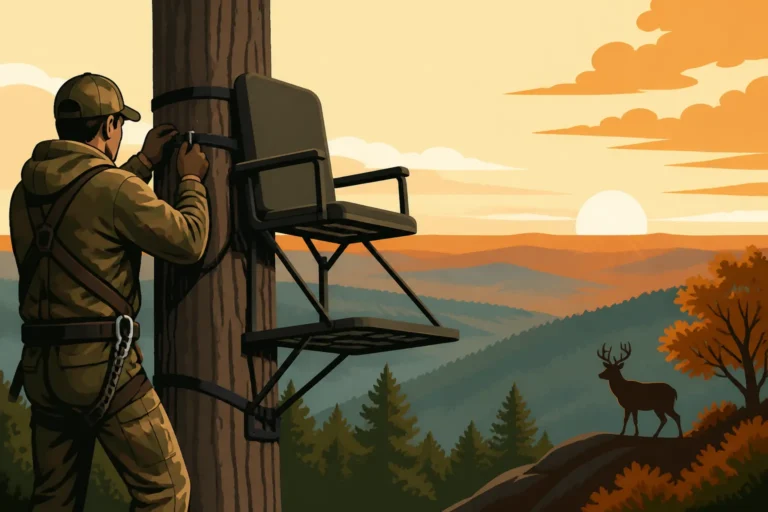
- Elevated Stands: A quality treestand is often your best friend in mature timber. It allows you to see over some of the undergrowth, increasing your visibility and making it harder for deer to pinpoint your location. When setting up your stand, consider common travel corridors like old logging roads, creek bottoms, or natural funnels between ridges. For example, knowing how to approach and set up for deer in areas like Finding Sign in Big Talladega Timber or on a Hanging a Stand on a Talladega Ridge will give you an edge.
- Ground Blinds: If an elevated stand isn't an option or you prefer hunting from the ground, a well-brushed-in ground blind can be highly effective. The key is blending in. Deer in mature timber are often accustomed to thick cover, so a ground blind can feel very natural to them if properly camouflaged. Ensure your shooting lanes are clear but not overly wide, maintaining that natural look. Using a ground blind on Alabama public land requires careful attention to rules and setup, often blending it into existing cover.
- Wind and Thermals: Never, ever forget the wind. In thick timber, wind can swirl unpredictably, especially in hilly terrain. Always position yourself so the prevailing wind carries your scent away from where you expect a deer to approach. Early morning thermals often drop down hillsides, while evening thermals rise. Factor this into your approach and calling strategy. You might need to adjust your setup significantly if you plan on calling aggressively.
- Visibility and Shooting Lanes: Before calling, ensure you have clear shooting lanes in multiple directions. A buck might come in cautiously, circling downwind. You need to be ready for an approach from any angle within your comfort zone. Trim small branches if necessary, but avoid making your spot look like a clear-cut.
The Art of the Calling Sequence
This is where the magic (or the frustration) happens. Knowing how to grunt is as important as when and where.
- Volume and Aggression: In mature timber, you often need more volume than in open country due to sound absorption. Start with a medium-volume basic grunt. If you don't get a response, slowly increase the volume. If you know there's a dominant buck in the area, or if it's the peak rut, you can be more aggressive with tending grunts or even a full grunt-snort-wheeze. However, if deer are heavily pressured, subtler calls might be better. There's a balance to strike; too loud and you might spook a nearby deer, too soft and it won't hear you.
- Frequency and Duration: Don't call constantly. A realistic sequence might involve 2-3 basic grunts every 15-20 minutes. If you get a response, wait. If a buck starts approaching, let him come. If he hangs up, a single, soft grunt might be all it takes to bring him the rest of the way. For tending grunts, you might do a longer series of 5-7 grunts over 30 seconds, then wait. When combining calls with rattling, as discussed in Rattling and Grunting in Alabama, the grunt often follows the rattle, mimicking a buck coming in to investigate a fight.
- The Follow-Up: This is crucial. If you make a series of grunts and don't see anything, wait. Give it at least 15-20 minutes, sometimes longer, especially in dense cover where a deer might be taking its time or circling downwind. A buck might hear you, pause, decide to investigate, and then take 10 minutes to slowly pick its way through the timber. Resist the urge to call again too quickly. If you do see a deer, especially if it stops or looks in your direction, try a soft, single grunt to pull its focus or encourage it to take a few more steps.
- Decoys: While not always practical in dense timber, a realistic doe decoy could add to the illusion of a tending grunt scenario, but consider visibility and ease of deployment. In most mature timber situations, focusing on sound alone is more effective.
Common Mistakes and How to Avoid Them
Even seasoned hunters make mistakes when calling deer, especially in the challenging environment of mature timber. Awareness is the first step to avoidance.
Overcalling and Undercalling
This is a classic dilemma. The fear of overcalling often leads to undercalling, and vice versa.
- Overcalling: Blowing your grunt tube too frequently or too loudly can easily spook deer. Imagine a buck hearing a grunt every five minutes – it sounds unnatural, almost like a hunter rather than a deer. Overcalling also often comes with impatience, leading hunters to move or adjust before a deer has had a chance to respond. In pressured areas, overcalling is a surefire way to send deer deeper into the thickest cover.
- Undercalling: On the flip side, being too timid or not calling enough means your message might never reach the deer you're targeting, especially in sound-absorbing timber. If you only grunt once every hour, a buck could easily pass by within earshot and never know you were there. The goal is to be heard but not detected.
The Balance: Start subtle. A few basic grunts, spaced out. If no response after 20-30 minutes, try increasing the volume slightly or adding a tending grunt if the timing is right (peak rut). Always listen intently after each sequence. Deer will often respond vocally or by moving, and you need to be ready to react. Think of it as a conversation; you say something, then listen for a reply. Using tools like GoHunt to study deer movement patterns in similar timber areas can help you anticipate how deer might react to various calling pressures.
Ignoring the Wind and Topography
As mentioned earlier, mature timber and varied terrain create unpredictable wind currents. Ignoring these nuances is a primary reason grunt calls fail.
- Swirling Winds: In deep creek bottoms or over sharp ridges, the wind rarely blows in a consistent direction. You might feel a breeze on your face, but 50 yards away, it could be swirling 180 degrees. Bucks, especially mature ones, are masters of using the wind to their advantage, often circling downwind of a call to scent-check the source before committing.
- Terrain Influence: A deer responding to your call from across a steep hollow might have to expend significant energy to reach you, giving them more time to get nervous. Conversely, a deer on a parallel ridge might hear your call perfectly but have a long, clear path to circle downwind. Always mentally map out how a deer might approach and use the wind to its advantage, then try to anticipate and counter that. This might mean setting up where a natural barrier (like a creek or thick impenetrable briar patch) prevents a full downwind circle, forcing them to approach from a more favorable angle.
Patience and Persistence
Hunting mature timber is rarely a quick affair. Unlike food plots or open fields, deer in big woods often move at a slower, more deliberate pace.
- The Wait: A buck might hear your call from a considerable distance and take 15, 30, or even 45 minutes to work its way to you, especially if it's circling downwind. Many hunters give up too soon, packing up their stand just as a responding buck is about to appear. Maintain vigilance for a solid hour after a calling sequence, particularly during the rut.
- Multiple Attempts: If a spot looks promising (good sign, fresh tracks, ideal cover), don't give up after one unsuccessful calling session. Deer move constantly, and a buck might not be in the area when you first call. Try again later in the day, or return to the spot a few days later. Sometimes, it’s about being there at the right time. For hunters looking to maximize their time on public land, learning Scouting Alabama Public Land Before Season can help pinpoint these promising spots before the season even begins, improving your odds.
Gear Considerations for Grunt Calling in Timber
While the technique is key, having the right tools can certainly make a difference in your grunt calling success. Don't overcomplicate it, but do choose a call that you're comfortable and confident with.
Choosing the Right Grunt Call
The market is flooded with grunt calls, from simple tubes to complex adjustable models.
- Tube Calls: These are perhaps the most common. They often have a flexible tube that allows you to change the pitch and tone by squeezing it. They're versatile and can produce a wide range of grunts, from deep buck grunts to softer doe bleats. Brands like Primos and Flextone make excellent, easy-to-use tube calls.
- External Reed Calls: These calls have a reed on the outside of the mouthpiece, making them very easy to operate. You simply blow into them. They tend to be very consistent in sound.
- Internal Reed Calls: These are more like duck or goose calls, with the reed inside. They can offer a wider range of sounds and more control for experienced callers but might have a steeper learning curve.
Ultimately, the "best" call is the one you can operate most realistically and consistently. Practice at home (or in your truck, away from judging ears!) to become proficient before hitting the timber. You want the sound to be second nature so you can focus on the deer, not on operating the call.
Integrating Other Calls
While grunts are powerful, combining them with other deer vocalizations or sounds can create a more compelling and realistic scenario.
- Rattling: Especially during the pre-rut and peak rut, combining rattling antlers with grunts can be incredibly effective. The sound of two bucks fighting often draws in other bucks looking to either challenge the victors or check out the competition. A common sequence is a minute or two of rattling, followed immediately by 2-3 aggressive grunts, as if a buck just entered the fray. Wait 15-20 minutes, then repeat. Remember that Rattling Volume in Thick Pine Cover needs to be adjusted for the environment.
- Snort-Wheeze: This highly aggressive call can be made with some grunt tubes or specialized calls. It’s a challenge, almost a "get out of my territory" sound. Use it sparingly and usually in conjunction with grunts or rattling when you know a big buck is nearby and you want to provoke a reaction.
- Doe Bleats/Fawn Bleats: While primarily for does, a soft doe bleat after a few buck grunts can sometimes add to the realism, suggesting a buck is tending a doe. Fawn bleats, while less common for attracting bucks, can occasionally bring in a curious buck, especially early in the season. However, be cautious, as it can also attract non-target animals.
- Deer Scents: While not a call, using deer scents (doe estrus, dominant buck urine) around your stand can enhance the illusion created by your calling. Place scent wicks downwind of your position to further draw deer into your shooting lane and divert their attention.
A great resource for tracking deer movement and applying these strategies is the GoHunt app, which allows you to overlay public land boundaries with satellite imagery and record observations, helping you develop a comprehensive hunting plan. Knowing where deer have been sighted, or where buck sign is concentrated, can inform your calling strategy. For those hunting in the cooler late season, consider how Warm-Weather Sitting Strategy in Alabama or Hunting Deer After a Cold Front might impact deer movement and your calling effectiveness.
Disclaimer
Hunting is an inherently dangerous activity. Always prioritize safety, follow all Alabama hunting regulations, and be aware of your surroundings. This information is for educational purposes only and does not guarantee hunting success. Always identify your target positively and be sure of your backdrop before taking a shot.