Layout Blind Hunting Delta Farm Fields
There’s nothing quite like the sight of ducks and geese pitching into a field, wings set, trustingly coming right to your spread. But if you’ve spent any time chasing waterfowl in Alabama, especially in the vast agricultural fields bordering our mighty river deltas, you know that finding good cover can feel like a mission impossible. Those wide-open spaces, while prime feeding grounds, offer little in the way of natural concealment. This guide is all about mastering the art of layout blind hunting in these challenging, yet incredibly rewarding, Delta farm fields, ensuring you can blend seamlessly into the landscape and put more birds in the bag.
Understanding the Delta Farm Fields for Waterfowl
Alabama’s river deltas, particularly the Mobile-Tensaw Delta, are ecological powerhouses, drawing in incredible numbers of migratory waterfowl each year. But unlike the timber hunting often associated with southern duck hunting, these delta regions also boast expansive agricultural fields that become critical feeding zones for ducks and geese, especially when winter weather sets in. It’s a different ballgame entirely from hunting flooded timber, demanding a completely different approach.
The Unique Habitat of Alabama's River Deltas
When we talk about "Delta farm fields," we're primarily referring to the agricultural lands adjacent to or within the broad floodplains of the Mobile-Tensaw River Delta. This sprawling network of rivers, bayous, and swamps opens up into vast tracts of farmland, often leased or privately owned, that provide crucial food sources for migratory birds. While the Tennessee River Delta also has significant waterfowl activity, for purposes of hunting these specific "Delta farm fields" in the lower part of the state, the Mobile-Tensaw is often the key area. These fields might be planted with corn, soybeans, winter wheat, or even sometimes left as fallow ground that still holds plenty of waste grain. The availability of these high-energy food sources, combined with proximity to abundant water, makes them irresistible to ducks and geese looking to refuel during their long journeys.
It’s this very combination of open agricultural fields right next to major flyways and expansive marsh or timber water bodies that makes these spots so appealing. Birds will often roost on big, open water or in the security of deep swamps, then fly out to these fields to feed during the day. Understanding this daily pattern is your first step to success. You’re essentially intercepting them between their bedroom and their kitchen. The challenges, of course, lie in how exposed these feeding areas are, requiring hunters to become masters of concealment. Knowing the local conditions, from recent rainfall affecting field access to specific crop rotations, can be crucial for success, especially as you think about where to set up your spread.
Key Forage and Water Sources
Waterfowl, particularly mallards, pintails, geese, and sometimes even wigeon, are highly attracted to waste grain left over from agricultural harvests. Fields of cut corn are absolute magnets, as are soybean fields after the combines have been through. Winter wheat fields, especially in the early stages, can also draw in geese and dabbling ducks. It's not just the grain itself; the invertebrates found in these fields can also be a supplemental food source. The critical factor is often the presence of water, even if it's just a shallow puddle or a low spot filled by rain. Ducks especially love to have a little water to splash down in before they start feeding.
This means scouting is absolutely paramount. You can’t just show up hoping for the best. You need to identify which fields the birds are actively using. Look for concentrations of droppings, disturbed stubble, and actual bird sightings from a distance. Sometimes, the most productive fields aren't necessarily the ones closest to major water bodies, but rather those that offer a particular food source the birds are keying in on, perhaps a field that dried out just enough for harvesting while others stayed too wet. Using tools like the GoHunt app to study satellite imagery for identifying unharvested or recently cut fields can give you a significant advantage, helping you pinpoint potential hot spots long before you ever step foot in the field.
Seasonal Migratory Patterns for Different Species
Alabama lies within the Mississippi Flyway, making it a critical wintering ground and stopover point for a diverse array of waterfowl. Understanding the general flow of these migrations, and how different species react to varying conditions, is key. Early season in the Delta might see more local birds and early migrants, while peak migration in late fall and early winter brings down a flood of northern-bred ducks and geese. You'll likely encounter a mix of mallards, gadwall, wigeon, pintails, and various teal. Geese, primarily specklebellies (white-fronted geese) and Canada geese, are also significant players in these farm fields. Knowing when the bulk of these birds are typically in Alabama is crucial for planning your trips, as is keeping an eye on colder weather fronts pushing birds south.
Different species have different preferences and behaviors. Mallards and pintails are notorious field feeders, especially for corn and rice. Specklebellies absolutely love freshly cut corn and soybean fields. Canada geese are often content with various grains and even graze on green winter wheat. Keeping abreast of the overall Alabama Waterfowl Migration Timing can help you anticipate which species you’re most likely to encounter. For instance, you might find that early season offers more teal and wood ducks, while the dead of winter brings in the big groups of mallards and pintails. This knowledge impacts your decoy spread, your calling strategy, and even the type of blind you might choose. Additionally, remember to be aware of regulations specific to different species, as Alabama Duck Daily Bag Limit and Alabama Goose Season Rules can vary.
Why Layout Blinds Are Essential for Field Hunting
When you're out in the open expanse of an Alabama farm field, surrounded by short stubble or freshly turned earth, you quickly realize that traditional hunting blinds or natural cover simply don't exist. That's where the layout blind becomes your absolute best friend. It's not just a convenience; it's a necessity for successful field hunting, allowing you to disappear into the landscape in a way no other blind can.
Overcoming the Lack of Natural Cover
Imagine a freshly cut cornfield or a vast expanse of soybean stubble. There are no trees, no thick brush, no ditches deep enough to hide a standing hunter. If you try to simply squat behind a small clump of weeds, you'll stick out like a sore thumb to sharp-eyed ducks and geese circling overhead. Their vision is incredible, and they’ve seen it all. They know what’s natural and what’s not. A traditional pop-up blind would be silhouetted against the open sky, instantly flaring incoming birds.
This is precisely where the layout blind shines. It’s designed to be low-profile, hugging the contours of the ground and minimizing your vertical presence. When properly brushed in, a good layout blind essentially becomes part of the field itself, breaking up your outline and allowing you to remain completely hidden until it's time to spring up and take your shot. Without this specialized piece of equipment, field hunting for waterfowl in Alabama's deltas would be an exercise in futility, as birds would almost always spot you long before they committed to the decoy spread. This low-to-the-ground approach is a game-changer, especially when targeting wary late-season birds that have seen every trick in the book.
Advantages of Low Profile and Mobility
The primary advantage of a layout blind is its incredibly low profile. Most modern layout blinds sit only a few inches off the ground, effectively making you invisible to overhead birds when properly camouflaged. This low profile isn't just about concealment; it's also about realism. Birds don't expect to see a vertical object in the middle of a field. They expect stubble and low-lying features, which is exactly what a well-brushed-in layout blind imitates. This makes birds feel much more comfortable locking up and working into your spread.
Beyond concealment, layout blinds offer a fantastic degree of mobility. Unlike permanent blinds or cumbersome panel blinds, layout blinds are relatively lightweight and designed to be portable. This means you can quickly move and reposition your spread as conditions change, or as you learn more about the birds' flight patterns. If the wind shifts, or if the birds are consistently trying to land just out of range, you can pack up, move 50 yards, and be reset in minutes. This adaptability is critical in field hunting, where conditions can change rapidly throughout the day, or even from one hunt to the next. The ability to make these on-the-fly adjustments can literally be the difference between a bust and a fantastic hunt.
Safety and Visibility Considerations
While layout blinds offer unparalleled concealment, there are crucial safety considerations, especially in group hunts. Because you are essentially lying flat on the ground and completely hidden, communication and awareness are paramount. Before anyone sets up or moves, clear instructions must be given. For instance, when hunting with multiple layout blinds, it's essential to set them up in a line or arc, all facing the same general direction, ensuring everyone has clear shooting lanes and no one is shooting across another hunter's line of sight.
Visibility to other hunters, both within your group and potentially from other parties, is also a concern. While you want to be invisible to the birds, you don't want to be invisible to other people. Brightly colored flags or markers can be placed on the ends of your spread to signal your presence to anyone approaching, especially if you're on public land or a large private tract where other hunters might be present. Always wear some blaze orange or pink when walking to and from your setup—but remove it once you're in the blind and brushed in. Remember, the goal is safe hunting first and foremost, so clear communication and responsible setup are non-negotiable.
Setting Up for Success: Decoys, Spacing, and Concealment
Once you've scouted your hot field and hauled your gear in, the real work of setting up begins. This isn't just about throwing out some decoys; it's about crafting an illusion that convinces wary waterfowl that your spread is a safe, inviting place to land. Every detail, from the type of decoy to its precise placement, plays a critical role in your success.
Strategic Decoy Placement and Spacing
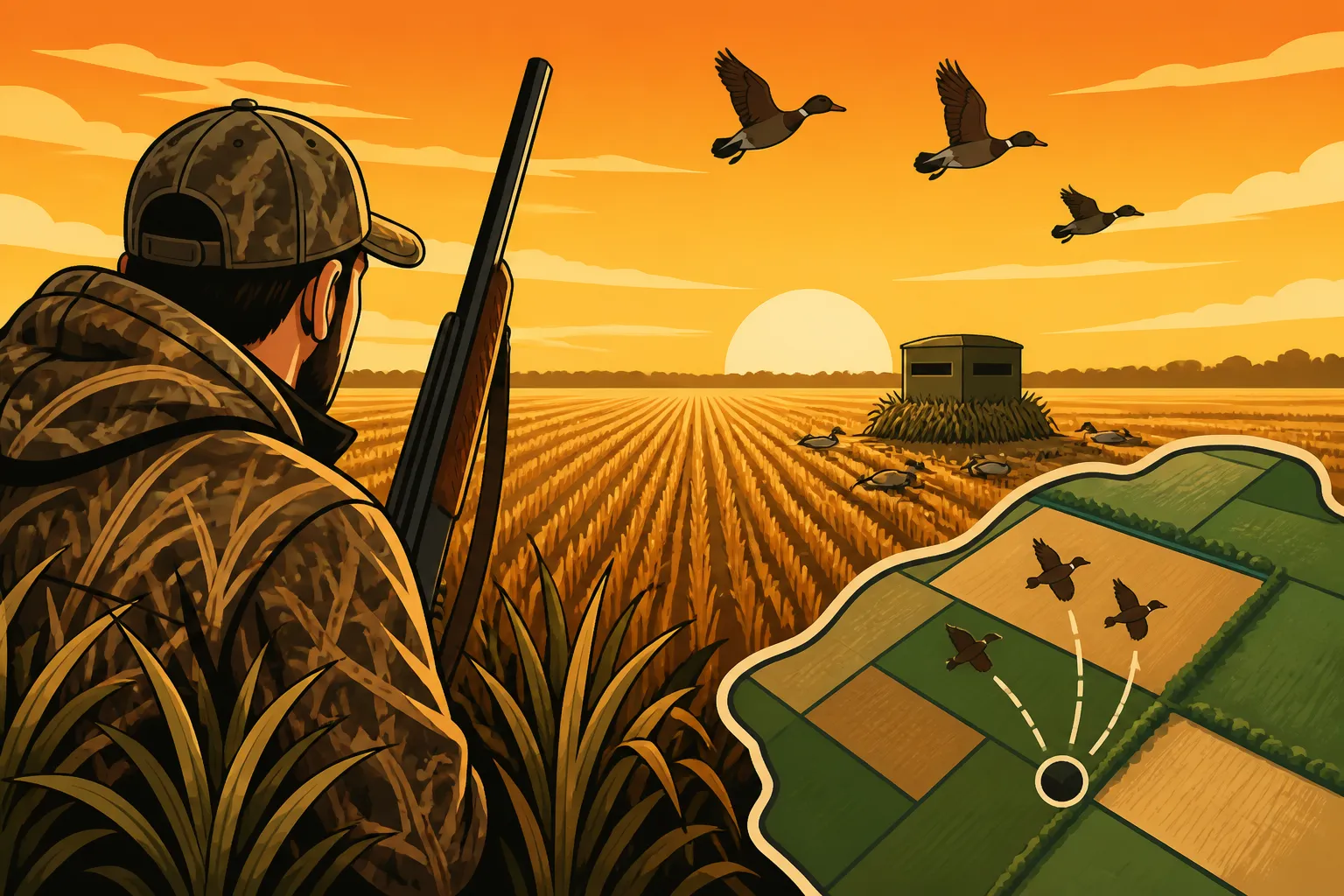
Decoy placement in a field is vastly different from a water spread. You’re trying to simulate birds feeding and resting on dry ground. For ducks, a common and effective strategy is to create a "U" or "J" shape, with the open end of the "U" facing directly into the prevailing wind. This forms a natural landing zone for incoming birds, as ducks and geese almost always land into the wind. Your layout blinds should be positioned at the "bottom" or closed end of the U, slightly downwind of the main body of decoys, giving you ideal shot opportunities as birds pitch into the landing zone.
Spacing is also key. Don't crowd your decoys. Field ducks and geese often spread out a bit when feeding. Giving them ample room makes your spread look more natural and relaxed. For a typical duck spread, 3-5 feet between decoys is a good starting point. For goose decoys, you might spread them out even further, 5-10 feet apart, mimicking their grazing behavior. If you’re hunting a mixed bag, consider separating your duck and goose decoys into distinct groups, perhaps with the goose decoys acting as a confidence spread further out, while the duck decoys are closer to your blinds. Using different types of decoys, like full-body feeders, sentinels, and even a few motion decoys, can add realism. On the Mobile-Tensaw Delta, it's not uncommon to see large groups of Canada geese mixed with specklebellies, so adjust your decoy ratios accordingly.
Achieving Superior Concealment
This is arguably the most crucial aspect of layout blind hunting. A layout blind, fresh out of the box, is just a piece of fabric. Its effectiveness depends entirely on how well you brush it in to match its surroundings. Your goal is to make it disappear completely. This means collecting local vegetation. If you’re in a corn stubble field, use corn stalks. If it’s soybean stubble, use that. If it’s winter wheat, use straw. Whatever the natural vegetation, cut it or gather it and weave it into the stubble straps and pockets on your blind.
Don't be shy with the brushing! Overdo it rather than underdo it. Pay particular attention to the edges of the blind and any areas where the fabric might be exposed. Break up the hard lines of the blind. Think about the shadow it casts; sometimes a little dirt or mud on the blind can help it blend in even better. Step back 20-30 yards and look at your setup from a bird’s eye view. Are there any shiny spots? Any unnatural angles? Do the colors match the field? This meticulous attention to detail is what separates a truly effective setup from one that flares birds consistently. Even with an excellent blind, like those from Avery Outdoors or Final Approach, the hunter's effort in brushing in is what seals the deal.
Working with the Wind and Sun
The wind is your best friend when hunting waterfowl in fields, dictating everything from decoy placement to the birds’ approach. As mentioned, ducks and geese almost always land into the wind. This means you want your decoy spread set up so the "kill hole" or landing zone is directly into the wind, with your blinds positioned downwind of that zone. This gives you the best shots as birds cup their wings and slow down for landing. Checking the wind direction on your GoHunt app or with a simple wind checker is one of the very first things you do when arriving at the field.
The sun, on the other hand, can be a trickier element. Ideally, you want the sun at your back, shining into the faces of the incoming birds. This not only makes it harder for them to see you, but it also lights up your decoys, making them more visible and realistic. Conversely, having the sun in your face can make it incredibly difficult to see incoming birds, forcing you to squint and potentially silhouetting you against the glare. If you can’t get the sun directly at your back, try to position yourself so it's at least off to one side. Sometimes, late in the day, if birds are working a different flight path, you might have to make a choice between perfect wind or perfect sun, and often the wind is the more critical factor for getting birds to commit. Remember, too, that Alabama Public Land Hunting Hours typically restrict shooting to specific periods around sunrise and sunset, so understand how those sun angles will change during your hunt.
Reading the Birds and Adapting Your Spread
You can have the most meticulously brushed-in blinds and the most realistic decoy spread, but if you don't understand what the birds are telling you, it's all for naught. Waterfowl hunting in farm fields is a dynamic game of observation, interpretation, and quick adjustments. Every circle, every flare, every hesitation has a meaning, and learning to read these signs is what turns an average hunter into a truly successful one.
Interpreting Flight Patterns and Landing Zones
When ducks and geese approach a field, they rarely commit directly on the first pass. They'll typically make several circles, often high above, assessing the situation. During these initial passes, pay close attention to their behavior. Are they looking intently at your spread? Are they swinging wide around a particular area? Are they showing interest in a spot outside your decoys? This information is critical. If they consistently flare at a certain point in their circle, there might be something wrong with your concealment in that direction, or perhaps a blind is silhouetted.
Watch for their landing intentions. Are they trying to land short of your spread, or just beyond it? Are they eyeing a particular wet spot or a patch of green growth? Sometimes, if birds consistently want to land in an area you didn't anticipate, it might be worth making a quick adjustment to your spread, even moving a few key decoys or adjusting your landing zone. This is a lot like Reading a Delta Slough for a Morning Flight – you're always looking for where the birds want to be, not just where you want them to be. The best hunters are those who adapt their plan to what the birds are actually doing, rather than stubbornly sticking to their original setup.
Calling Strategies for Field Geese and Ducks
Calling in an open field is different from calling in flooded timber or over open water. Sound travels further in open spaces, so your calls can be heard from a greater distance, but they also dissipate quickly. For geese, especially specklebellies and Canada geese, realistic calling is paramount. Short, sharp clucks and murmurs work well for feeding geese, while longer honks and moans can be used to grab distant birds' attention. For ducks, a series of comeback calls or pleading licks can be effective, especially on high, circling mallards. As the birds get closer, soften your calls. A soft greeting call or a feeding chuckle can be incredibly effective at the critical moment when birds are deciding whether to commit.
Don't overcall. Let the decoys do their job. If birds are locked up and working, sometimes the best call is no call at all. Just watch them, and only call again if they seem to be losing interest or drifting. A good strategy is to use louder calls to get their attention, then transition to softer, more contented calls as they work closer. If you have multiple callers in your group, coordinate your calling to sound like a realistic flock, with different voices and cadences. Remember, the goal is to sound natural and inviting, not like a blaring concert.
Adjusting Your Spread Mid-Hunt
One of the greatest benefits of layout blind hunting is the ability to adapt. If you've been sitting for an hour and the birds are consistently doing something unexpected—flaring at a certain spot, landing short, or only working one side of your spread—don't be afraid to make a change. This might mean moving a few blinds, shifting your landing zone, or even picking up and relocating your entire spread to a different part of the field. This is where the mobility of layout blinds truly pays off.
For example, if the birds are consistently trying to land in a shallow puddle 30 yards to your left, consider moving some of your duck decoys to that puddle and shifting a blind or two to accommodate. If the wind unexpectedly shifts, you absolutely must adjust your spread to keep the landing zone into the wind. This might mean a complete re-do of your decoy pattern. It can be a pain, especially in cold weather, but it will dramatically increase your success rate. A hunter who is willing to get out of the blind, observe, and adapt their setup based on what the birds are telling them will consistently out-hunt those who stick rigidly to their initial plan.
Essential Gear and Preparation for Delta Field Hunts
Success in layout blind hunting in Alabama’s Delta farm fields isn't just about strategy; it's also about having the right tools for the job and preparing adequately for the often challenging conditions. From choosing the right blind to dressing for the weather, every piece of gear and every bit of preparation contributes to a safer, more comfortable, and ultimately more successful hunt.
Choosing the Right Layout Blind
The market offers a wide variety of layout blinds, and choosing the right one can significantly impact your comfort and effectiveness. Key features to consider include durability, ease of setup and takedown, comfort, and how well it brushes in. Brands like Avery Outdoors, Final Approach, and Rogers Sporting Goods offer excellent options that are popular with serious waterfowl hunters. Look for blinds with a sturdy frame, good back support (you'll be in it for hours!), and plenty of stubble straps or loops for attaching natural vegetation.
Size and weight are also important, especially if you have to walk a significant distance to your field. Some blinds are more compact and lighter, ideal for mobile hunters, while others offer more room and features but come with added bulk. Consider the color and camouflage pattern as well; most blinds come in neutral earth tones that can be customized with local vegetation. Some even feature "flagging ports" for working a motion flag to attract distant birds. Think about how much gear you typically bring; some blinds have more internal storage pockets than others, which can be a real convenience for calls, shells, and snacks.
Decoy Spreads for Delta Fields
For field hunting, you'll want to prioritize full-body decoys or at least high-quality shell decoys that offer a realistic silhouette. Silhouettes or "Sillosocks" are also very effective, especially for geese, as they're lightweight and highly portable, allowing you to deploy a massive spread without breaking your back (or the bank). For ducks, full-body feeders are a must, along with some sentinels and active poses. For geese, a mix of feeders and upright sentinels creates a natural look. Consider adding a few specialized motion decoys, such as a "flapper" or a motorized spinning-wing decoy (where legal and appropriate for the species) to add lifelike movement.
Here’s a look at common decoy spread types and their ideal uses in Delta farm fields:
| Spread Type | Description | Ideal Use | Key Advantage |
|---|---|---|---|
| U-Shape/J-Hook | Decoys form a U or J shape, with the opening facing into the wind. Blinds typically at the "bottom" or "hook" of the J. | Standard for ducks and geese. Creates a clear, inviting landing zone. | Directs birds to a specific, controlled landing spot for optimal shots. |
| V-Shape | Decoys form a V, with the point into the wind. Blinds hidden at the base of the V. | Often used for geese or larger duck species, simulating an approaching flock. | Guides birds along a flight path and into the pocket. |
| X-Pattern | Two lines of decoys intersecting, creating four distinct "arms." Blinds often in the center or outside the intersection. | Good for large fields with varied wind directions or where birds might approach from multiple angles. | Offers multiple landing zones and appears as a larger, more active spread. |
| Blob/Cluster | Decoys are grouped tightly together, with open pockets around the edges. Blinds hidden within or near pockets. | Simulates a resting or concentrated feeding flock. Often used for shy birds or late season. | Natural appearance, can be effective for wary birds or smaller groups. |
| Dispersed Feed | Decoys scattered widely and randomly across a large area. Blinds hidden among them. | Best for very large fields where birds are spread out, especially geese. | Mimics large feeding flocks, looks less "set up" to educated birds. |
Remember to use dark colors for goose decoys against light stubble, and vice-versa, to create contrast and make them stand out. Don't forget about adding a few oversized decoys (magnum size) for added visibility from afar.
Clothing, Calls, and Accessories
Hunting in Alabama’s Delta can expose you to a wide range of weather conditions, from frosty mornings to unexpectedly warm afternoons, often with significant wind chill. Dressing in layers is absolutely crucial. Start with a moisture-wicking base layer, add insulating middle layers (fleece or down), and top it off with a waterproof and windproof outer shell in a good camouflage pattern. Don't forget insulated, waterproof boots, gloves, and a warm hat. Even if the forecast calls for mild weather, the wind whipping across an open field can drop the effective temperature significantly.
For calls, have a versatile duck call (like a double-reed mallard call) and at least one good goose call (specklebelly or Canada, depending on your target). Practice your calling before the season! Other essential accessories include plenty of shotgun shells (steel shot, appropriate for waterfowl, usually 3-inch or 3.5-inch with BB, #1, or #2 shot sizes), a reliable headlamp for setting up in the dark, a thermos of coffee or hot chocolate, snacks, and a sturdy decoy bag. Many hunters also carry a small shovel or a de-mudding tool for their boots if the fields are wet. Don't forget your hunting license, state and federal duck stamps, and Alabama Migratory Bird Certification, which are all legally required for waterfowl hunting in Alabama.
Disclaimer
This article is intended for informational purposes only and does not constitute legal advice. Hunting regulations in Alabama can change, and it is the hunter's sole responsibility to be aware of and comply with all current local, state, and federal laws and regulations. Always refer to the official Alabama Department of Conservation and Natural Resources (ADCNR) regulations before planning any hunt.