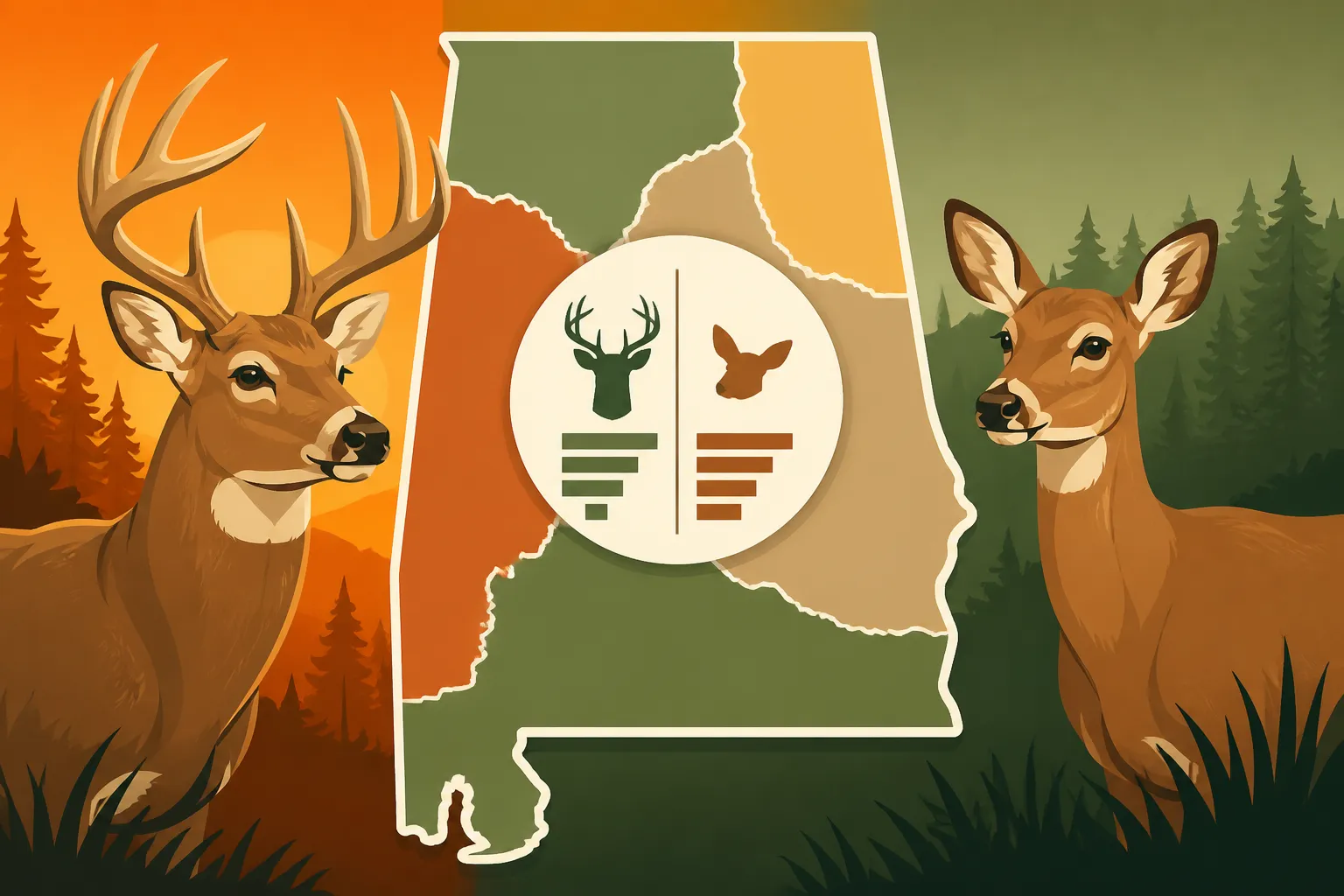
Alabama Buck-to-Doe Ratio by Region
For many Alabama hunters, there's a quiet frustration that comes from not truly understanding the deer herd they pursue. You might be seeing plenty of does, or maybe you're just not encountering those mature bucks you hoped for. This guide aims to demystify one of the most crucial elements of deer management and hunting success in our state: the buck-to-doe ratio, and how it varies across Alabama's diverse regions, giving you a clearer picture of what to expect and how to adapt.
What Exactly Is a Buck-to-Doe Ratio and Why It Matters for Alabama Hunters
When we talk about the buck-to-doe ratio, we're simply referring to the number of antlered bucks for every doe in a given deer population. For instance, a 1:2 ratio means there's one buck for every two does. On the surface, it might seem like just another biological statistic, but for serious deer hunters and land managers, this ratio is a fundamental indicator of herd health, rut intensity, and ultimately, your chances of a successful hunt.
A balanced buck-to-doe ratio, ideally somewhere between 1:1 and 1:3, is the holy grail for healthy deer populations. When the ratio is heavily skewed – say, 1:10 or more does per buck – it can lead to a host of problems. Does might be bred later in the season, resulting in fawns born later and potentially less equipped to survive their first winter. The breeding season itself can become drawn out and less intense, making it harder for hunters to pattern and intercept bucks during the peak rut. You might see a lot of deer, but the quality of the herd, both in terms of age structure and antler development, can suffer significantly.
Conversely, a more balanced ratio generally translates to a more vibrant and predictable hunting experience. Bucks are under more competitive pressure to breed, which means more intense rut activity, more daytime movement, and more aggressive responses to calling and rattling. Does are bred efficiently, leading to earlier fawn drops and healthier offspring. It's a win-win: a healthier herd for the long term and a more exciting, productive hunting season for us. Understanding this foundational principle is the first step toward becoming a more effective deer hunter in Alabama. You can often see the difference clearly when comparing observations from areas known for balanced populations versus those with heavy doe numbers.
Exploring Alabama's Diverse Regional Buck-to-Doe Ratios
Alabama is a large and geographically varied state, and just like our landscapes, our deer populations and their buck-to-doe ratios aren't uniform. What you might encounter in the fertile fields of the Black Belt can be vastly different from the dense pine forests of the Coastal Plain or the rugged mountains up north. Each region presents its own set of challenges and opportunities, largely shaped by habitat quality, hunting pressure, and local management practices.
The Black Belt: Often Closer to Ideal Ratios
The Black Belt region, stretching across central Alabama, is often considered the deer hunting Mecca of the state. Characterized by rich soils and diverse agriculture, this area provides prime habitat for whitetails. Here, you'll often find private land managers actively working to maintain healthier, more balanced buck-to-doe ratios. They understand that a 1:2 or even 1:1.5 ratio means stronger rut activity and older, healthier bucks. These landowners frequently implement selective harvest strategies, focusing on removing a significant number of does and allowing young bucks to mature. The result is often an impressive age structure and intense rut behavior that every hunter dreams of. Hunters on well-managed properties in the Black Belt may observe more consistent rutting activity, with mature bucks chasing does more frequently during daylight hours. Why the Black Belt Grows Big Bucks is a testament to this focused management. Tools like the GoHunt mapping platform, which often shows land ownership, can help identify these managed tracts, though actual ratio data usually comes from direct observation or harvest records.
North Alabama Mountains and Public Lands: Variable Ratios
As you move into the mountainous terrain of North Alabama, including areas like the Talladega and William B. Bankhead National Forests, the story can change quite a bit. Public lands, while offering extensive access, often face higher hunting pressure, especially on bucks. This can sometimes lead to more skewed ratios, where does outnumber bucks by a larger margin. The challenge on these public tracts is that individual hunters aren't necessarily managing the overall herd, and often, hunters are primarily focused on harvesting any legal deer. Habitat can also be more rugged, with fewer agricultural food sources, leading to different deer densities. While there are still good bucks to be found, hunters on public land might need to adapt their strategies, understanding that rut activity might be spread out due to a higher number of unbred does or that older bucks are simply harder to find in dense cover with higher pressure. Scouting these areas thoroughly is paramount, and using public land maps to identify overlooked pockets is key. Talladega National Forest Hunting and William B. Bankhead National Forest Hunting are great resources for understanding these areas.
South Alabama's Coastal Plain and Wiregrass: Later Rut, Diverse Ratios
Down in the Coastal Plain and Wiregrass regions of South Alabama, the buck-to-doe ratio picture is again distinct. These areas typically feature extensive pine plantations, mixed forests, and some agricultural fields. The rut often occurs later here compared to the Black Belt, and ratios can vary widely. On well-managed private properties, landowners may strive for balanced ratios, similar to the Black Belt, though perhaps with different management goals. However, in areas with less intensive management or higher localized pressure, you might find more skewed ratios. The later rut means bucks are breeding later, and the intensity of that breeding activity can be influenced by the buck-to-doe ratio. A heavy doe population can mean a prolonged, less dramatic rut, making it more challenging to predict peak buck movement. Hunters in this region often rely heavily on food sources and understanding deer patterns throughout the extended season. Hunting South Alabama's Wiregrass Region offers more insights into this unique hunting environment.
The Science Behind Managing Alabama's Deer Ratios
Understanding the buck-to-doe ratio isn't just about observation; it's about active management, both by state agencies and by individual landowners. The Alabama Department of Conservation and Natural Resources (ADCNR) plays a crucial role in monitoring and providing recommendations, while private land managers have the most direct impact on the deer on their property. This collaborative effort helps shape the deer herds we hunt across the state.
How ADCNR Tracks the Numbers
Alabama's wildlife biologists rely on several key methods to estimate deer populations and, by extension, approximate buck-to-doe ratios. One of the most critical tools is the mandatory Alabama Deer Reporting Rules through the Game Check system. Every harvested deer provides valuable data on sex, date, and location, giving biologists a snapshot of harvest patterns. While Game Check primarily reflects harvest, long-term trends can indicate shifts in population structure. Additionally, ADCNR conducts spotlight surveys, where they drive designated routes at night, counting and classifying deer. These surveys offer direct observation data, providing insights into general densities and ratios in specific areas. On Wildlife Management Areas (WMAs), more intensive data collection occurs, including hunter harvest surveys, biological check stations, and often, staff observations from consistent patrols. This detailed data helps guide management decisions for specific WMAs. How ADCNR Counts the Alabama Deer Herd goes into greater detail on these methods.
The Role of Antlerless Harvest in Ratio Management
The most effective tool for managing buck-to-doe ratios is the strategic harvest of antlerless deer. When a ratio becomes skewed, meaning there are too many does for the available bucks, increasing the antlerless harvest is typically the primary recommendation. By reducing the number of does, managers can bring the ratio closer to that desired 1:1 to 1:3 range. This reduces competition for resources, leads to healthier does, and allows bucks to exert more competitive pressure during the rut. On private lands, this is a decision often made by the landowner or hunting club. They might set specific quotas or guidelines for doe harvest, sometimes informed by professional wildlife biologists. Many land managers use sophisticated mapping and analysis tools, like those found on GoHunt, to help visualize their property and track harvest data, making informed decisions on doe removal. For instance, in areas with abundant does, a manager might encourage hunters to fill multiple Filling Two Unantlered Tags in Zone A to help balance the herd.
Challenges and Influences on Public vs. Private Land
The ability to manage buck-to-doe ratios effectively differs significantly between private and public lands. On private land, owners have the autonomy to implement detailed harvest strategies, habitat improvements, and even supplemental feeding programs, all of which influence herd dynamics. This focused management is why some private properties consistently produce older bucks and exhibit strong rut activity. On public lands, however, management is broader. While ADCNR strives for healthy herds, the sheer volume of hunters and diverse hunting goals make precision management challenging. Public land regulations, such as antler-point restrictions or specific antlerless season dates, are designed to manage the herd on a larger scale. Hunters on public land often face higher pressure, which can make it harder for bucks to reach older age classes. Understanding these inherent differences is crucial for setting realistic expectations and tailoring your approach, whether you're hunting a well-manicured private lease or venturing deep into a national forest.
Adapting Your Hunting Strategy to Local Buck-to-Doe Dynamics
Knowing the buck-to-doe ratio in your hunting area isn't just academic; it's practical intelligence that can dramatically influence your hunting strategy. Whether you're targeting a mature buck or looking to contribute to sound deer management by taking a doe, understanding the local dynamics puts you a step ahead.
How to Gauge the Ratio in Your Hunting Area
While official statistics might be available for WMAs or large private properties, it's often up to individual hunters to gauge the buck-to-doe ratio in their specific hunting spots. The best way to do this is through consistent observation. Utilize trail cameras year-round, paying attention to how many different bucks and does you photograph. Keep a log of deer sightings while scouting and hunting, noting the sex of each animal. Talk to local landowners, game wardens, and experienced hunters in the area – their cumulative knowledge is invaluable. Applications like GoHunt provide valuable mapping tools that, while not directly showing ratios, can help you identify high-potential areas where you might conduct your own observations. If you consistently see many does and only young, small-antlered bucks during the rut, chances are your ratio is skewed. Conversely, seeing a good mix of mature bucks and fewer does suggests a healthier, more balanced population.
Strategies for a Balanced Ratio Area (Closer to 1:1 or 1:2)
If your hunting area boasts a balanced buck-to-doe ratio, you're in a prime position to experience a dynamic and intense rut. In these areas, bucks face competition for breeding opportunities, which often makes them more aggressive and prone to daylight movement.
- Rut Focus: Plan your hunts around the peak rut timing for your specific When the Alabama Rut Peaks by Zone. During this period, rattling, grunting, and even doe bleats can be incredibly effective as bucks are actively seeking and competing for does.
- Travel Corridors: Concentrate on pinch points, funnels, and transition zones between bedding and feeding areas. Bucks will be covering a lot of ground in search of does, and these travel routes become hotbeds of activity.
- Stand Placement: Consider setting up stands that offer visibility over scrapes and rub lines, which often intensify during a strong rut. Look for areas with fresh sign indicating buck activity.
- Patience: With a balanced ratio, mature bucks are more likely to make a mistake during the rut. Be patient and consistent in your efforts. Rattling and Grunting in Alabama can be especially effective in these settings.
Strategies for a Skewed Ratio Area (Many Does, Few Bucks)
Hunting an area with a heavily skewed buck-to-doe ratio can be more challenging for trophy buck hunters, but it’s still entirely possible to be successful and contribute to herd health. In these situations, the rut might be less intense and more prolonged, as there are fewer bucks to breed a large number of does.
- Food Source Focus: Bucks will still need to eat! Focus your efforts on primary food sources, especially those preferred by does, as bucks will eventually show up to check for receptive females. Think green fields, acorn flats, or agricultural fields.
- Late Season Opportunity: A prolonged rut in a skewed ratio area can mean that some does are bred much later. This can sometimes lead to renewed buck activity well after what's considered the "peak" rut in other regions. Don't give up on the late season, especially around key food sources.
- Cover and Seclusion: Mature bucks in high-pressure, skewed-ratio areas are often very reclusive. They've learned to avoid pressure. Hunt thick cover, remote pockets, and areas that other hunters overlook. GoHunt's satellite imagery can help you identify these untouched spots. Finding Ground Others Walk Past is crucial here.
- Doe Harvest: To contribute to herd health and improve the buck-to-doe ratio over time, consider harvesting antlerless deer if your tags allow. This is a direct way to help balance the population and improve future hunting opportunities. Filling Two Unantlered Tags in Zone A is a prime example of management through harvest.
- Scouting is King: In areas where bucks are fewer and smarter, your scouting efforts need to be top-notch. Look for subtle signs, fresh tracks, and use trail cameras strategically to pattern individual bucks. Understanding individual deer movement can be more productive than relying on general rut patterns.
Ultimately, whether you're hunting in the rich Black Belt or the rugged mountains, adapting your approach based on the local buck-to-doe ratio is a hallmark of an informed and successful Alabama hunter.
Disclaimer
This article is for general informational purposes only and does not constitute professional advice. Laws, prices and regulations vary by location and change over time. Consult a qualified professional for guidance on your specific situation.