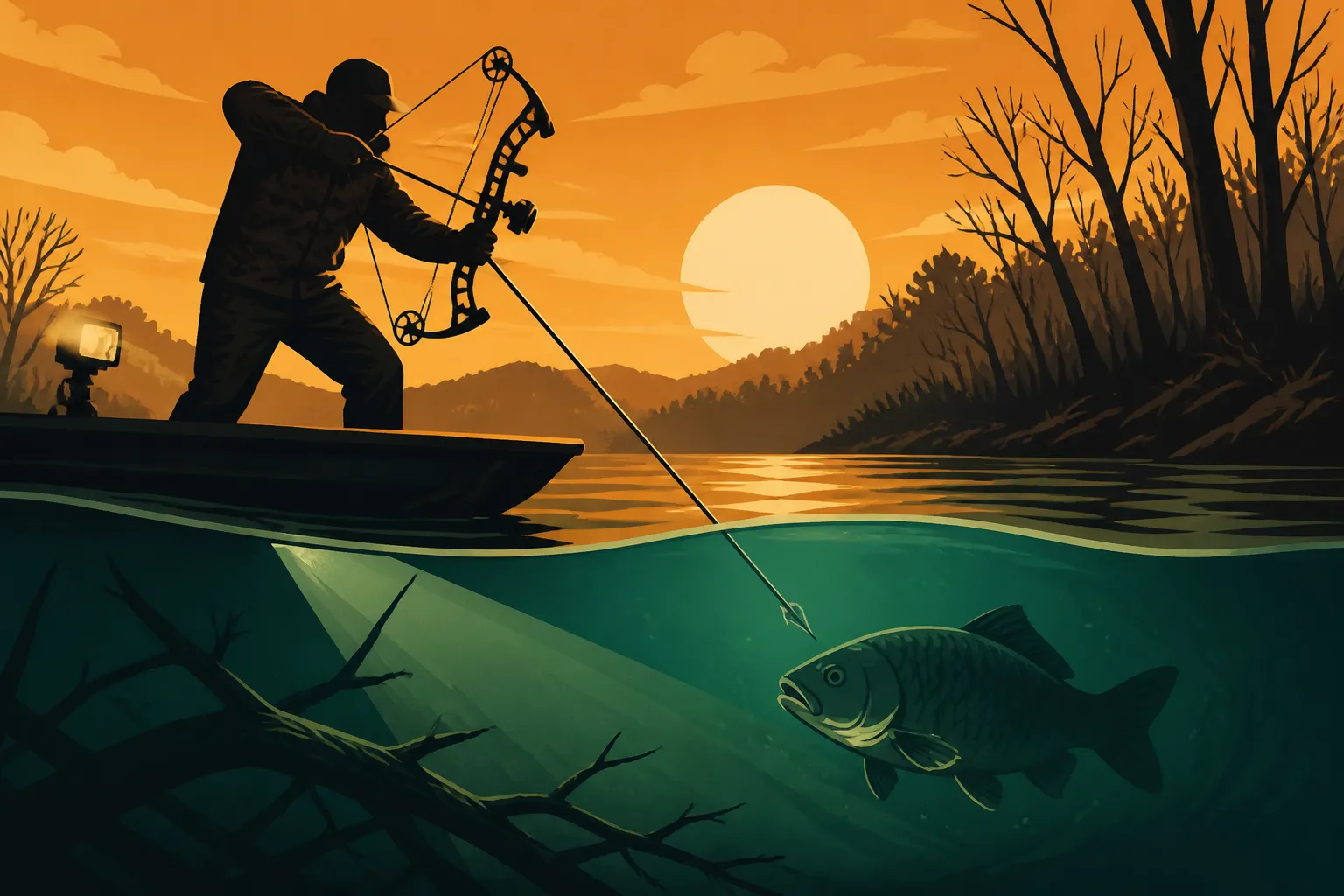
Bowfishing Alabama Rivers in the Off-Season
When deer and turkey seasons close, many of us Alabama hunters find ourselves staring at the calendar, feeling that familiar ache for outdoor action. That's where bowfishing comes in – it’s an exhilarating way to stay connected to the thrill of the hunt, hone your archery skills, and harvest some often-underappreciated fish species from our abundant rivers and lakes, all during the perceived "off-season." This guide will walk you through everything you need to know to get started in bowfishing Alabama's fantastic waterways.
Why Bowfishing Fills the Off-Season Void
For dedicated hunters, the quiet months after deer and turkey season can feel like an eternity. The woods might be beautiful, but that primal urge to pursue game is still very much alive. Bowfishing offers a unique and thrilling way to satisfy that craving, providing year-round action that's unlike anything else.
Beating the Post-Season Blues
Let's be honest, there's nothing quite like the rush of a big buck slipping through the timber or a gobbler answering your call at sunrise. But when the last legal shooting light fades and those seasons wrap up, a definite void can set in. You start thinking about Shed Hunting on Alabama Public Land or maybe just scouting for next year’s Hunting the Rut in the Southern Zones. Bowfishing, though, isn't just a placeholder; it's a legitimate, adrenaline-pumping sport in its own right. It requires a keen eye, quick reflexes, and a steady hand, much like traditional hunting. The anticipation of spotting a massive gar cruising in shallow water, drawing your bow, and making that perfect shot can absolutely rival the excitement of a whitetail encounter. It keeps your archery muscles tuned and your hunting instincts sharp, preventing that disheartening slump.
Year-Round Action and Opportunity
One of the biggest advantages of bowfishing in Alabama is that the action never truly stops for many species. Unlike the strict, limited seasons for deer, turkey, or even Alabama Waterfowl Zones and Seasons, many of the prime bowfishing targets—like various species of gar, carp, and buffalo—are considered rough fish and can be harvested year-round. This means no more counting down the days until October or March; you can hit the water almost any time the mood strikes and the weather cooperates. This constant availability makes it an ideal pursuit for those who simply can't get enough time in the field or on the water. Whether it's a warm winter afternoon or a sultry summer night, the opportunities are there for the taking.
A Different Kind of Challenge
Bowfishing isn't just "archery for fish"; it presents a unique set of challenges that distinguish it from terrestrial hunting. The primary hurdle is light refraction. Water bends light, making fish appear shallower than they actually are. This means you can't aim directly at what you see; you have to aim low, often significantly so, depending on depth and distance. Mastering this visual distortion takes practice, patience, and a bit of mental recalibration. Add to that the constant movement of fish, the glare on the water, and sometimes the currents of our big Alabama rivers, and you've got a sport that demands a blend of precision, quick thinking, and adaptability. It’s a fantastic way to develop new skills and enjoy a fresh perspective on our state's rich aquatic resources.
Gear Up for Alabama Bowfishing
Just like any specialized hunting or fishing pursuit, bowfishing requires specific equipment to be safe, effective, and fun. You can't just grab your deer bow and head to the river; a dedicated setup will make all the difference.
Essential Bow Setup for the Water
When it comes to the bow itself, many options work well. You can use a compound bow, often one with a lighter draw weight (30-50 lbs is common) since you'll be shooting many arrows and short distances. Recurve bows are also very popular for their simplicity and quick-shooting capability. Some companies even make dedicated bowfishing bows that are super lightweight and designed for quick shots. The most critical component for bowfishing, however, is the reel. You'll typically choose between two main types:
- Spincast Reels: These are essentially modified fishing reels mounted directly to your bow. They're easy to use, familiar to most anglers, and allow for quick retrieves. The key is to always push the button to release the line before shooting, or you'll have a tangled mess and potentially a ruined arrow.
- Bottle/Retriever Reels: These are specialized bowfishing reels that house the line in a bottle or canister. They offer smoother line release and retrieval, less tangling, and usually more line capacity. Brands like AMS Bowfishing and Cajun Archery are popular choices for these types of setups.
Arrows for bowfishing are also distinctive. They are solid fiberglass, heavier than hunting arrows, and lack fletching (or have minimal, stiff fletching) because they don't need to spin for accuracy underwater. Instead of a field point or broadhead, they have a barbed point designed to penetrate the fish and hold it securely. A safety slide system is crucial on your arrow, keeping the line in front of your bow and preventing it from tangling in the string or cables.
Boat and Lighting Considerations
While you can certainly bowfish from shore or wade in shallow areas, a boat opens up a world of possibilities, especially for night bowfishing, which is incredibly popular and effective.
- Jon Boats and Airboats: A flat-bottomed jon boat is a common choice, offering stability in shallow water and a good platform. For serious shallow-water, obstacle-ridden areas like the Mobile-Tensaw Delta, an airboat is king, though they are a significant investment.
- Shooting Platforms: Many bowfishing boats are customized with raised shooting platforms on the bow. These platforms get you higher above the water, which helps immensely with seeing fish and reducing the effects of refraction.
- Lights for Night Hunting: This is where night bowfishing truly shines. Powerful, bright lights (often LED or halogen) are mounted on the boat to illuminate the water. These lights penetrate the surface, making it easy to spot fish lurking in the shallows. Generators are typically used to power these extensive lighting setups. When you’re Night Hunting Hogs With Lights on Private Land, you know how game-changing good illumination can be; it’s no different for fish.
Must-Have Accessories
Beyond the main gear, a few accessories will make your bowfishing trip safer and more productive:
- Polarized Sunglasses: Absolutely essential for day bowfishing to cut glare and help you spot fish.
- Line Cutters: A sharp knife or dedicated line cutter is a must for quickly cutting lines if you get snagged or tangled.
- Fish Holders/Stringers: A sturdy stringer or a large cooler to hold your harvested fish. Some bowfishers use specialized fish buckets that bolt to the boat.
- Safety Gear: Life jackets, navigation lights if boating at night, and a first-aid kit are paramount.
- Gloves: Can protect your hands from line burns and fish scales.
- GoHunt Account: While GoHunt is typically geared toward big game hunting, many of the navigational tools and map overlays for public land access can be invaluable for finding suitable launch points and understanding the topography of river systems and lakes, even if you’re only looking for areas good for rough fish. It's always good to have the most current mapping data.
Prime Alabama Waters for Bowfishing
Alabama is blessed with an incredible network of rivers, lakes, and coastal estuaries, offering a diverse array of bowfishing opportunities. Knowing where to go and what species to target can significantly increase your success.
Major Rivers and Their Best Targets
Alabama's vast river systems are often teeming with rough fish, making them prime bowfishing grounds.
- Alabama River: This majestic river, especially its middle and lower stretches, is fantastic for longnose gar, spotted gar, and common carp. The numerous oxbows, backwaters, and shallow flats are ideal hunting grounds.
- Tennessee River: In North Alabama, the Tennessee River and its chain of lakes (like Wheeler, Guntersville, Wilson) offer superb action for buffalo, common carp, and various gar species. The flats and shallow embayments, particularly where feeder creeks enter, can hold large numbers of fish. When you’re thinking about Hunting the Tennessee River Delta for Waterfowl, remember that those same nutrient-rich waters also hold some monster fish beneath the surface.
- Mobile-Tensaw Delta: This immense, intricate delta system near Mobile is a bowfishing paradise. Its labyrinth of sloughs, bayous, and shallow bays is renowned for massive alligator gar, along with abundant longnose and spotted gar. The sheer wildness and productivity of this area are legendary. Public access here, much like Mobile-Tensaw Delta Public Hunting Ground for ducks, can be found via numerous boat ramps.
- Coosa and Tallapoosa Rivers: These central Alabama rivers, and the lakes they form (Lay Lake, Logan Martin Lake, Lake Martin, Lake Jordan), have healthy populations of carp and various gar species, particularly in their shallower arms and coves.
Lake and Reservoir Hotspots
Beyond the major rivers, many of Alabama's large reservoirs also offer phenomenal bowfishing, especially in their shallower sections.
- Lake Guntersville: Famous for bass, but also a hotspot for carp and buffalo, particularly in the sprawling shallow flats and lily pad fields. Night bowfishing here can be phenomenal.
- Lake Eufaula: On the Georgia border, Lake Eufaula (the "Big Bass Capital of the World") is also excellent for carp and gar, especially in its extensive shallow creek arms and shoreline vegetation.
- Inland Lakes (smaller): Don't overlook smaller, local lakes and even large ponds. Many private and public lakes not only have bass but also hold healthy populations of carp and sometimes smaller gar species, offering more accessible bowfishing. Always ensure you have the necessary permissions for private waters.
Seasonal Movements and Best Times
Understanding the seasonal movements of fish is key to consistent bowfishing success.
- Spring Spawn: This is often considered the prime time. As water temperatures rise in spring (typically March to May), carp, buffalo, and some gar species move into extremely shallow water to spawn. They become highly concentrated and relatively oblivious, offering fantastic shooting opportunities. Look for murky, agitated water in shallow coves, bays, and flooded vegetation.
- Summer Nights: Once the spawn is over and water temperatures really heat up, many fish move to deeper, cooler water during the day. However, they'll often venture into the shallows to feed at night, making summer nights (especially with a good lighting setup) incredibly productive. Target vegetated shorelines and flats.
- Fall: As temperatures cool, fish activity can pick back up as they feed heavily before winter. You might find them in shallower water during the day, similar to spring, though often less concentrated.
- Winter: Bowfishing can still be done in winter, though success rates may drop. Fish are less active and often hold in deeper channels or thermal refuges. Look for warmer, sunny days when fish might move shallower to warm up.
Remember, a current Alabama Hunting Licenses and What They Cost or Alabama All-Game Versus Small-Game License is usually sufficient for bowfishing, but always double-check the latest regulations from the Alabama Department of Conservation and Natural Resources (ADCNR) to ensure you're compliant.
Mastering Bowfishing Techniques for Success
Bowfishing isn't just about pulling the string and letting fly. There are nuances, especially when dealing with water, that can drastically impact your hit rate.
Aiming for Refraction: The Science of Shooting Fish
This is arguably the most critical skill to master in bowfishing, and it trips up almost every beginner. When you look at an object in water from above, the light bending (refraction) makes the object appear to be in a different position than it actually is. Specifically, fish appear shallower than they truly are. If you aim directly at the fish you see, your arrow will fly over its back every single time.
The rule of thumb is: Aim low.
How low? It depends on several factors:
- Depth of the fish: The deeper the fish, the more pronounced the refraction, and the lower you need to aim.
- Distance to the fish: The farther away the fish, the more the angle of your shot changes, and the more you need to compensate.
- Angle of your shot: Shooting straight down (from a raised platform, for example) reduces refraction effect slightly compared to a long, flat shot.
It takes practice. Many seasoned bowfishers use a "hold under" approach, aiming at the belly or even below the fish. Some even use a "Kentucky windage" type of estimation, constantly adjusting based on conditions. Don't get discouraged if your first few dozen shots miss; it's a learning curve unique to bowfishing. Consistent practice will build that muscle memory and visual estimation.
Night vs. Day Tactics
The time of day can dramatically change your bowfishing approach.
- Daytime Tactics: When the sun is up, stealth and observation are key. Using high-quality polarized sunglasses is non-negotiable for cutting glare and seeing into the water. You'll often be sight-fishing for individual fish or small groups. Wade slowly in shallow areas or use a trolling motor on your boat to quietly approach. Look for subtle signs like fin tips breaking the surface, muddy water from feeding fish, or ripples in still coves. Your shots will generally be reaction-based, as fish can spook easily in daylight. Remember that fish in clear, shallow water can be highly visible but also incredibly wary.
- Nighttime Tactics: This is where the magic often happens. The darkness combined with powerful boat lights creates a unique advantage. Fish are often less spooky under lights and will hold in the shallows to feed or rest. The lights effectively eliminate surface glare and allow you to see fish that would be invisible during the day. The ideal conditions are calm, clear nights. You'll slowly cruise the shallows, shining your lights ahead, looking for the tell-tale shapes of carp, buffalo, or gar. The intensity of the light can mesmerize some fish, giving you more time for a shot. Night bowfishing is generally more productive for sheer numbers of fish, though it requires a more specialized boat setup.
Approaching and Spotting Fish
Whether day or night, how you approach and spot your quarry is crucial.
- Stealth is Key (Day): For daytime bowfishing, move slowly and quietly. Use a trolling motor at its lowest setting, or paddle/pole your boat. Avoid sudden movements or loud noises that can send fish scattering.
- Reading the Water: Look for anomalies. A ripple in glassy water, a subtle swirl, a flash of scales, or even a column of bubbles can all indicate a fish is present. In murky water, look for mud trails left by feeding carp or the distinctive "rolls" of gar taking a gulp of air.
- Scanning with Lights (Night): At night, constantly scan the illuminated water, paying close attention to the edges of the light beam. Fish often prefer to lurk just outside the brightest zone. Look for the distinct outline of a fish or their eyes reflecting the light.
- Patient Pursuit: Sometimes you'll spot a fish at the edge of range. Instead of a hurried shot, try to slowly and deliberately close the distance if conditions allow. A closer, more confident shot with less refraction to consider is always better. Patience can lead to bigger fish and fewer missed arrows.
Rules, Regulations, and Ethical Considerations
While bowfishing for rough fish generally has fewer restrictions than hunting traditional game species, it's vital to know and follow Alabama's specific rules to ensure you're hunting legally and ethically.
Alabama's Bowfishing Regulations
The Alabama Department of Conservation and Natural Resources (ADCNR) sets the rules for all hunting and fishing activities in the state. For bowfishing, generally:
- Licenses: You will need a valid Alabama fishing license. If you hold an Alabama Resident All-Game License Cost for hunting, it typically covers fishing as well. Non-residents will need a non-resident fishing license. Always carry proof of your license while on the water.
- Legal Species: Common carp, grass carp (sterile varieties), bighead carp, silver carp, buffalo (various species), longnose gar, spotted gar, shortnose gar, and alligator gar are typically legal bowfishing targets. Species like largemouth bass, crappie, catfish, and other sport fish are not legal to harvest with a bow. Make sure you can correctly identify your target before shooting.
- Time of Day/Year: Most rough fish can be bowfished year-round, day or night. There are usually no closed seasons or time-of-day restrictions for these species, unlike the specific Alabama Zone 1 Turkey Season Rules or deer season dates.
- Carcass Movement Restrictions: If you're bowfishing in or near the Which Counties Sit in Alabama's CWD Zone, there might be specific rules about transporting fish carcasses out of the area, though this is primarily geared towards deer. It’s always best to be informed on local rules.
It's always a good idea to consult the current Alabama Hunting and Fishing Digest, available online through Outdoor Alabama, before each trip. Regulations can change, and staying informed is your responsibility.
Responsible Harvest and Disposal
Ethical bowfishing extends beyond just following the law; it's about respecting the resource and other users.
- No Waste: Don't shoot fish you don't intend to harvest or dispose of properly. While rough fish aren't typically considered table fare by everyone, many species like carp and buffalo are excellent to eat when prepared correctly. There are numerous recipes for smoking, grinding into patties, or frying. If you don't plan to eat them, consider offering them to others who will, or utilizing them as fertilizer if you have a garden.
- Proper Disposal: If you must dispose of fish, do so responsibly. Never simply dump carcasses near boat ramps, public access points, or residential areas. This can create public nuisances, attract scavengers, and reflect poorly on the bowfishing community. Dig a hole away from waterways and bury them, or package them for proper garbage disposal. In rural areas, some people will dispose of them deep in wooded areas where they can naturally decompose.
- Minimize Suffering: Once a fish is shot, retrieve it quickly and dispatch it humanely. A swift blow to the head is usually sufficient.
Respecting Other Water Users
Alabama's waterways are shared by a diverse group of users: anglers, recreational boaters, kayakers, swimmers, and homeowners. As a bowfisher, it's crucial to be a good steward and neighbor.
- Anglers: Give traditional anglers a wide berth. Avoid running your boat (especially if it's loud like an airboat) or shining bright lights too close to their fishing spots. Their pursuit often relies on quiet and minimal disturbance.
- Recreational Boaters/Paddlers: Be mindful of traffic lanes and common recreational areas. Avoid creating hazards with your boat or gear.
- Private Property: Always respect private property boundaries. Ensure you have permission if you're bowfishing near private docks, land, or impoundments. Trespassing, even on the water's edge, can lead to negative perceptions and potential legal issues. Knowing Alabama Trespass and Permission Law is important even when on public waterways adjacent to private land.
- Noise and Lights: While powerful lights are part of night bowfishing, be considerate of shore-side residents. Avoid excessive noise or shining lights directly into homes.
By acting responsibly, you help ensure that bowfishing remains a respected and enjoyable sport for all in Alabama.
Disclaimer
Always consult the most current regulations from the Alabama Department of Conservation and Natural Resources (ADCNR) before engaging in any hunting or fishing activity. Regulations can change, and it is the individual's responsibility to stay informed and compliant. This guide is for informational purposes only and does not supersede official ADCNR guidelines.