Predator Calling Alabama Pine Plantations
Anyone who's spent time in Alabama's pine country knows the struggles: you work hard to improve deer habitat, plant food plots, and watch those fawn crops, only to wonder where all the young come from. Often, the unseen culprits are predators. Coyotes, bobcats, and even foxes can put a serious dent in game populations, especially in the managed environment of a pine plantation. This guide is all about giving you the strategies and insights to effectively call in these elusive predators and help balance the ecosystem on your valuable timberland.
Why Predator Control Matters in Pine Plantations
It's easy to think of a pine plantation as just timber, but for a savvy hunter and land manager, it's a dynamic ecosystem. These areas, from young, dense thickets to mature, thinned stands, provide crucial habitat for deer, turkeys, and small game. When predator populations get out of whack, the impact on these desirable game species can be significant, especially on the most vulnerable, like fawns and poults.
Protecting Vulnerable Game Species
Imagine putting in all that effort: planting fields, cutting lanes, and meticulously Scouting Alabama Public Land Before Season for deer sign, only to find that your fawn recruitment numbers are consistently low. Or maybe you've got booming turkey numbers, only to see poult survival rates plummet. Often, predators are the missing piece of that puzzle. Coyotes, in particular, are incredibly efficient fawn predators, and a healthy population can wipe out a significant percentage of a new deer crop before they even reach a few weeks old. Young pine plantations, with their dense undergrowth, create ideal cover for fawns and poults, but also prime hunting grounds for a stealthy coyote or bobcat. By actively managing predator numbers, you're not just "killing varmints"; you're directly investing in the future of your deer and turkey herds. It's about ensuring those future hunting seasons are as fruitful as possible.
Maintaining Ecological Balance
While some might argue that nature should take its course, on a managed property like a pine plantation, human intervention is already a part of the equation, whether through timber operations or habitat improvements. Without large apex predators like wolves or bears (which are protected in Alabama), coyotes and bobcats can reach unnaturally high numbers. This isn't just bad for deer and turkeys; it can also affect smaller prey species like rabbits and squirrels, which are the bread and butter for many hunters during Squirrel and Small Game Hunting in Alabama. Think of it as tuning an engine; sometimes, you need to adjust certain components to get the best performance. Predator calling is one of the most proactive and engaging ways to make that adjustment, contributing to a healthier, more balanced ecosystem where all native species have a better chance to thrive.
Understanding Your Quarry: Alabama's Common Predators
Before you can effectively call in a predator, you've got to understand who you're calling. Alabama's pine plantations are home to a few key players, each with their own habits, vocalizations, and reactions to a call. Knowing these nuances is absolutely critical for success.
Coyote Behavior in Pine Plantations
Coyotes are the undisputed kings of predator calling in Alabama. They are highly adaptable, intelligent, and incredibly responsive to calls. In pine plantations, coyotes often use the dense, younger stands for bedding and raising pups, and the thinned, more open mature stands for travel lanes and hunting. They'll frequent the edges where pine plantations meet agricultural fields, hardwood bottoms, or clear-cuts, as these ecotones offer a buffet of prey species. Their diet is incredibly varied, including deer fawns, rabbits, rodents, birds, and even insects or fruit.
When it comes to calling, coyotes are curious. They're drawn to distress calls (like a rabbit in trouble) because it signals an easy meal, or they'll respond aggressively to challenge calls (like another coyote invading their territory). They're also smart enough to associate certain sounds with danger, so varying your calls and setups is key. Understanding their tendency to circle downwind is also paramount; they'll try to get your scent before committing, so you need to be ready for that. Knowing the Alabama Coyote Range and Density in your specific area can help you gauge the potential for success and the types of responses you might expect.
Bobcat and Fox Habits
While coyotes might be your primary target, don't overlook bobcats and foxes. Both are present in Alabama's pine plantations, though they can be a bit more challenging to call in consistently. Bobcats are stealthy, opportunistic hunters, primarily preying on rabbits, rodents, and birds. They often respond to distress calls, but they do so much more cautiously than coyotes. They'll stalk in slowly, using every piece of cover, making them tough to spot before they spot you. Their curiosity can sometimes be piqued by bird distress calls or even a "purr" call designed specifically for them.
Foxes, both red and gray, also inhabit these areas, though gray foxes are generally more common in dense, wooded habitats like pine plantations. They're smaller than coyotes and bobcats, preying mostly on small rodents, rabbits, and birds. They respond well to high-pitched distress calls. Both bobcats and foxes, unlike coyotes, tend to approach more directly, often not circling as widely downwind, but they are incredibly observant of movement. Success with these two often comes down to supreme patience, excellent camouflage, and minimizing movement.
Essential Gear for Pine Plantation Predator Calling
Just like you wouldn't head out for Muzzleloader Deer Hunting in Alabama without your trusty smoke pole, you need the right tools for predator calling in the pines. The gear you choose can make a significant difference in your success rate, allowing you to maximize your time afield and increase your chances of bringing in a wary predator.
Calls: Electronic vs. Mouth Calls
When it comes to calls, you've got options, and most serious predator hunters use a combination.
Electronic Calls: These are incredibly versatile and have become a staple for many. Brands like Foxpro or Primos offer a wide range of realistic sounds, from rabbit distress to coyote howls, pup distress, and even bird calls. The biggest advantage is the ability to place the call away from your position, drawing the predator's attention to the sound source and not directly to you. This is especially beneficial in dense pine plantations where visibility can be limited, and predators often try to circle. Many models come with remote controls, allowing you to change sounds, adjust volume, and even throw in some "decoy" movement with an attached critter topper. For calling Coyote Calling in Alabama Farm Country, an electronic call can be a game-changer, broadcasting sounds across large fields or dense timber blocks.
Mouth Calls: Don't underestimate the power of a good mouth call. They're lightweight, require no batteries, and allow for immediate, nuanced sound adjustments. Open-reed calls can mimic a wide array of distress sounds, while closed-reed calls offer consistency. Hand calls are particularly effective for "finishing" a coyote that's hung up at a distance, or for making softer, more subtle sounds when you suspect a predator is close. They also provide a backup if your electronic call fails. Learning to use both effectively will give you the most flexibility in the field, adapting to different situations and predator responses.
Firearms and Optics for Close Encounters
Once you've got them coming, you need to be ready for the shot. Predator calling often involves fast-paced action and sometimes tight windows in the trees.
Firearms: For coyotes and bobcats, a flat-shooting rifle in a caliber like .223 Remington, .22-250 Remington, or even .243 Winchester is ideal. These cartridges offer excellent velocity and accuracy, critical for reaching out across a clear-cut or punching through a narrow lane in the pines. Many hunters also use shotguns, particularly in dense cover where ranges are short. A 12-gauge or 20-gauge loaded with buckshot (like #4 buck) or even heavy turkey loads can be incredibly effective at 30-50 yards. Make sure your chosen firearm is legal for predator hunting in your specific area and that you're comfortable shooting it quickly and accurately.
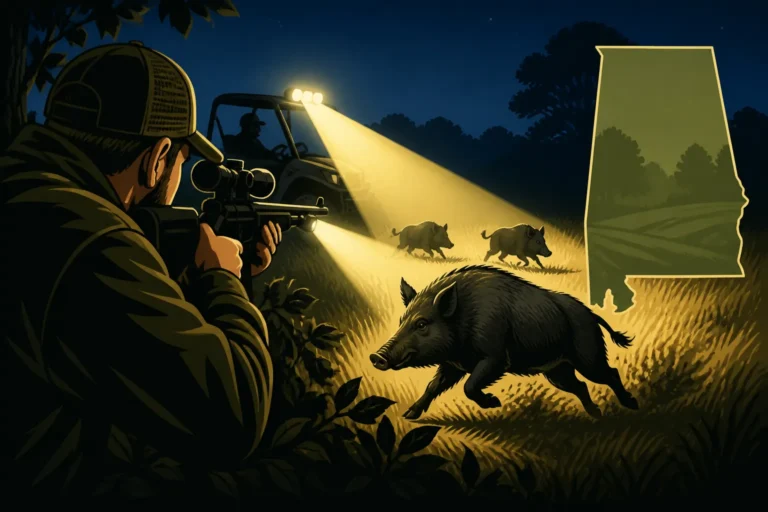
Optics: A good scope on your rifle is a must. Variable power scopes (e.g., 3-9x or 4-12x) allow you to adapt to different ranges. For shotgun hunters, a red dot sight can provide quick target acquisition in thick cover. Beyond the firearm, a pair of quality binoculars (8x or 10x) is indispensable for scanning the landscape and spotting those subtle movements that betray an approaching predator. Don't forget a good headlamp with a red or green light setting for navigating in the dark if you're out late, especially considering Night Hunting Rules for Alabama Coyotes might allow after-dark operations on private land.
Camouflage and Scent Control
Predators, especially coyotes, have incredibly keen senses of sight, smell, and hearing. If you're going to fool them, you need to vanish into your surroundings.
Camouflage: Full camouflage, head to toe, is non-negotiable. Break up your outline with patterns that match the pine plantation environment – greens, browns, and grays that mimic tree bark, pine needles, and shadows. A face mask or face paint is essential to conceal the bright areas of your skin. Breaking up your silhouette is more important than specific pattern, so choose something that blends with the typical dark vertical lines and mottled ground of a pine forest.
Scent Control: This is arguably the most crucial element, especially for coyotes. They will try to get downwind of you. Use scent-eliminating sprays on your clothes and gear, wash your hunting clothes in scent-free detergent, and store them separately. Avoid scented deodorants, soaps, and even chewing gum. Pay attention to the wind direction constantly, choosing stand locations that put the wind in your favor, ideally quartering towards your back or side. The GoHunt app, for example, offers excellent mapping tools that can help you predict wind direction and thermals for your stand location, giving you a significant advantage in scent management. Even the slightest whiff of human odor can send a wary coyote scrambling back into the pines.
Effective Calling Strategies for Alabama Pine Plantations
Now for the fun part: bringing them in! Calling predators in pine plantations presents unique challenges and opportunities. Success often hinges on strategic setup, knowing what to call, and adapting to the situation.
Strategic Setup and Stand Placement
Your setup is perhaps the most critical factor. In a pine plantation, you're dealing with varied visibility – from open, thinned stands to incredibly dense young growth.
Choosing Your Location: Look for natural travel corridors, such as old logging roads, fire breaks, or the edges where pines meet a clear-cut, a hardwood bottom, or a field. Predators will use these routes. Also, consider areas with abundant prey sign, like rabbit runs or deer trails, as these are natural hunting grounds for coyotes and bobcats. A good approach is to study aerial maps, looking for funnels, pinch points, and cover changes. The GoHunt app is fantastic for this, allowing you to scout potential calling locations from home, identify dominant wind directions, and plan your entry and exit routes. You want a spot that offers good visibility in the direction you expect the predator to approach, but also excellent cover for yourself.
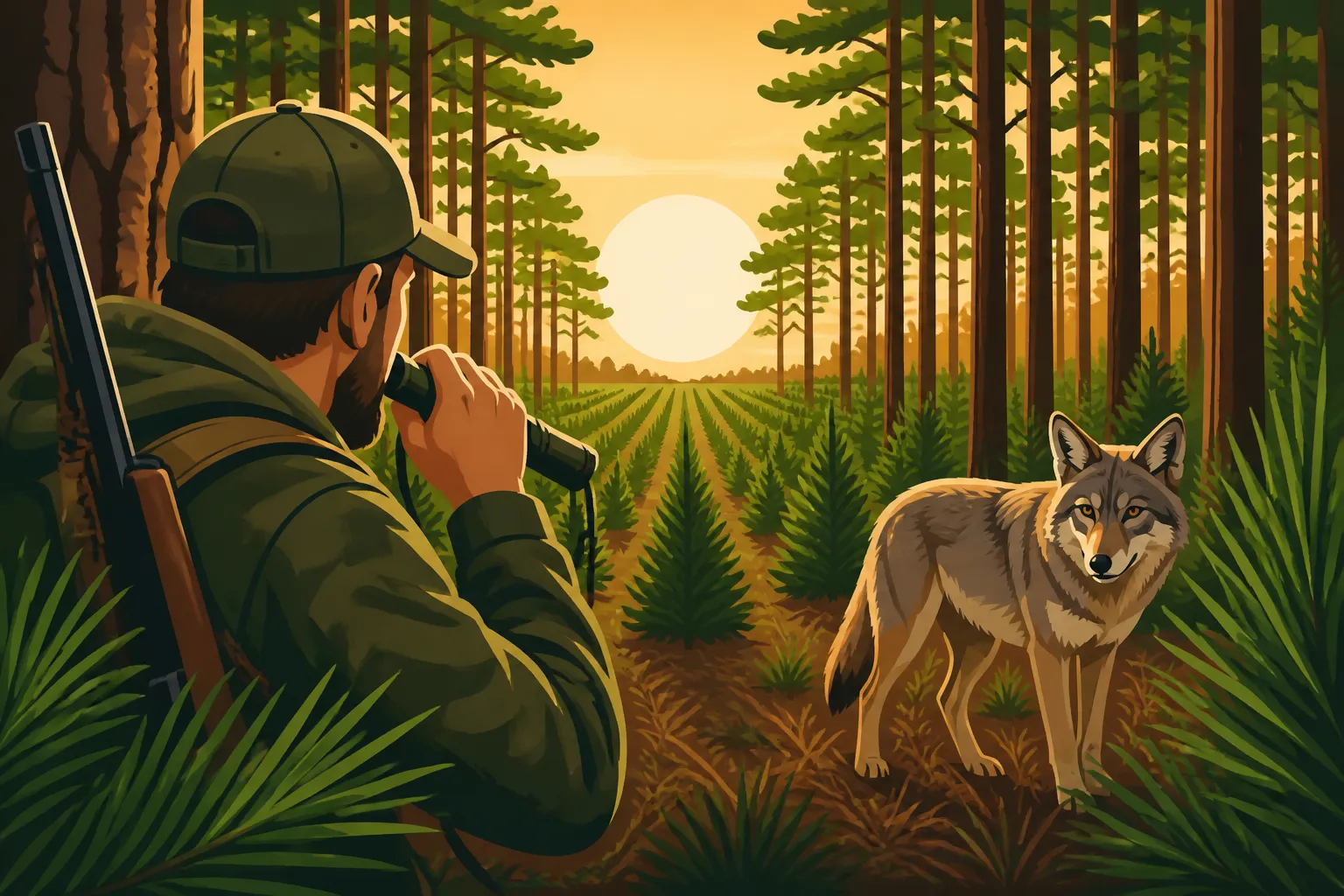
Setting Up Your Stand: Always position yourself with your back against a thick tree or clump of brush to break up your silhouette. Ensure you have a clear shooting lane or two in the direction you anticipate the predator will appear. Remember the wind! Coyotes will almost always try to circle downwind to get your scent. Position yourself so the wind is blowing across your setup, or ideally, slightly into your face from where you expect them to approach. If using an electronic call, place it 50-100 yards out in front of you and slightly to the side, drawing the predator's attention away from your actual location. This makes them focus on the sound, giving you precious seconds for a shot when they emerge.
Calling Sequences and Timing
Calling isn't just about making noise; it's about telling a story. Different sounds at different times convey different messages.
Starting Your Sequence: Begin with softer, less aggressive calls. A few short distress squalls (like a rabbit in trouble) are often a good start. If nothing responds after 5-10 minutes, gradually increase the volume and intensity. Sometimes, a series of lonesome howls or challenge howls can provoke a response from a territorial coyote, especially during breeding season or when you're hunting in areas known for a high Alabama coyote density. Pay close attention to the wind and thermals, especially on cold mornings or evenings, as sound can carry differently.
Varying Your Calls: Don't stick to one sound for too long. If a coyote hangs up, try switching to a different distress call, or even a pup distress call, which can often bring in a curious adult. If you hear a distant howl, respond with a challenge howl or a pair of barks to mimic a territorial intrusion. Remember, predators are smart; they've heard it all before. Mix it up, experiment, and learn what works best in your specific area and with the local population. A typical calling stand should last at least 20-30 minutes, as predators can take their sweet time to approach, often pausing and observing before committing. Patience is a virtue in predator calling.
Understanding Predator Response and Adjusting Tactics
The hunt isn't over until the predator is down or has slipped away. Understanding how they respond and adjusting your tactics on the fly is crucial.
Reading Body Language: Watch for subtle cues. A coyote pausing, sniffing the air, or looking directly at the call is assessing the situation. If they stop and look away, they might be trying to circle downwind. If they drop their head and trot purposefully, they're probably committed. Bobcat and fox responses are often more subdued; they'll slip through the cover, appearing and disappearing, making them very hard to pinpoint until they're close. Use your binoculars to scan constantly.
Adjusting Your Calls: If a coyote hangs up at 150 yards, staring at the call but not coming closer, try reducing the volume, or switching to a softer, more subtle distress squeak. Sometimes a few soft mouse squeaks or bird chirps can make them think the coast is clear and coax them closer. If they start to circle, be ready for them to pop out at an unexpected angle. For this, it helps to have your GoHunt map marked with your expected approach lanes so you're not caught off guard. If you get no response after a prolonged period, it might be time to move to a new stand location, perhaps after practicing some Rattling and Grunting in Alabama for deer during another season, you can apply similar patience here. Remember to always approach and depart from your calling setup quietly and stealthily to avoid educating any nearby predators.
| Predator Type | Preferred Habitat in Pines | Primary Calls That Work | Typical Approach Behavior |
|---|---|---|---|
| Coyote | Dense young growth, edges, clear-cuts | Rabbit distress, pup distress, howls | Often circles downwind, curious |
| Bobcat | Thickets, dense cover, rocky areas | Bird distress, mouse squeaks, rabbit distress | Stealthy, slow approach, uses cover |
| Fox (Gray) | Deep woods, dense brush, timber | Mouse squeaks, bird distress, high-pitched rabbit | Direct, but cautious; relies on cover |
Safety Considerations
Always remember that safety comes first. When hunting predators, especially with powerful rifles, be absolutely certain of your target and what lies beyond it. Pine plantations can have uneven terrain, old stumps, and thick underbrush that can cause deflections. Always wear proper hunter orange if required by law, even if you’re predator hunting during seasons when it isn’t strictly mandated for small game. Although not always required for predator hunting, it's good practice to wear How Much Blaze Orange Alabama Requires during daylight hours, especially if other hunters are in the area pursuing small game. Ensure you have landowner permission if hunting private timberland – Do Feral Hogs Need Landowner Permission? covers similar rules for other nuisance animals, and it's no different for predators.
Maximizing Your Success on Pine Plantation Predators
Predator calling in Alabama's pine plantations is a blend of art and science. It requires patience, keen observation, and the ability to adapt. But beyond the technical skills, there are also some broader strategies that can significantly increase your odds of success.
Scouting for Predator Sign
You can't call 'em if they ain't there. Just like you'd scout for deer sign before Opening Weekend Tactics for Zone A Gun Season, effective predator hunting starts with thorough scouting. Look for tracks in soft dirt, especially along logging roads, fire breaks, and creek beds. Scat is another key indicator – coyote scat often contains hair and bone fragments, while bobcat scat might show more bird feathers. Listen for howls, especially at dawn and dusk. Setting up trail cameras in key areas can also give you invaluable intel on predator presence, travel routes, and even peak activity times. Pay attention to areas where you've seen deer fawns or turkey poults, as these are natural hunting grounds for coyotes. A good scouting trip before you even blow a call can dramatically improve your chances.
Understanding the Best Times to Hunt
Predators are active year-round, but certain times offer better calling opportunities. The cooler months, particularly late fall through early spring, are often the most productive. During these periods, coyotes are often focused on breeding (January-March), and food sources can be scarcer, making them more responsive to distress calls. Early morning and late evening are generally the best times, mirroring when many predators are most active. However, don't rule out midday, especially on overcast days or in areas with heavy cover. If you're targeting other species like Hunting Alabama's Year-Round Feral Hogs, you'll find that their activity patterns can sometimes overlap, giving you multi-species opportunities. The key is to be out there when they are, and often, that means being persistent.
Post-Call Analysis and Learning
Every stand is a learning opportunity, whether you connect or not. After each call sequence, take a moment to analyze what happened. Did you get a response? From what direction? Did the predator hang up? Why? Was the wind a factor? Did you see any sign that you missed during your initial setup? Use the mapping features of tools like GoHunt to mark your stand locations, wind direction, and any observed predator activity. This data will help you refine your strategies for future hunts. Perhaps the call was too loud, or not loud enough. Maybe you should have used a different type of distress call. Over time, you'll develop a deeper understanding of predator behavior in your specific pine plantation and become a much more effective caller. There's always something new to learn in the woods.
Disclaimer
Hunting is an inherently dangerous activity. Always prioritize safety, adhere to all local, state, and federal hunting regulations, and obtain proper licenses and permits before heading into the field. The information provided in this guide is for informational purposes only and should not replace professional training or expert advice. Be sure to check the latest Alabama Department of Conservation and Natural Resources (ADCNR) regulations for predator hunting seasons, legal methods, and specific rules regarding private land access and night hunting.