Hunting Sand Mountain Ridgelines
You drive up the plateau before daylight, park along a county road between a chicken house and a soybean field, and walk to the edge of the woods only to find that the “ridge” on your map is really a sharp sandstone brow dropping three hundred feet into a hollow. Sand Mountain confuses a lot of hunters. This guide explains how its ridgelines work and how to hunt them.
Understanding Sand Mountain Before You Hunt It
Sand Mountain is not a single peak. It is a long, flat-topped plateau that runs from the Tennessee line southwest through Jackson, DeKalb, Marshall and Etowah counties, sitting between the Tennessee River valley on the northwest side and Wills Valley on the southeast. Towns like Albertville, Boaz, Rainsville, Fyffe, Henagar, Section and Crossville sit on top of it. If you grew up hunting the Black Belt or the coastal plain, the first thing to understand is that the top of the mountain is mostly farmland and the real deer country hangs off its edges.
The Plateau Top Versus the Brow
On top, the land is gently rolling. You will see poultry houses, pastures, row crops, small woodlots, fencerows and a surprising number of houses scattered along every paved road. Deer live up there, but they live in the gaps between people. The cover is patchy, a lot of it is under an acre, and the deer use it the way urban deer use a greenbelt.
The brow is where the plateau breaks. Along the rim you get a narrow band of oak, hickory and pine, often with exposed sandstone ledges, laurel thickets and boulder fields. Below the brow, steep sidehills fall into coves and hollows with small creeks. Locals talk about “the bluff” or “the brow” more than they talk about ridges, and once you have stood on one you understand why. A mature buck can bed on a ledge thirty yards below a cut soybean field and never be seen from the road.
Why Ridgelines Matter So Much Here
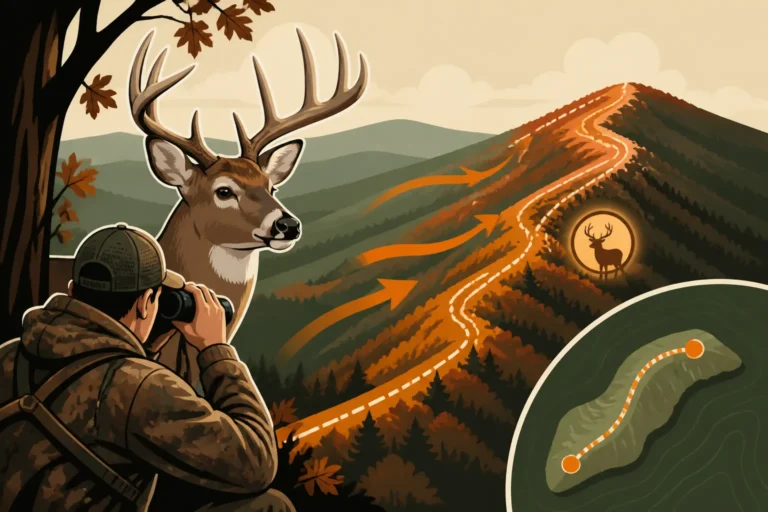
On Sand Mountain, the ridgelines that matter are the fingers and points that run out from the plateau edge. Each one is a peninsula of woods with farmland behind it and a hollow on each side. Deer feed on the plateau at night, then drop off the edge to bed on the points and the upper sidehills where they can smell what is behind them and see what is below them. That pattern is the backbone of almost every successful setup on the mountain.
If you have read Reading a Ridge for North Alabama Deer, much of it carries over, but the plateau adds a twist. Ordinary ridges have deer moving along their spines. Sand Mountain points have deer moving across them, from field edge to bedding cover and back, with only short stretches of travel along the spine itself.
Who Owns the Ground
Almost all of Sand Mountain is private. Farms are small, families have held the same land for generations, and many tracts are posted. Public options exist nearby, and you can read about them in Sand Mountain Public Hunting Ground and Skyline Wildlife Management Area, which sits farther north on the plateau country of Jackson County. Still, most hunters who do well up here have permission on a farm or two. Because tracts are so small, a boundary layer in a mapping app such as GoHunt is worth having on your phone so you never wander across a property line while following a trail off the brow. A friendly visit, a firm handshake and an offer to help with hogs or fence repair go a long way, and Asking an Alabama Farmer for Permission walks through the conversation.
Reading the Terrain From the Truck to the Stand
A lot of hunters on Sand Mountain make the same mistake. They hunt the plateau top because it is easy to reach, sit over the field edge they can see from the road, and wonder why they only see does and young bucks after dark. The older deer are almost always closer to the brow.
Start With an Aerial Map
Pull up satellite imagery and find the line where the farmland ends and the timber begins. That line is your brow. Then look for three things:
- Points where the timber pokes out into fields like a finger.
- Saddles, or low dips in the rim, where a hollow cuts back into the plateau.
- Benches, which show on contour lines as a flat shelf partway down the sidehill.
Mapping apps with property lines and terrain shading help a lot here. Many hunters use a layered map app, such as the one GoHunt offers, to mark points and benches before ever setting foot on the farm. Whatever app you choose, look at the topo and the aerial side by side. A point that looks small from above might hold a perfect bench just below its tip.
Saddles and Hollow Heads
Where a hollow cuts back into the plateau, the head of that hollow forms a natural crossing. Deer coming off the mountain to bed on the far side of the hollow would rather walk around its head than climb down and back up. That makes the hollow head a funnel. It is the same funnel logic hunters use between two creek bottoms, just turned upside down.
Saddles on the rim do something similar. A dip in the brow lets deer slip off the plateau without crossing a ledge. During the rut, bucks cruising for does work these saddles hard, which is why Hunting a Ridge-Top Saddle for Rutting Bucks is worth reading before November.
Benches and Ledges
Benches are the hidden bedrooms of the mountain. A bench forty yards below the brow gives a deer a flat place to lie down, rising thermals that bring scent from below in the morning, and a wall of rock and laurel behind. Approach from below on a cold morning and you will often find a string of beds pressed into the leaves along the lip.
Ledges are a different story. Sandstone outcrops can create one-way trails where the only gentle path down is a crack or a slope between boulders. Find one of those and you have found a trail every deer on that point uses.
Field Edges on Top
Do not ignore the farmland completely. A field edge that runs to within a hundred yards of the brow is often the best evening setup on the mountain. The deer stage just inside the timber, at the head of the point, before stepping out at last light. The difference between a good field-edge stand and a great one is how close it sits to the drop. If you hunt beans, the setup ideas in Hunting a Standing Soybean Field fit the plateau well.
Wind, Thermals and Access on the Brow
Wind is the reason most Sand Mountain setups fail. The plateau top has fairly predictable wind, but the brow behaves like the edge of a table. Air rolls over it, swirls in the hollows and changes direction with the sun.
How Thermals Move on a Plateau Edge
In the morning, cool air sinks. Before the sun hits the sidehill, air drains off the plateau and down into the hollows. That means a hunter sitting on the brow at daylight will have scent pulled downhill, straight toward bedded deer on the benches below. As the sun warms the slope, usually by mid-morning, the flow reverses and air rises up the sidehill toward the plateau.
In the evening, the pattern runs backward. Warm air rises through the afternoon, then sinks again as the sun leaves the slope. A stand that is perfect at 3:00 can be blowing your scent into the hollow by 5:30. The principles in Wind and Thermals on a Piedmont Ridge apply, but the plateau’s sharp edge makes the switch faster and more dramatic.
A Simple Thermal Plan
Here is a sequence that works for many hunters on the brow:
- Hunt mornings below the deer, on a bench or in the hollow, so sinking air carries your scent away from the point.
- Move up to the field edge for evenings, where rising thermals during the afternoon push your scent away from deer bedded below.
- Leave the stand or shift position if the evening sit runs past the point where the slope goes into shade and air starts sinking again.
- Check wind with a puff bottle or milkweed fluff every twenty minutes, not just when you arrive.
- Keep a backup stand on the opposite side of the point for days when the prevailing wind is wrong.
Getting In Without Being Heard
Leaves on the brow are dry and loud, and sandstone gravel rolls under boots. The best access usually runs along the field edge on top, then drops straight down to the stand rather than sidehilling along the slope through the bedding area. On a point, walk the open field to its tip, then step off on the downwind side.
Morning hunts below the deer require a long loop through the hollow. Use creek beds where you can. Running water covers footsteps, and the creek bottom keeps you below the deer’s line of sight. Leave thirty minutes earlier than you think you need to.
Comparing Common Setups
| Setup | Best Time | Wind Needed | Main Risk |
|---|---|---|---|
| Field edge near the brow | Evenings, early season | Steady wind from field toward road | Late-day thermal reversal |
| Point tip | Mid-morning, rut | Crosswind off the tip | Swirling air below the rim |
| Bench below the brow | Mornings | Sinking air before sunrise | Long, noisy access route |
| Saddle on the rim | All day in the rut | Wind from the plateau side | Pressure from neighboring farms |
| Hollow head crossing | Mornings and midday | Wind blowing down the hollow | Deer approach from many angles |
Seasonal Tactics on Sand Mountain Ridgelines
Sand Mountain deer behave a little differently through the season than deer in the southern half of the state, and knowing the calendar helps you decide where to sit.
Early Season
Early archery season is all about food and water. Bucks bed on the cooler, shaded sides of the points and feed on soybeans, clover, acorns where the white oaks are dropping, and pasture edges. Hang a stand on the field edge nearest the brow and hunt evenings with a steady wind blowing toward the road. Drop a pin in GoHunt or a similar app for every rub, scrape and bed you find, because the patterns only show up once you see a season of marks on one screen. Trail cameras on the field edge and along the trail coming up the point show you which spots the deer actually use, and Where to Hang a Camera on a Logging Road has tips on placement that suit farm lanes too.
Heat can be brutal well into October, so keep sits short and avoid walking through the bedding cover. One bump in September can push a mature buck to a neighbor’s farm for weeks.
Pre-Rut and Rut
As the days cool, scrapes show up along the rim, especially near saddles and field corners. Bucks begin cruising the brow, checking points for does. This is when a stand on the tip of a point or in a saddle shines, and when all-day sits pay off.
The rut on the north end of the state tends to come later than many newcomers expect, often stretching into late December and January. Hunting the Rut in the Northern Zones explains the timing, and Finding Which Zone Your Alabama County Sits In helps you confirm which season framework covers the farm you hunt. Zone lines and dates change, so check the regulation book every year rather than relying on last season’s memory.
Gun Season on Small Farms
When gun season opens, pressure on the plateau rises fast. Houses are close together, neighbors hunt their own small tracts, and deer react by bedding deeper in the steepest, nastiest parts of the brow. Safety becomes a real concern because fields are open and rifles carry a long way across flat ground. Know your backstop on every shot, and know how far you are from the nearest house. Follow the rules on How Much Blaze Orange Alabama Requires whenever you are in the woods during a firearm season.
A rifle setup on Sand Mountain often looks like this: a ladder stand or box blind at the head of a point, looking across a field corner toward the brow. That gives a safe, downward-angled shot into the earth. Avoid shots toward the plateau horizon, where a miss could carry into the next field or a road.
Late Season
In late season, after the crops are cut and the oaks are bare, food gets scarce. Deer bunch up on remaining green fields, standing cover, and acorn pockets that held on in the hollows. Cold fronts trigger good daytime movement, so watch the forecast and plan sits for the first cold, clear day after a front passes. Look for south-facing points that catch winter sun, because deer bed there on cold, clear mornings.
A Hypothetical Weekend
Imagine you have permission on a ninety-acre DeKalb County farm with a cut cornfield on top and two points running off into a hollow. Friday evening, the wind is out of the north. You sit the field edge at the base of the eastern point, where the north wind pushes your scent onto the open field. You see six does and a young buck at dusk.
Saturday morning, the wind is still north and the air is cold. You loop into the hollow from the south and climb to a bench below the western point, staying below the bedding area while sinking air drains down the slope past you. At 8:15 a buck walks the bench toward the point. You do not get a shot, but now you know where he beds.
Saturday evening, you stay out of that point entirely. Sunday morning, with the same wind, you slip into the bench thirty minutes earlier, and this time the buck comes through at 7:50. That is the rhythm of the mountain: learn the points, respect the thermals, and spend each sit where it fits the wind.
Recovery on Steep Ground
A deer hit on the brow almost always runs downhill. Mark the last place you saw it and wait longer than feels comfortable. Blood trails on sandstone and dry leaves can be faint, and a wounded deer will often end up in a laurel tangle near the creek. The tips in Tracking a Deer Through Alabama Pine Straw help on the pine-covered points, and the same patience pays off in the hollows. Plan your drag before you shoot: hauling a deer up a three-hundred-foot sidehill is a hard job, and a game cart is useless on ledges.
Bringing It Together
The checklist below captures the main ideas:
- Find the brow, then mark points, saddles, benches and hollow heads.
- Hunt mornings below the deer and evenings on the field edge near the drop.
- Watch thermals closely, especially in the last hour of daylight.
- Keep access routes on the field edge or in creek beds.
- Expect the rut later in the north, and plan vacation days to match.
- Treat every shot on flat farmland as a safety decision first.
Sand Mountain rewards hunters who slow down and learn the edges. A small farm with two good points can produce for years if you hunt it carefully, rotate stands with the wind, and avoid walking through the places deer feel safest.
Disclaimer
This article is for general informational purposes only and does not constitute professional advice. Laws, prices and regulations vary by location and change over time. Consult a qualified professional for guidance on your specific situation.