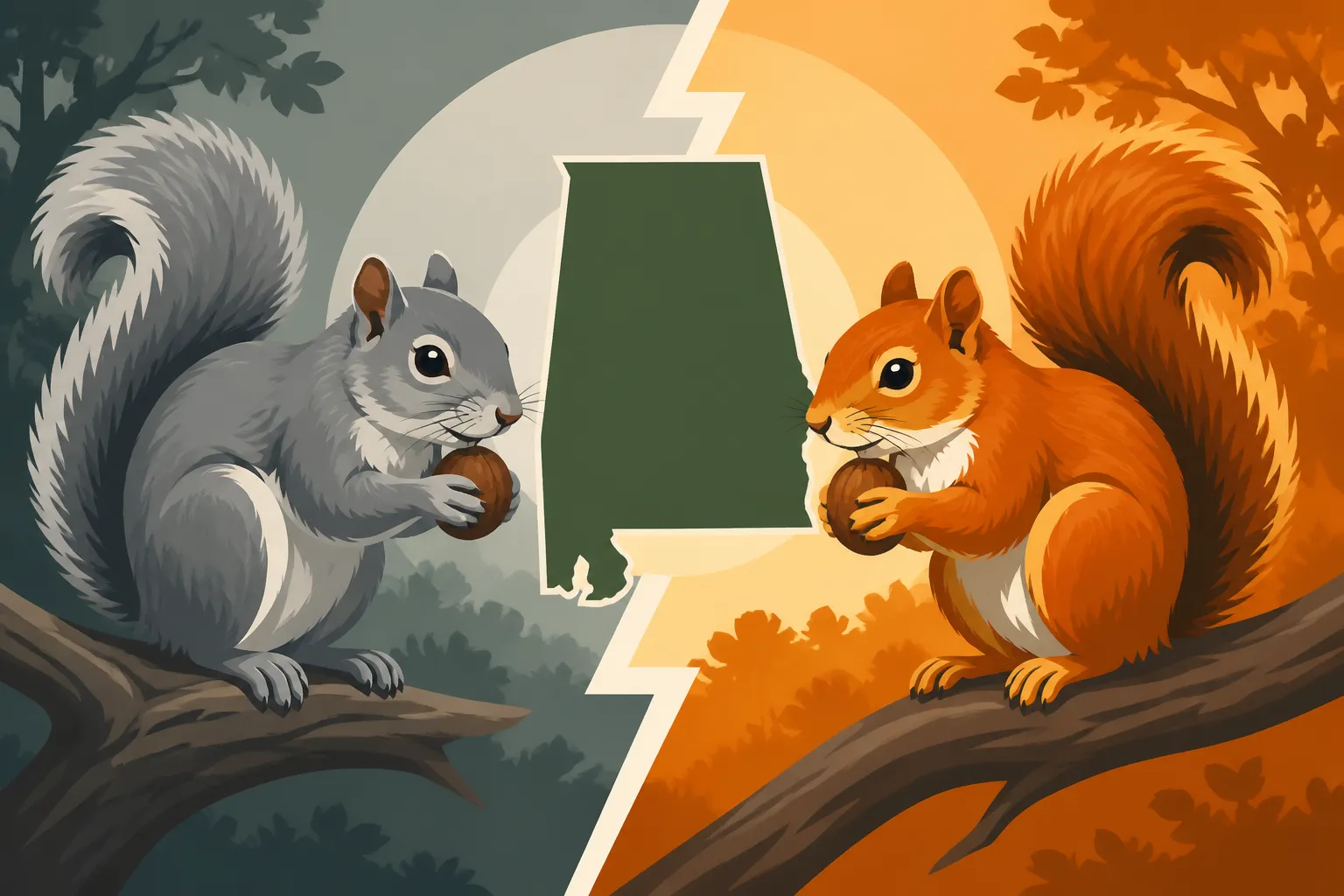
Gray Versus Fox Squirrels in Alabama
It can be surprisingly tricky to tell the difference between Alabama's two most common squirrel species, the gray squirrel and the fox squirrel, especially when they're darting through the canopy or blending into the forest floor. Hunters often find themselves wondering if that quick flash of movement was a big gray or a smaller fox, and knowing the distinctions can really fine-tune your approach in the woods. This guide is here to clear up the confusion, helping you confidently identify both species, understand their unique behaviors, and improve your hunting success across our diverse Alabama landscapes.
The Elusive Gray Squirrel: Alabama's Woodland Acrobat
Ah, the gray squirrel. This is probably the squirrel most folks picture when they think about the bushy-tailed critters in their backyard or zipping up an oak tree. In Alabama, the eastern gray squirrel (often just called a "gray squirrel" or sometimes even "cat squirrel" by older hunters) is incredibly abundant and widespread. They're true inhabitants of our hardwood and mixed forests, and they've perfected the art of blending in and making a quick escape.
Appearance and Size: Built for Agility
The gray squirrel is generally smaller and more streamlined than its fox squirrel cousin. Typically, an adult gray squirrel will weigh in at around a pound to a pound and a half, with a total length of about 15 to 20 inches, including that impressive tail. Their fur, as the name suggests, is predominantly gray, though you'll often see hints of brownish-red on their flanks, head, and feet, especially during different times of the year or in various lighting conditions. Their belly is usually white or very light gray.
What really stands out is their tail: long, bushy, and often fringed with white hairs, it's used as a balance beam, a rudder for jumping, and even a cozy blanket on a cold night. Their ears are relatively small, and their overall build suggests quick, agile movements rather than the more robust stature of a fox squirrel. If you see a squirrel that seems almost too fast to track, it's likely a gray.
Habitat Preferences: Where You'll Find Them Thriving
Gray squirrels are most at home in mature hardwood forests. Think about those beautiful stands of oaks, hickories, pecans, and sweetgums – that's prime gray squirrel country. They absolutely thrive in areas with a dense canopy and plenty of mast-producing trees. You'll find them in river bottoms, along creek drainages, and throughout the extensive hardwood ridges of places like the Talladega National Forest or the Bankhead National Forest. They prefer denser cover where they can easily disappear into the branches or a tree cavity.
They're less common in purely pine forests, though they will utilize mixed pine-hardwood stands, especially if there's a good mast crop available from the hardwoods. Squirrel Hunting Alabama Bottomland Hardwoods is a classic example of where you'll find gray squirrels in abundance, scurrying amongst the fallen leaves. They rely heavily on tree cavities for nesting and escape, but will also build leaf nests high in the canopy.
Behavior and Diet: Masters of the Acorn Hunt
Gray squirrels are diurnal, meaning they're most active during the day, particularly around dawn and dusk. They're incredibly industrious, spending countless hours foraging for food. Their diet is primarily made up of nuts, seeds, and fruits. Acorns, hickory nuts, and pecans are absolute favorites. They're notorious for burying caches of nuts for later retrieval, often relying on their excellent memory and sense of smell to dig them up months later.
Beyond mast, they'll also eat buds, tree bark, fungi, and occasionally even insects or bird eggs. When disturbed, a gray squirrel is known for its quick, erratic movements, often spiraling around a tree trunk, making it a challenging target for even the most seasoned hunter. They're also quite vocal, communicating with a variety of barks, chatters, and chirps. Hearing those excited barks can often tell you exactly where a gray squirrel is feeding or alerting its companions to your presence.
The Distinctive Fox Squirrel: A Bigger, Bolder Presence
Now, let's talk about the fox squirrel. If you've ever seen a squirrel that made you do a double-take because of its sheer size or unusual coloring, it was probably a fox squirrel. These aren't just bigger gray squirrels; they're a distinctly different species with their own unique traits and habits.
Appearance and Size: Varied and Robust
Fox squirrels are significantly larger than gray squirrels, often weighing between 2 to 3 pounds, and reaching lengths of 20 to 30 inches, including their tail. Their build is more robust, almost stocky, and their movements tend to be slower and more deliberate compared to the lightning-fast grays.
What truly sets fox squirrels apart is their incredible variation in coat color. While gray squirrels are fairly consistent, fox squirrels can range dramatically. In Alabama, you might encounter individuals with rusty-orange undersides, ears, and tails, contrasting with a grizzled gray-brown back. Others might be almost entirely black, or a mix of dark gray and black with a white nose and ears. It's not uncommon to see fox squirrels with black phases, especially in certain regions. Their tail is also very bushy, but often lacks the pronounced white fringe of the gray squirrel and can be more uniformly colored to match their body. Fox Squirrel Color Variations are something to marvel at and can sometimes confuse hunters new to identifying them.
Habitat Preferences: Open Pine and Woodlot Dwellers
Unlike their gray cousins who prefer dense hardwoods, fox squirrels gravitate towards more open, mature pine forests, pine-hardwood mixes, and scattered woodlots with larger, more widely spaced trees. They're often found on the edges of agricultural fields, in mature longleaf pine savannas, or in more open park-like timber stands. They seem to prefer areas where they can see predators coming from a distance and don't rely as heavily on dense canopy cover for escape.
You might find them around old farmsteads with pecan trees, along fencerows, or in upland pine stands. While they also use tree cavities, they're more prone to building large, messy leaf nests in the crooks of branches, especially in areas with fewer suitable den trees. You won't typically find large concentrations of fox squirrels in dense bottomland hardwood swamps where gray squirrels flourish. Instead, look for them where the canopy is more open and the understory less cluttered, such as in areas managed with prescribed burns common in Hunting Longleaf Pine Savanna for Deer.
Behavior and Diet: Ground Foragers and Mast Lovers
Fox squirrels are also diurnal, but their activity pattern can be a bit more relaxed than the frantic pace of gray squirrels. They spend a good deal of time foraging on the ground, often digging for buried nuts or searching for fungi. Their diet is similar to gray squirrels, focusing heavily on nuts, seeds, and fruits, with a particular fondness for pine seeds, pecans, and acorns. They're less prone to extensive food caching than grays, often burying nuts individually.
When alarmed, a fox squirrel might take a moment longer to decide its escape route, sometimes even freezing on a tree trunk or limb rather than immediately scrambling away. When they do move, it's typically a more deliberate, bounding gait on the ground, or a slower climb up a tree. Their calls are also distinct, often a more guttural bark or a series of clucking sounds, rather than the sharper, higher-pitched chattering of a gray.
Why Knowing the Difference Matters for Alabama Hunters
You might be thinking, "A squirrel is a squirrel, right? If it's legal, I'll shoot it!" And while that's certainly true in terms of the general hunting season, understanding the differences between gray and fox squirrels can actually make you a more successful and discerning hunter.
Bag Limits and Regulations: A General Squirrel Season
In Alabama, the hunting regulations for squirrels typically lump both species together. There isn't a separate bag limit for gray squirrels and fox squirrels; it's usually a combined daily limit. For instance, the daily bag limit for squirrels is quite generous, which means you don't typically have to stress about exceeding a specific species quota. However, knowing which species you're pursuing can inform your strategy. Alabama Squirrel Daily Bag Limit outlines the specifics, but generally, you'll find the rules cover both equally.
Preferred Habitats and Hunting Strategies: Tailoring Your Approach
The biggest reason to differentiate between the two is because their preferred habitats dictate where you'll find them and, consequently, how you should hunt them.
- For Gray Squirrels: If your goal is to fill your limit with fast-paced action, head to dense, mature hardwood bottoms and creek drains. Still-hunting slowly, listening for their barks and the rustle of leaves, is very effective. Sitting quietly near a productive oak or hickory can also yield good results.
- For Fox Squirrels: If you're looking for a larger squirrel and appreciate the challenge of finding a less numerous species, focus on more open pine stands, mixed forests with large, scattered oaks, or woodlots bordering fields. Fox squirrels are often found on the ground, so still-hunting with a keen eye on the forest floor, especially in areas with good mast production, can be productive. Their slower movements sometimes make for an easier shot, but their scarcity can mean more walking.
Understanding the terrain and timber types available is key. Tools like the GoHunt app can be incredibly useful here. You can use its satellite imagery and land ownership layers to identify promising hardwood bottoms for grays or expansive pine plantations and scattered oak flats for fox squirrels, even before you ever step foot in the woods. This can save you a lot of time and effort by helping you narrow down your hunting grounds based on species preference. Scouting Alabama Public Land Before Season is always a good idea, and mapping tools are a huge part of that.
Appreciating Alabama's Wildlife Diversity
Beyond the practical hunting benefits, simply knowing the difference allows you to better appreciate the incredible biodiversity we have here in Alabama. Each species plays a vital role in our ecosystems, from seed dispersal to serving as a food source for predators. Observing their unique behaviors and understanding their ecological niches adds another layer of richness to your time afield. When you correctly identify a large, rusty-bellied fox squirrel lumbering across an open pine flat versus a quick, agile gray squirrel spiraling up a river birch, you're not just seeing "a squirrel" – you're truly connecting with the specific wildlife of our state.
Hunting Both Species: Tactics for Success
Whether you're targeting the ubiquitous gray or the more distinctive fox squirrel, some core hunting principles apply. However, adjusting your tactics slightly based on the species you encounter or intend to pursue can significantly boost your success.
Gear Considerations: Small Game Specifics
For squirrel hunting, the gear is pretty straightforward and accessible, which is one of the joys of the sport.
- Firearms: A .22 caliber rimfire rifle is arguably the most popular choice. It's accurate, quiet, and effective for squirrels. Shotguns, especially a .410 or 20-gauge, are also excellent, particularly for those fast-moving grays in dense cover. Just be mindful of pellet spread and shot size. Many hunters also enjoy pursuing squirrels with air rifles or even traditional archery gear for an added challenge. Alabama Small Game Season Rules will cover specific legal methods.
- Ammunition: For a .22 rifle, standard velocity or subsonic rounds are often preferred for their reduced noise, which can allow for multiple shots if a group of squirrels is present. For shotguns, a light load of #6 or #7.5 shot is usually perfect.
- Optics: A good set of binoculars (8×32 or 10×42) is invaluable for spotting squirrels high in trees or identifying movement in the canopy. For rifles, a low-power scope (1-4x or 2-7x) can greatly improve accuracy on small targets.
- Clothing: Camouflage is always a good idea, but more importantly, wear quiet fabrics that won't rustle as you move. Comfortable walking boots are essential, as squirrel hunting often involves a lot of still-hunting. Don't forget bug spray, especially in early season.
Timing Your Hunt: Capitalizing on Activity Peaks
Squirrels are most active during the cooler parts of the day, particularly early morning and late afternoon. These are generally the best times to be in the woods, as they'll be out foraging. Mid-day can be slow, especially on warm days, but they'll still move.
Weather plays a role, too. A crisp, cool morning after a rainy night can be fantastic, as squirrels are often eager to get out and dry off, and the damp leaves make for quieter walking. Conversely, high winds can make squirrel hunting tough, as their movements are harder to spot and the wind itself can mask sounds. Pay attention to food sources; during acorn drop, squirrels will be concentrated in those areas, and you'll hear the tell-tale cutting of nuts.
Location, Location, Location: Scouting for Success
Scouting is just as important for squirrels as it is for deer. You're looking for signs of activity: cut nut shells on logs or stumps, squirrel tracks in soft dirt, and most importantly, the presence of mast-producing trees.
- For Grays: Focus on large stands of oaks, hickories, and pecan trees, especially in bottomland areas or along creek drainages. Look for signs of heavy acorn or hickory nut cutting. Squirrel Hunting Alabama Hickory Groves are always a hot spot for them.
- For Fox Squirrels: Scan more open pine stands, mixed pine-oak forests, and woodlots on the edges of agricultural fields. Look for bigger, more scattered hardwoods. Often, a single large pecan or oak tree on a field edge can hold several fox squirrels.
- Utilizing Mapping Tools: This is where the GoHunt app comes into its own. Before you even head out, you can use the app to identify different timber types. Look for areas marked as hardwood stands on public land like our National Forests or WMAs. You can toggle satellite views to visually confirm tree species if you're good at recognizing them from above, or use topographic maps to pinpoint creek bottoms and ridges where different mast trees might grow. This kind of digital scouting can significantly narrow down your search and put you in the right habitat for your target species. You can also mark potential squirrel hot spots you find on GoHunt's map as waypoints for future reference.
Still-Hunting vs. Sitting: Diverse Strategies
- Still-Hunting: This involves moving slowly and quietly through the woods, pausing frequently to listen and scan. It's excellent for both species, allowing you to cover ground and find active squirrels. Move a few steps, then stop for a minute or two, scanning the trees and ground for movement. This strategy is highly effective for Squirrel and Small Game Hunting in Alabama.
- Sitting: If you've identified a particularly hot area, like a grove of dropping acorns or a productive pecan tree, setting up quietly and waiting can be very effective. This is often best for grays who might be more numerous in one area. Get there before daylight and be ready when they start moving.
By understanding the subtle, and sometimes not-so-subtle, differences between gray and fox squirrels in Alabama, you can become a more knowledgeable and successful hunter. Each trip afield becomes a bit more rewarding when you're not just hunting "squirrels," but actively seeking out and appreciating the unique characteristics of our diverse wildlife.
Gray vs. Fox Squirrel Comparison
To help you quickly distinguish between these two fantastic game animals, here's a handy comparison table summarizing their key characteristics:
| Feature | Eastern Gray Squirrel (Sciurus carolinensis) | Eastern Fox Squirrel (Sciurus niger) |
|---|---|---|
| Size | Smaller, ~1-1.5 lbs, 15-20 inches total | Larger, ~2-3 lbs, 20-30 inches total |
| Body Build | More slender and agile | More robust, stocky |
| Primary Color | Gray, with brown/red highlights | Highly variable: rusty, gray-brown, black |
| Belly Color | White or light gray | Often rusty-orange or brownish |
| Tail | Bushy, often white-fringed | Very bushy, variable color, less white-fringed |
| Ear Size | Relatively smaller | Slightly larger, often prominent |
| Movement | Quick, erratic, acrobatic | Slower, more deliberate, bounding |
| Preferred Habitat | Dense, mature hardwood forests, bottomlands | Open pine forests, mixed woods, field edges |
| Primary Nesting | Tree cavities, leaf nests | Leaf nests, tree cavities |
| Vocalizations | High-pitched chattering, barks, chirps | More guttural barks, clucking sounds |
| Foraging Style | Tree canopy and ground, extensive caching | Primarily ground, less extensive caching |
Disclaimer
This article is for general informational purposes only and does not constitute professional advice. Laws, prices and regulations vary by location and change over time. Consult a qualified professional for guidance on your specific situation.