Tracking a Deer Through Alabama Pine Straw
The shot felt good, but now you're standing over an empty patch of ground, heart pounding, wondering if your trophy buck or freezer doe is truly down. Losing a deer after the shot is one of the most gut-wrenching experiences for any hunter, especially when you're dealing with the often-challenging terrain of Alabama, where a thick blanket of pine straw can swallow every drop of blood and make a clear track vanish into thin air. This guide is here to walk you through the meticulous, sometimes frustrating, but ultimately rewarding process of tracking a deer through those notoriously tricky Alabama pine forests, helping you recover your game even when the trail seems to disappear.
The Critical First Moments After the Shot
There's a universally accepted truth in deer hunting: the moment you pull the trigger is only the beginning of the hunt. What happens in the immediate aftermath can make or break your chances of recovering the animal. Rushing in too soon is a mistake many of us have made, driven by adrenaline and anticipation, only to push a wounded deer further than it needed to go.
The Golden Rule of Waiting
Patience is not just a virtue in hunting; it's a strategic imperative, especially after the shot. Your first instinct might be to sprint to the spot, but that's often the worst thing you can do. A deer that's been hit, even fatally, will often run a short distance and then bed down if it feels unpressured. If you go barging in, you risk spooking it from its bed, sending it off on another run, potentially making a recovery much harder or even impossible.
The ideal waiting period depends heavily on where you believe you hit the deer. For a solid lung or heart shot, a deer might only travel 50-100 yards before expiring. In these cases, 30 to 60 minutes of quiet waiting can be sufficient. However, if you suspect a liver hit (darker, thicker blood) or, heaven forbid, a gut shot (greenish or brownish fluid, possibly with stomach contents and a distinct odor), the waiting game becomes significantly longer. For a gut shot, you're looking at a minimum of 6-8 hours, and often an overnight wait, to allow the animal to expire and stiffen up. It's an agonizing wait, full of doubt and second-guessing, but it's often the only way to ensure a successful recovery. We've all been there, sitting on pins and needles, replaying the shot a hundred times, but resisting that urge to immediately pursue is paramount.
Before you even think about tracking, take a mental snapshot. Where exactly was the deer standing when you shot? What direction did it run? Did it stumble, kick, or hunch up? Did you hear it crash within earshot, or just the fading sound of hooves? Every single one of these details is a piece of the puzzle. The more information you gather from your stand or shooting position, the better prepared you'll be to interpret the sign once you start on the ground.
Marking the Initial Impact Site
Once you've given the deer ample time, and you're ready to begin your search, your very first physical step should be to go to the exact spot where the deer was standing when you shot it. This is your "point of impact." Mark this spot unequivocally. Use a piece of flagging tape tied to a branch, your hunting hat, a water bottle, or anything bright and easily visible. This landmark establishes your absolute starting point for the track.
Without a clearly marked starting point, you’re essentially guessing. In a dense Alabama pine forest, with its uniform canopy, thick undergrowth, and a deep carpet of pine straw, every tree can look the same. You'll find yourself circling, disoriented, and quickly discouraged if you don't have that initial anchor point. After marking the shot site, also mark the exact spot where you last saw the deer. Even if you don't find blood right away, this gives you a clear line of travel for the deer's initial escape.
This initial line of flight is invaluable. If the blood trail is sparse or non-existent, knowing the general direction the deer fled allows you to concentrate your search in the most probable area. While you're at the impact site, sweep the ground thoroughly with your eyes. Look for any tell-tale signs: fresh tracks, disturbed pine straw, hair, bone fragments, or the first drops of blood. Sometimes, a deer will "blow out" on impact, leaving a significant amount of hair or initial blood right where it was hit.
Deciphering the Story in Pine Straw and Scrapes
Tracking a deer in Alabama often means dealing with pine straw. It's a beautiful, quiet carpet to walk on, but a notorious challenge for blood trailing. The fine, dry needles absorb moisture quickly, making blood disappear into the forest floor like magic.
Reading the Blood Trail
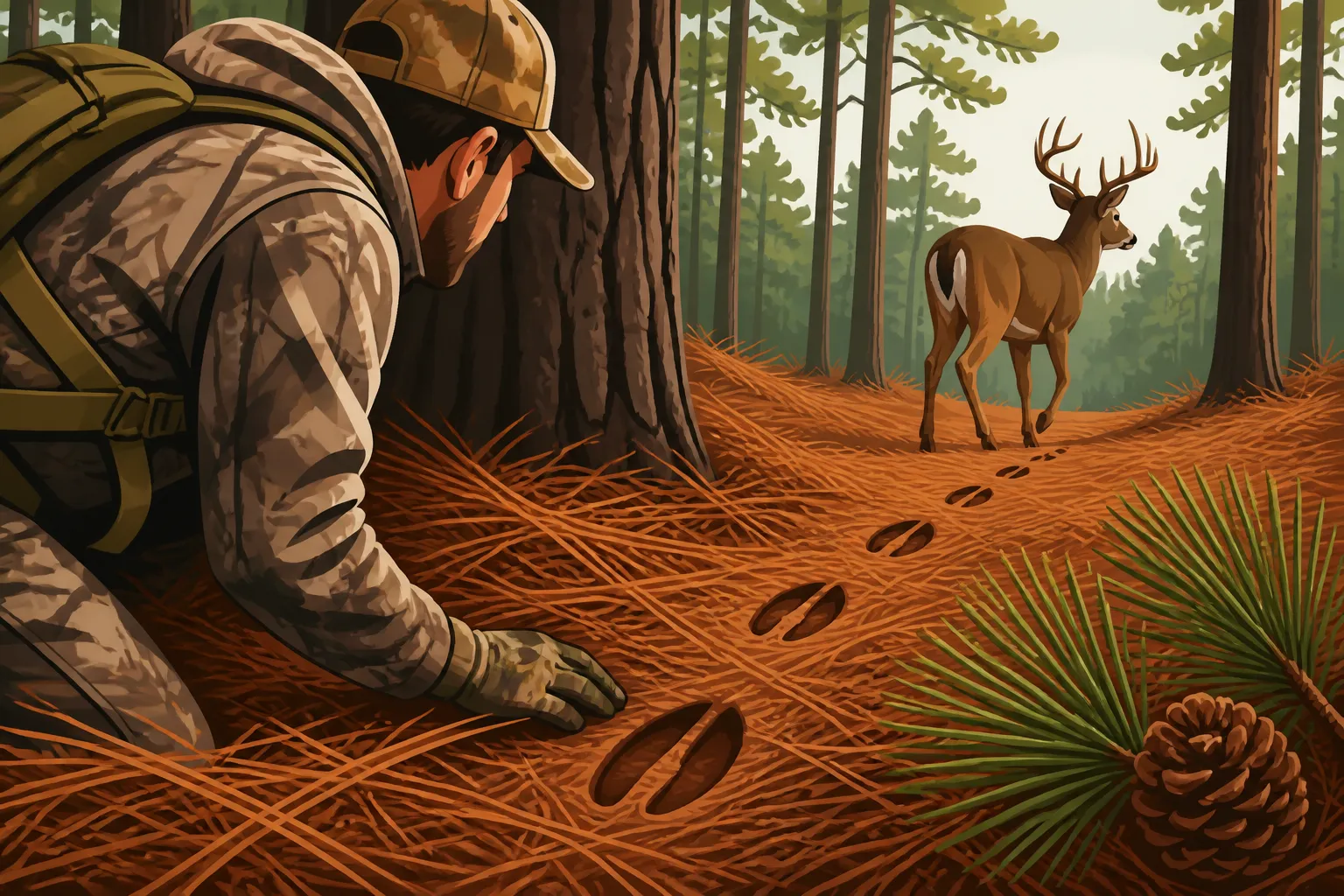
Pine straw is infamous for being a blood sponge. Unlike open soil or damp leaves that might hold a clear, shiny pool of blood, pine straw drinks it up, often leaving only a dull stain that can be incredibly hard to spot. This is why you need to slow down, get low, and be methodical. Often, you'll find yourself on your hands and knees, parting the needles, looking for the tell-tale crimson. Don't be shy about doing so; it's the most effective way to pick up the faint signs.
The color and consistency of the blood tell a critical story about the shot placement. Bright red blood, often with a pinkish hue and tiny bubbles, is a fantastic sign. This frothy blood indicates a lung hit – air mixing with blood, typically meaning a fatal wound and a relatively short track. Dark red blood that is thick and clumpy might point to a liver hit. These deer often take longer to expire, but they're still usually fatal. If you find greenish or brownish fluid, sometimes mixed with partially digested food particles and possessing a strong, foul odor, you've likely got a gut shot. This is the hardest to track and requires the longest waiting period. Dark, watery blood without much volume, perhaps with muscle tissue, usually means a muscle hit, often a leg or shoulder, which can be non-fatal or lead to a very long, difficult track.
Pay attention to the shape and distribution of the blood. Pinprick drops indicate minimal blood loss, while splatters or smeared blood on vegetation suggest heavy bleeding or the deer crashing through cover. Look for blood on both sides of the trail. This is a crucial indicator of an exit wound, which generally means better blood trails and a higher chance of recovery. If you only find blood on one side, it might be a single-lung shot or an arrow that didn't pass through, making the trail tougher.
Following Tracks and Disturbance
When the blood trail becomes faint or vanishes altogether, it's time to become a detective of disturbance. While pine straw might hide blood, it can't hide every physical sign. Look for scuffed areas where hooves have displaced the needles, creating small piles or lines where the deer's feet dragged. Observe how the pine needles lie – a deer crashing through will often kick the needles backward, creating a subtle directional arrow.
Actual hoof prints can be elusive in soft pine straw, but with the right light and a keen eye, you might still catch impressions. Look for the distinct split of the hooves, the depth of the track, and the spacing. Running deer tracks will typically be deeper, wider apart, and might show signs of hooves splaying out or digging in. A walking deer's tracks will be more evenly spaced and less disruptive.
Don't overlook the smaller details. A wounded deer, especially one running through thick cover, might leave hair caught on briars or low branches. You might even find broken twigs, pieces of bone, or fragments of flesh. These are invaluable clues. This kind of detailed scouting, similar to Finding Sign in Big Talladega Timber, is about looking beyond the obvious. As you follow what you believe to be the deer's path, scrutinize every low branch, every bush, and every patch of thicket. Deer often seek the path of least resistance, following old logging roads, creek bottoms, or well-used game trails. If the direct trail disappears, check these natural travel corridors ahead.
| Blood Color/Type | Indication | Recommended Wait Time | Notes |
|---|---|---|---|
| Bright Red, Frothy | Lung/Heart Hit (Good Shot) | 30-60 minutes | Bubbles indicate air from lungs. Good sign for quick recovery. |
| Dark Red, Thick | Liver Hit | 4-6 hours (minimum) | Often slower bleeding, deer may go further. |
| Dark Red, Watery | Muscle Hit / Leg | 1-3 hours (assess movement) | May not be fatal, can be a long track. Look for bone fragments. |
| Greenish/Brownish | Gut Shot | 6-8+ hours, or overnight | Distinct odor, often contains stomach contents. Deer may travel far before bedding. |
| Pinkish, Non-frothy | Arterial (Possible) | 1-2 hours | Could be a major artery, but not a lung shot. Look for pulsing. |
| Scant, Pinprick | Graze / Non-fatal | Check movement, assume non-fatal | May be a minor wound or just initial bleed. |
Smart Tracking Strategies for Alabama's Forests
Once you've done the initial assessment and confirmed a hit, it's time to engage systematic tracking. Random wandering in the woods will only exhaust you and increase the chances of getting lost or missing crucial signs.
The Grid and Line Approach
When the blood trail becomes intermittent or vanishes completely, the "grid search" or "line search" becomes your best friend. Instead of aimlessly circling, which rarely works, you systematically comb the area. If you have a tracking partner or two (something similar to the coordination needed for Deer Drives With Three or Four Hunters), this is much more efficient. Start at the last confirmed sign. One person can stay at that spot, acting as the anchor. The others spread out, walking parallel lines a few yards apart, slowly sweeping the area in the direction the deer was last seen.
Flagging tape is indispensable here. Every time you find a drop of blood, a scuffed patch of pine straw, or any other distinct sign, mark it with a piece of brightly colored tape. This isn't just for yourself; it helps your partners visualize the deer's path and ensures no sign is overlooked. It also provides a clear path back to the last known sign if you momentarily lose the trail. Don't worry about leaving a few pieces; you'll meticulously gather all the tape once the deer is found or the search is officially concluded.
Lighting plays a critical role. The angle of the sun in early morning or late afternoon can create shadows that make tracks and disturbances on the pine straw much more visible. If you're forced to track into low light or darkness, a high-quality headlamp is essential. A bright beam held at a low angle can highlight subtle changes in the ground that are invisible in direct light. This is especially true if you find yourself Blood Trailing After Dark in Alabama.
Leveraging Technology and External Help
Modern hunters have some incredible technological advantages at their fingertips. Mapping applications, like GoHunt, can be absolute game-changers. Before you even set foot out of your truck, use GoHunt to drop pins at your stand location, the exact spot where you shot the deer, and the last known sign. This creates a real-time visual record of your hunt and the track, helping you maintain your bearings and navigate accurately, especially in dense forests or on unfamiliar public lands.
These apps aren't just for marking; they offer invaluable topographical information, showing you elevation changes, creek bottoms, and areas of thick cover where a wounded deer might seek refuge. Understanding the Wind and Thermals on a Piedmont Ridge can even give you clues as to where a deer would naturally try to escape or bed. By using tools like GoHunt or the Outdoor Alabama App, you can save crucial time and focus your efforts more efficiently, rather than relying solely on your internal compass or memory. It's also incredibly useful for marking your entry and exit routes, helping you avoid getting disoriented. Reading Aerial Photos for Piedmont Deer can also give you a head start on understanding the terrain before you even get on the ground.
Despite your best efforts and all the technology, some trails simply go cold. This is where external help becomes a responsible and often necessary step. Alabama law permits the use of leashed tracking dogs for wounded game recovery. There are many skilled and dedicated dog handlers across the state who specialize in this service. Don't view calling one as a failure; it's a testament to your commitment to ethical hunting and recovering your animal. These dogs have an incredible sense of smell and can pick up trails days after a shot, especially if the ground scent is still there.
When you contact a dog handler or fellow hunter for assistance, be prepared to give them all the details you’ve gathered: the weapon used, estimated shot placement, the deer’s reaction, the last confirmed sign, and how much time has passed since the shot. The more information they have, the better their chances of success. It’s a community effort to ensure that game is not wasted.
Overcoming Challenges and Making the Call
Tracking a deer, especially in Alabama’s varied conditions, is rarely a straightforward walk in the park. You’ll inevitably face challenges that test your resolve and tracking skills.
Dealing with Inclement Weather and Time
Rain is arguably the greatest adversary of a blood tracker. A sudden shower can wash away blood signs within minutes, turning an already difficult track into a near impossibility. If rain is in the forecast, you might need to adjust your waiting period. For marginal hits, you may need to start tracking a bit more aggressively to beat the weather, knowing that every minute under precipitation reduces your chances. Always check the weather forecast before heading out to hunt, and factor it into your recovery strategy.
Darkness presents its own set of problems. While a good headlamp is a must, discerning subtle changes in pine straw, faint blood specks, or tiny hair fragments becomes exponentially harder in the dark. If the sign is minimal and you're tracking into full darkness, especially on a suspected gut shot, it's often wiser to mark your last sign meticulously, back out, and resume the search at first light. Pushing a deer in the dark without a clear trail often means losing it completely. Take a note of your location, perhaps using GoHunt to mark your stopping point, and get some rest so you can come back refreshed and with better visibility.
Time is also a factor. The longer a deer is unrecovered, the colder the trail becomes, and the more likely scavengers will find it. If you suspect the deer has gone into a tough area, like trying to Recovering a Deer From a River Bottom where it might be swept away, acting swiftly after the appropriate waiting period is critical. While patience is key immediately after the shot, prolonged delays beyond that can work against you.
When to Broaden Your Search or Call It Quits
If the trail completely vanishes, don't just follow a straight line. Wounded deer often behave erratically. They might circle back, or make sharp turns when pressured. Broaden your search area by making concentric circles around the last confirmed sign. Remember that deer will naturally seek the path of least resistance or the thickest cover. If the sign disappears at the edge of a dense thicket or a clear-cut, assume the deer went into it and focus your efforts there. Pay attention to the Hunting Pressure on Alabama Public Land in the area; if it's high, a deer might seek refuge in an unexpected, inaccessible spot. Consider natural travel corridors such as creek beds or ditches; a deer might cross a small stream and continue on the other side. You'd be surprised how often a deer will take advantage of a small funnel, even when wounded, much like a healthy deer might use Hunting a Funnel Between Two Creek Bottoms.
Knowing when to give up is one of the hardest parts of ethical hunting. You've invested time, effort, and emotion. You've walked miles, scrutinized every needle, and perhaps called in a friend or even a dog. If you've exhausted every reasonable avenue – systematic grid searches, checking probable bedding areas, following natural travel corridors – and found no further sign, it's okay to make the difficult call to discontinue the search. It's a tough pill to swallow, but sometimes, despite our best efforts, a deer simply cannot be found.
However, before you throw in the towel, commit to one last, thorough effort. Recharge, rehydrate, and reconsider every piece of information. Sometimes, that deer is just another 50 yards further than you thought, tucked away in an impossibly thick patch of briars. Many a deer has been found by a hunter who decided to push "just a little further" or revisit a seemingly exhausted area with fresh eyes. Your determination, combined with smart, systematic tracking, significantly increases your chances of a successful recovery, even when the pine straw tries its best to hide the truth.
Disclaimer
This guide offers general advice for tracking deer. Every hunting situation is unique, and circumstances may vary. Always prioritize safety, adhere to all local and state hunting regulations, and ensure you have permission to track on private land. When in doubt about a tracking situation or animal recovery, consult with experienced local hunters or a professional tracking dog service.