Oakmulgee District Deer Hunting
Hunting deer in Alabama, especially on public land like the Oakmulgee District, can feel like navigating a complex maze. You're trying to figure out where the deer are, what they're eating, and most importantly, how to get away from the crowds who often have the same idea. This guide is all about cutting through that confusion, giving you the real-world insights and practical strategies you need to be successful in the challenging yet rewarding Oakmulgee District.
Understanding the Oakmulgee District Landscape
The Oakmulgee District of the Talladega National Forest, nestled in west-central Alabama, offers a vast and varied landscape for deer hunters. It's not just one big chunk of woods; it's a dynamic environment shaped by timber management, natural features, and the ever-present influence of hunter pressure. Many hunters are drawn to the region, and it's easy to see why, given its reputation and size. However, to truly succeed here, you need to understand the nuances of its terrain and how deer utilize it.
Geography and Habitat Types
The Oakmulgee District primarily lies within the Coastal Plain ecoregion, but it has some rolling hills that hint at the nearby Piedmont. This gives it a unique mix of habitat. You'll find expansive pine plantations in various stages of growth, from young, dense clearcuts offering incredible bedding and browse, to mature, open stands of longleaf and loblolly pine. Mixed in are hardwood bottoms, especially along the numerous creeks and drainages that crisscross the landscape. These hardwood areas are critical, providing vital food sources like acorns, persimmons, and other mast crops that deer depend on, particularly as the season progresses. Understanding the difference between a thick, nearly impenetrable pine thicket and a more open, mature hardwood ridge is fundamental to predicting deer movement. Deer will often bed in the security cover of the pines during the day and venture into the hardwoods to feed during low-light hours.
Navigating these diverse habitats means being prepared for different challenges. A stalk through a mature pine forest might be quiet, but an attempt to slip through a young clearcut can be an ear-shattering, impossible feat. The creek bottoms can be swampy and dense, making for tough going but also providing natural travel corridors and escape routes for deer. Knowing these distinct habitat types and how deer use each one during different times of the day and season is a huge advantage. This ecological mosaic is part of what makes Talladega National Forest Hunting so unique and challenging.
Key Features and Topography for Deer
While much of Oakmulgee is rolling, it's far from flat. You'll encounter subtle ridges, saddles, and drainages that, while not as dramatic as mountain terrain, are incredibly important for deer movement. These topographic features act as funnels, pinch points, and natural travel corridors. For example, a saddle between two small ridges can be a prime crossing point for deer moving between bedding and feeding areas. A hard bend in a creek or a narrow strip of hardwoods between two pine blocks can also concentrate deer movement.
Water sources are another critical feature. The district is laced with small creeks, springs, and even some beaver ponds. These not only provide water but also create riparian corridors that deer use for travel and cover. Scouting these areas thoroughly before the season is crucial. Look for tracks in the mud, rub lines along creek banks, and worn trails entering and exiting these wet areas. Even small ditches or depressions can influence how deer move through the landscape. Pay close attention to these features on your maps; they are often the secret highways of the whitetail world.
Navigating Access and Pressure
One of the biggest hurdles to hunting public land in Alabama, and especially in a popular area like the Oakmulgee District, is dealing with other hunters. It can be incredibly frustrating to scout a perfect spot, only to arrive opening morning and find another truck already parked there, or worse, someone already in your chosen stand site. Learning how to access the land strategically and find pockets of seclusion is key to having a rewarding experience.
Common Access Points and Their Drawbacks
Most hunters will gravitate towards the easiest access points: the established forest roads, paved access points, and well-known trailheads. These spots are often clearly marked on maps and easy to get to, which is exactly why they see the most pressure. Parking lots along major roads, for instance, are usually full during peak season. This heavy traffic leads to deer becoming much warier and often moving deeper into cover or becoming almost entirely nocturnal near these high-pressure zones.
While these easy access points might get you onto the property quickly, they often lead to crowded conditions and spooked deer. If you're planning on hunting near one of these popular spots, be prepared to get there very early, or adjust your strategy significantly. This is where understanding Hunting Pressure on Alabama Public Land becomes vital. Consider these areas for scouting, but don't expect them to hold unpressured deer consistently once the season is in full swing.
Finding Seclusion on Public Land
The real magic in Oakmulgee lies in finding those overlooked pockets that other hunters either don't know about or aren't willing to work for. This usually means putting in the legwork. Look for sections of public land that are a mile or more from the nearest road or established access point. These remote areas, often accessible only by foot, tend to hold deer that are less accustomed to human presence. Don't be afraid to walk further than most; it often pays off handsomely.
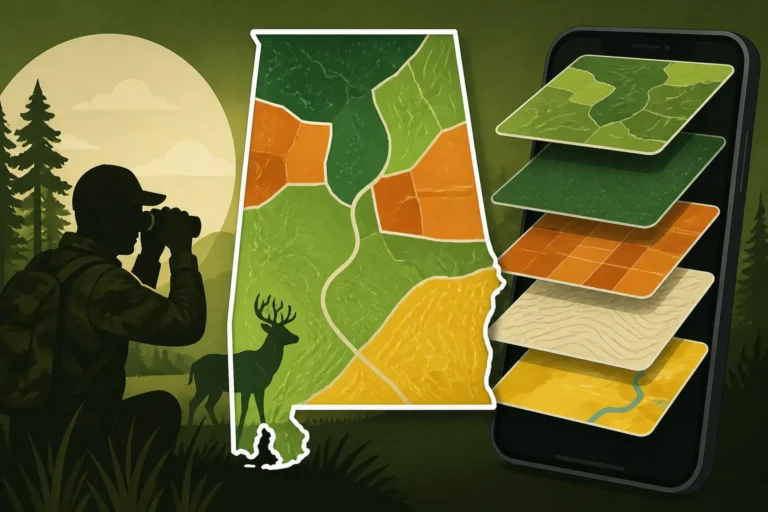
Using mapping tools like onX Hunt is invaluable for this. You can overlay satellite imagery with public/private land boundaries and topographic maps, allowing you to identify remote fingers of public land, small overlooked hardwood drains, or thickets that are just too far for the casual hunter. Look for areas with natural barriers like steep ravines, dense swamps, or long, winding creek systems that deter easy access. These natural features can create sanctuaries where deer feel safe. Sometimes, even just a quarter-mile walk off a less-traveled gravel road can make all the difference, putting you beyond where most hunters bother to go. Reading Aerial Photos for Piedmont Deer can also apply here, even in this slightly different terrain, helping you pinpoint those hidden gems.
Deer Behavior and Seasonal Strategies
Deer behavior in the Oakmulgee District is heavily influenced by food availability, hunter pressure, and the timing of the rut. Adapting your strategy to these factors throughout the season is essential for consistent success. What works in early October won't necessarily work in late December.
Early Season Scouting and Stand Placement
When Alabama's archery season kicks off, typically in mid-October, deer are primarily focused on food sources. Early season scouting should center around identifying what deer are currently eating. In Oakmulgee, this often means white oaks and other early dropping mast crops. Fresh droppings, tracks, and chewed-on acorns are clear indicators. Also look for soft mast like persimmons if you can find them. Deer will be patterning these food sources quite predictably.
Stand placement during this time should be tight to these food sources, often along trails leading into or out of them. Consider wind direction very carefully, as deer haven't been pressured much yet and are less forgiving of human scent. Elevated positions, whether in a climbing stand or a ladder stand, are excellent for minimizing your scent cone and getting a good vantage point. Remember, it's about intercepting deer as they move between bedding areas and these early season buffets. Using a tool like onX Hunt to mark these food sources and plan your approach routes is a game-changer. For advice on putting up your stand, check out Treestand Setups in Talladega National Forest.
Rut Phase Tactics
The rut in the Oakmulgee District, like much of central Alabama, can be a bit later than in some northern regions, often peaking in mid-to-late January. This is the time when buck behavior shifts dramatically from food-driven to doe-driven. Forget the acorn flats for a few weeks; now you need to be where the does are, or where bucks are cruising to find them. Look for scrapes and rub lines becoming more active, especially along ridge lines, pinch points, and travel corridors between known doe bedding areas.
During the rut, bucks will often throw caution to the wind, making them more visible during daylight hours. Rattling and grunting can be highly effective now, drawing in curious or aggressive bucks. Set up in areas that offer good visibility into open timber or fields where bucks might be cruising. You might also find success hunting transition zones where different habitat types meet, as bucks will patrol these edges. The goal is to intercept a buck as he searches for receptive does, or as he follows a hot doe. Keep an eye on those later season dates, as Hunting the Rut in the Southern Zones can be quite productive.
Late Season Food Sources
As the season progresses into December and January, many of the early fall food sources are depleted. Hard mast like white oak acorns are gone, and deer turn to different options. In the Oakmulgee, this means focusing on persistent food sources. Red oak acorns, which often drop later and last longer, become critical. Additionally, evergreen browse, honeysuckle thickets, and any remaining agricultural fields (if you're near private land borders) will draw deer.
During late season, deer are often grouped up and concentrated on these limited food sources. Cold weather fronts can make them move more during the day as they try to pack in calories. Scout for fresh sign around red oak stands, thickets of green briar, or other browse that stays palatable. Hunting thick cover adjacent to these food sources can also be productive, as deer will often bed very close to their feeding areas to conserve energy and stay warm. If you're willing to brave the colder weather, Hunting Into the Late February Either-Sex Window can offer some fantastic opportunities, especially for filling those doe tags.
| Season Phase | Primary Deer Focus | Key Tactics | Ideal Stand Location |
|---|---|---|---|
| Early Season | Hard/Soft Mast (Acorns, Persimmons) | Food source interception, scent control, quiet entry | Downwind of active feeding areas, travel corridors |
| Pre-Rut/Rut | Does / Breeding | Calling, rattling, cruising travel routes, scrapes | Doe bedding areas, pinch points, funnels |
| Late Season | Persistent Food (Red Oaks, Browse) | Tight to remaining food, thick thermal cover | Thickets adjacent to red oaks or evergreens |
Essential Gear and Technology
Hunting the Oakmulgee District, like any expansive public land, demands preparedness. Beyond your weapon of choice, the right gear and modern technology can make a significant difference in your safety, comfort, and success. Don't underestimate the power of good planning and the tools available to you.
Mapping and Navigation Tools
In a vast forest like Oakmulgee, getting lost is a real concern, and knowing precisely where you are and where public land begins and ends is paramount. This is where digital mapping applications shine. Tools like onX Hunt have revolutionized how hunters approach public land. With detailed satellite imagery, topographic maps, and clear property lines (including public land boundaries), you can scout from your couch, plan precise routes to your stand, and navigate confidently in the field. Imagine knowing exactly where a small, isolated finger of public land extends into private property, giving you a less-pressured access point to a prime area. It's an absolute game-changer.
Similarly, other apps like GoHunt offer robust mapping features that can provide invaluable insights into terrain and potential hotspots. These apps allow you to mark waypoints for rubs, scrapes, bedding areas, and food sources, building a comprehensive picture of deer activity over time. Having these maps on your phone, even if you lose cell service (many of them work offline after you've downloaded maps for your area), is a critical safety measure and a powerful scouting tool. Before you even set foot in the woods, you can identify potential funnels, hidden clearcuts, and remote ridges that might hold unpressured deer. For more on this, check out Using the Outdoor Alabama Map Tool.
Public Land-Specific Gear Considerations
Beyond mapping, there are specific gear considerations for hunting public land in Oakmulgee. Since you'll likely be doing a fair amount of walking, a comfortable, well-fitting backpack is essential for carrying your stand, layers of clothing, water, and emergency supplies. Lightweight, packable treestands or mobile ground blinds are often preferred over heavy, permanent setups, as they allow you to adapt to changing deer patterns and hunter pressure. Using a Ground Blind on Alabama Public Land can be a great tactic, especially in open pine stands or field edges.
Water is another big one; always carry more than you think you'll need, especially during Alabama's warmer early season. A good headlamp or flashlight is non-negotiable for those pre-dawn walks in and post-sunset walks out. Safety gear like a treestand harness, a small first-aid kit, and a whistle for emergencies are also crucial. Finally, remember your blaze orange during gun seasons! Understanding Alabama Hunter Education Requirements will remind you of these critical safety measures. Being prepared not only keeps you safe but also allows you to focus on the hunt itself.
Respecting Regulations and Fellow Hunters
Hunting public land is a privilege, and it comes with responsibilities. Adhering to regulations and showing respect for the land and other hunters is paramount. Not only does it ensure your own safety and legality, but it also helps preserve hunting opportunities for everyone in the long run.
Understanding WMA and National Forest Rules
The Oakmulgee District is part of the Talladega National Forest and is managed as a Wildlife Management Area (WMA). This means there are specific rules that apply beyond the general statewide Alabama hunting regulations. These often include different season dates, bag limits, and specific regulations regarding weapon types, ATV use, camping, and even how you can put up stands. It’s absolutely critical to consult the Alabama Department of Conservation and Natural Resources (ADCNR) hunting regulations for the current season, specifically for the Oakmulgee WMA. Don't just assume the general statewide rules apply.
For instance, there might be specific days designated for still hunting versus dog hunting, or particular regulations on when you can place or leave treestands. Ignoring these rules, even unintentionally, can lead to fines, loss of hunting privileges, and a negative perception of hunters. Always carry a copy of the regulations (digital or physical) with you. Make sure you're clear on things like Alabama Public Land Antlered-Only Windows or any special youth hunt dates. These details can change year to year, so always check the latest regulations before heading out.
Ethical Hunting Practices in Crowded Areas
Public land hunting, by its very nature, means you're likely to encounter other hunters. Maintaining ethical behavior and showing respect can go a long way in ensuring a positive experience for everyone. This includes being mindful of where you set up your stand relative to others, avoiding sky-lining yourself on a ridge where you might be mistaken for game, and always being aware of your background when taking a shot.
One of the most important rules of thumb is to allow other hunters their space. If you encounter a parked vehicle, consider moving to a different section of the forest. The Oakmulgee is large enough to spread out. If you walk into an area and discover someone is already hunting there, politely and quietly back out and find another spot. Communication, when appropriate and safe, can also prevent issues. If you plan to retrieve a deer after dark, a bright light and some reflective tape on your person are not only safe but also signal to any remaining hunters that you are not game. Remember that Alabama Public Land Hunting Hours are typically dawn to dusk, but retrieving game may extend beyond that. Always be courteous and respectful, and understand that we're all out there for a similar experience.
Disclaimer
This article is for general informational purposes only and does not constitute professional advice. Laws, prices and regulations vary by location and change over time. Consult a qualified professional for guidance on your specific situation.