Alabama Songbird Nest Predation by Hogs
It's a disheartening reality many Alabama landowners and nature enthusiasts face: the vibrant chorus of our native songbirds is increasingly under threat, not from the usual suspects, but from an invasive species that few connect directly to bird nests – the feral hog. These intelligent, opportunistic animals are causing devastating, often unseen, damage to ground-nesting songbirds and their fragile eggs and chicks. This guide will explore how feral hogs impact Alabama's songbird populations and what steps can be taken to protect these vital members of our ecosystem.
The Silent Threat: How Feral Hogs Prey on Alabama Songbird Nests
When we talk about the impact of feral hogs, often the first things that come to mind are crop damage, torn-up food plots, or even direct competition with native wildlife like deer for food resources. However, one of the most insidious and often overlooked forms of destruction they inflict is the predation of songbird nests. Many of our cherished Alabama songbirds build their homes either directly on the ground or very low in dense undergrowth, making them incredibly vulnerable to the relentless rooting and foraging habits of hogs.
The Omnivorous Appetite of an Invasive Species
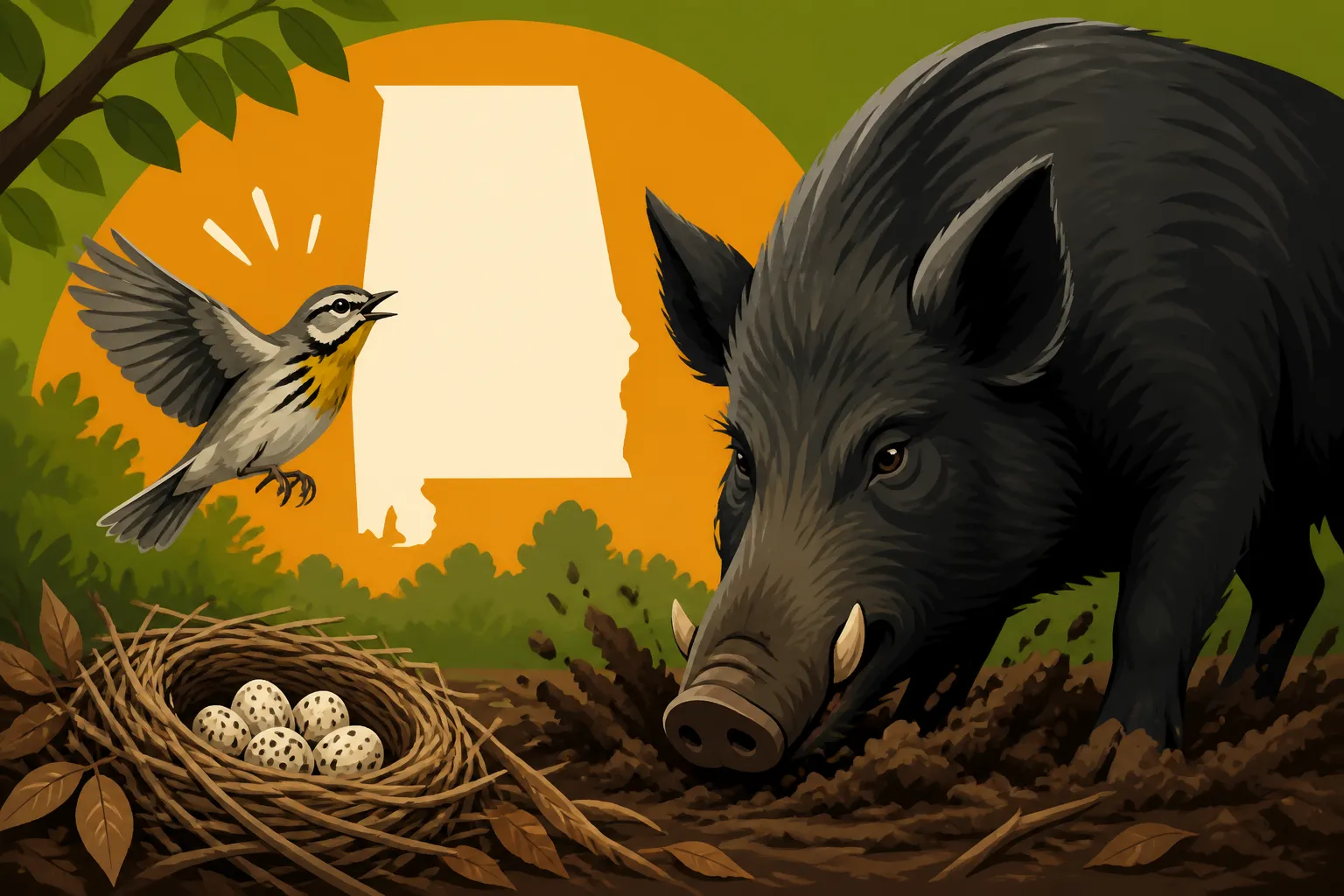
Feral hogs are not picky eaters; they are true omnivores with a highly adaptable diet. While they certainly love acorns and other mast crops, their diet also includes roots, tubers, insects, carrion, and, critically for our songbirds, eggs and young animals. A hog's keen sense of smell, designed to locate food buried underground, is equally effective at pinpointing a hidden bird nest by detecting the scent of eggs or chicks. They don't discriminate between a turtle nest, a fawn, or a clutch of ovenbird eggs – if it's a calorie source, it's fair game. This indiscriminate feeding makes them exceptionally destructive to vulnerable nesting sites.
Imagine a sow with a litter of piglets, constantly moving through the woods, rooting and snorting. Any ground-nesting bird, such as an Eastern towhee or a wood thrush, that has carefully concealed its nest among the leaf litter or at the base of a small shrub has little chance against such a thorough and hungry predator. The sheer number of hogs and their constant movement across the landscape means that very few vulnerable nests are likely to escape detection in areas with high hog activity. This isn't just an occasional occurrence; it's a systemic problem that compounds with every generation of hogs.
Direct Predation and Nest Destruction
The primary mechanism of impact is direct predation. Hogs will simply consume the eggs and young birds they discover. Unlike some predators that might take one egg or a single chick, a hog will often clear out an entire nest. Beyond the actual consumption, the very act of rooting is destructive. Even if a hog doesn't find a nest, its extensive rooting behavior can inadvertently crush eggs, destroy nest structures, or displace young birds, leaving them exposed to other predators or the elements. This physical disturbance alone can cause significant nest failure.
Consider the detailed work a female ovenbird puts into building her dome-shaped nest on the forest floor, carefully camouflaged with dead leaves. Or a Kentucky warbler, nesting low in a dense thicket. A single pass by a sounder of hogs can obliterate such a fragile structure, leaving no trace of the reproductive effort. This means not only the loss of that season's brood but also the potential for the parent birds to abandon the territory if they repeatedly face such devastation. The cumulative effect of these repeated failures year after year is what truly alarms conservationists. Alabama Songbird Nest Predation by Hogs is a problem that requires a multifaceted approach to understand and mitigate.
Unseen Consequences: The Wider Ecological Damage to Alabama's Birdlife
The direct loss of eggs and chicks to feral hog predation is just the tip of the iceberg. The presence of these invasive animals in Alabama's ecosystems creates a cascade of negative effects that ripple through the environment, ultimately impacting overall songbird populations and the health of the entire forest or field. It's a complex web of interactions where hogs are, unfortunately, a major disruptor.
Habitat Degradation and Alteration
Beyond direct nest predation, feral hogs are notorious for their habitat destruction, which indirectly harms songbirds. Their constant rooting churns up the soil, destroying native vegetation, seedlings, and the intricate understory that many songbirds rely on for cover, nesting materials, and insect food sources. This rooting can convert lush, diverse forest floors into barren, disturbed patches of dirt, making it harder for birds to find suitable nesting sites or the insects they need to feed their young.
Imagine a pristine section of bottomland hardwood forest, rich with native grasses, wildflowers, and a thick layer of leaf litter. This is prime real estate for many species, including our ground-nesting songbirds. Now picture that same area after a sounder of hogs has moved through, turning it into a mosaic of churned-up earth and broken plant stems. This isn't just an aesthetic problem; it directly reduces the quality and availability of essential nesting habitat. When the ideal spots for a Carolina wren or a common yellowthroat to build a nest are literally dug up, it forces them into less suitable, more exposed areas, further increasing their vulnerability to other predators or harsh weather. Over time, this repeated disturbance can permanently alter plant communities, favoring invasive weeds over native species, which in turn reduces the food sources and nesting opportunities for our native birds.
Competition for Resources and Disease Transmission
Feral hogs compete with native wildlife for critical food resources, which can indirectly affect songbird health and reproduction. While hogs might not directly eat the same insects as a chickadee, their rooting can destroy the very habitat where those insects live. More broadly, when hogs consume large quantities of acorns or other mast, they reduce the food available for species like deer, squirrels, and turkeys. While not a direct competition for songbirds, a decline in other wildlife can indicate a stressed ecosystem, which invariably affects all its inhabitants.
Furthermore, feral hogs can carry and transmit diseases to native wildlife, though the direct link to songbirds is less studied. However, a less healthy ecosystem, overall, is a less resilient one. The constant stress from invasive species, habitat degradation, and potential disease vectors weakens the entire food web and makes it harder for all species, including songbirds, to thrive. The long-term implications for biodiversity in Alabama are significant if hog populations remain unchecked. The issue of Alabama Feral Hog Regulations often focuses on hunting and agricultural impacts, but the ecological toll on smaller creatures is just as critical.
| Impact Category | Description | Affected Songbird Examples |
|---|---|---|
| Direct Predation | Hogs consume eggs and nestlings from ground or low-lying nests. | Ovenbirds, Eastern Towhees, Kentucky Warblers, Grasshopper Sparrows, Common Yellowthroats, Wood Thrushes. |
| Nest Destruction | Rooting behavior physically destroys nest structures, crushing eggs or exposing young birds. | Same as above; nests are simply obliterated. |
| Habitat Degradation | Extensive rooting damages understory vegetation, destroys critical nesting cover and food sources. | All forest-dwelling songbirds that rely on healthy understory and insect populations, including tree-nesting species. |
| Soil Compaction | Heavy hog traffic compacts soil, reducing water infiltration and harming plant growth. | Indirectly affects food sources and plant communities vital for bird habitat. |
| Competition | Hogs consume mast and other food sources, indirectly impacting ecosystem health and food availability. | All songbirds, as a healthy ecosystem provides ample resources. |
Fighting Back: Strategies to Protect Songbird Nests from Hogs
Dealing with feral hogs is a marathon, not a sprint, especially when trying to protect something as delicate as a songbird nest. However, a multi-pronged approach that combines targeted removal, habitat management, and vigilant monitoring can make a significant difference in localized areas, providing pockets of refuge for our feathered friends. It requires dedication and a good understanding of hog behavior.
Intensive Trapping and Removal Efforts
The most effective method for reducing feral hog populations and, consequently, their impact on songbird nests, is intensive trapping and removal. Hunting alone, while enjoyable and helpful for individual animals, rarely makes a dent in the overall population due to their rapid reproduction rate. Large, corral-style traps equipped with smart technology that allows for remote monitoring and triggering are proving to be highly efficient. These systems allow landowners to wait until an entire sounder enters the trap before dropping the gate, ensuring maximum removal.
Successful trapping relies on consistent baiting to habituate hogs to the trap site. Corn is a common attractant, sometimes soured to make it even more appealing. The goal isn't just to catch a few hogs; it's to remove entire family groups, which are the primary reproductive units. Regular movement of traps can also prevent hogs from becoming "trap shy" in one location. This level of dedication is crucial, particularly in areas identified as vital songbird nesting grounds or during critical nesting seasons. Companies like GoHunt offer mapping tools that can help identify areas of high hog activity or prime nesting habitat, allowing landowners to strategically place traps where they'll have the most impact. Remember, every hog removed is one less predator rooting through our valuable bird habitat.
Targeted Hunting and Monitoring
While broad hunting efforts might not eradicate an entire population, targeted hunting, particularly at night where legal and safe, can be an important component of a comprehensive management strategy. Night hunting with thermal or night vision equipment, often combined with bait sites, can remove significant numbers of hogs. This is especially effective for individual hogs that might be avoiding traps or for dealing with smaller, transient groups. Night Hunting Hogs With Lights on Private Land has proven to be an effective tactic in Alabama.
For landowners, consistent monitoring using trail cameras is invaluable. These cameras can help determine hog travel patterns, congregation areas, and the timing of their movements. This intelligence allows for more strategic placement of traps and more effective hunting efforts. Knowing when and where hogs are most active can help you focus your limited resources. If you're using a comprehensive tool like GoHunt, you can layer trail camera data with other mapping information to get a complete picture of animal movement on your property, including potential nesting areas you want to protect. This isn't just about reducing hog numbers; it's about being smarter about how and when you reduce them to maximize protection for other wildlife.
Habitat Management and Exclusion
Improving habitat for songbirds can also indirectly help them cope with hog pressure. Creating dense, thorny thickets or brush piles can offer some protection for low-nesting birds, making it harder for hogs to access certain areas. While building hog-proof fences around entire forests is impractical, smaller, strategically placed exclusion fencing around known critical nesting sites, if they are compact enough, might offer temporary relief for specific, highly vulnerable areas or species. This is often more feasible for species like gopher tortoises than for widely dispersed songbird nests, but the principle of creating safe zones holds.
Another aspect of habitat management is controlling invasive plant species, which often thrive in hog-disturbed areas. By restoring native understory plants, you provide better cover and food sources for songbirds, helping them to be more resilient even with hog presence. Ultimately, the goal is to create a healthy, robust ecosystem where native species have the best possible chance to survive and reproduce. Integrating these efforts with broader Feral Hogs Across Alabama management plans is key to long-term success.
The Long Game: Understanding Alabama's Feral Hog Challenge for Conservation
The problem of feral hogs predating on songbird nests in Alabama is a stark reminder of the broader ecological challenges posed by this invasive species. Their impact extends far beyond the immediate damage, creating a complex and persistent issue for conservationists, landowners, and the natural world itself. Understanding the scope of this challenge is the first step towards sustained, effective solutions.
An Unchecked Reproductive Machine
One of the most frustrating aspects of feral hog management is their incredible reproductive capacity. A sow can begin breeding as early as six months of age and can have two litters per year, averaging four to six piglets per litter, though larger litters are common. This means that even aggressive removal efforts can struggle to keep pace with their population growth. It's like trying to empty a bathtub with a teacup while the faucet is wide open. This exponential growth rate is precisely Why Alabama Hogs Reproduce So Fast and why their numbers are so difficult to control.
This unchecked reproduction means that even if you manage to clear out a sounder from your property, new hogs can quickly move in from adjacent areas, or a missed sow can rapidly replenish the local population. This constant pressure means that any efforts to protect songbird nests must be continuous and sustained, not just a one-time event. It's a commitment to ongoing management, year after year, to see any lasting positive change in the ecosystem.
Broader Ecosystem Implications
The predation on songbird nests is just one facet of the widespread damage feral hogs inflict. They impact deer, turkey, and quail populations by competing for food and destroying habitat. They consume reptile and amphibian eggs, and even prey on fawns and turkey poults. Their rooting damages sensitive wetlands, alters soil chemistry, and contributes to erosion and water quality issues. When we talk about Crop Damage Hogs Cause in Alabama, we're often thinking of corn and soybeans, but the damage to native plant communities is equally profound, altering the very foundation of the food web that supports our songbirds.
The sheer scale of their presence—with How Many Feral Hogs Alabama Has running into the hundreds of thousands—makes them one of the most significant invasive species threats to Alabama's biodiversity. Their ability to thrive in almost any habitat, from dense swamps to agricultural fields to suburban fringes, means that few areas are truly safe from their destructive tendencies. For songbirds, already facing challenges from habitat loss and climate change, feral hog predation adds another formidable hurdle to their survival.
The Need for Collective Action and Persistence
Ultimately, protecting Alabama's songbirds from feral hog predation requires more than just individual effort; it demands collective action and a commitment to persistence. Landowners, state agencies, and conservation groups must work together, sharing knowledge, resources, and best practices. Initiatives that support landowners in their hog removal efforts, whether through trap loans, educational workshops, or coordinated large-scale trapping campaigns, are vital.
The challenge is immense, but the stakes are high. The melodious songs of Alabama's native birds are an invaluable part of our natural heritage. By understanding the specific threat posed by feral hogs and engaging in strategic, sustained management, we can help ensure that these vital voices continue to echo through our forests and fields for generations to come. It’s a battle of attrition, but one worth fighting for the sake of our wildlife and the health of our natural landscapes.
Disclaimer
This article is for general informational purposes only and does not constitute professional advice. Laws, prices and regulations vary by location and change over time. Consult a qualified professional for guidance on your specific situation.