Alabama Minimum Rifle Caliber Rules
Navigating the ins and outs of Alabama's hunting regulations can feel like trying to untangle a particularly stubborn fishing line, especially when it comes to the nitty-gritty details of firearms. Many new hunters, and even some seasoned ones, get understandably confused about what's actually legal to use in the field. But don't you worry, because this guide is here to clear up all that head-scratching about Alabama's minimum rifle caliber rules, ensuring you're both compliant and ready for a successful, ethical hunt.
Understanding Alabama's Rifle Caliber Regulations
It’s not just about picking up a rifle and heading to the woods; there are specific rules in place to ensure fair chase, hunter safety, and, most importantly, the humane take of game. Alabama's Department of Conservation and Natural Resources (ADCNR) sets these guidelines, and understanding them is your first step to being a responsible hunter.
Why Caliber Rules Exist
You might wonder why the state even bothers with caliber restrictions. It boils down to a few critical factors: safety, ethical harvest, and minimizing animal suffering. Imagine trying to take down a robust Alabama whitetail with a caliber too small; you'd likely wound the animal, causing undue suffering, and potentially lose the game entirely. The rules are designed to ensure that the projectile has enough kinetic energy and penetration to deliver a quick, humane kill when placed correctly. This isn't about making your life harder; it's about respecting the animal and upholding the ethics of hunting. It's a fundamental part of responsible game management, much like understanding the Alabama Deer Season Structure Explained or your local bag limits.
The Specifics: Minimum Caliber Requirements
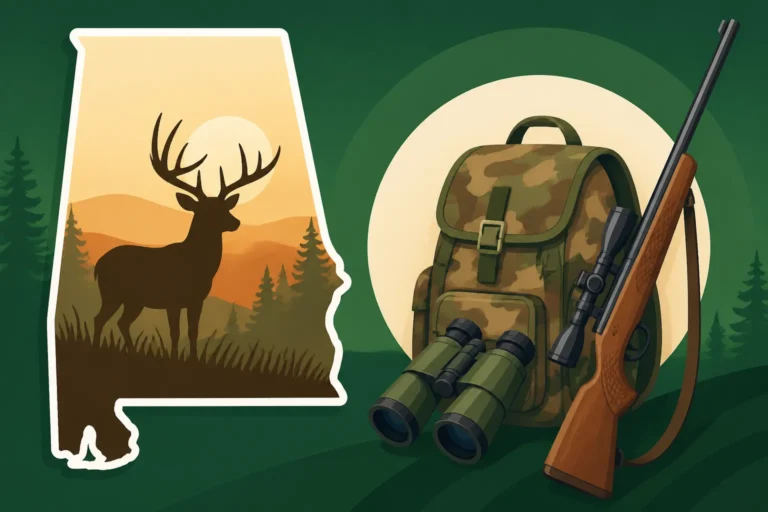
For deer hunting in Alabama, which is by far the most popular big game species here, the rules are pretty straightforward but absolutely non-negotiable. According to current ADCNR regulations, for centerfire rifles, you must use a caliber no smaller than .22 caliber. This means anything .22 centerfire and larger is generally permissible. We're talking about cartridges like the .22-250 Remington, the .223 Remington (if it's a centerfire round), and, of course, all the bigger calibers like .243 Winchester, .270 Winchester, .30-06 Springfield, and .308 Winchester.
Here’s a quick breakdown to help visualize it:
| Caliber Category | Examples | Meets Alabama Minimum (Deer) | Typical Use Case |
|---|---|---|---|
| .22 Centerfire | .22-250 Rem, .223 Rem (centerfire) | Yes | Smaller deer, varmints, shorter ranges |
| .243 – .264 | .243 Win, 6.5 Creedmoor, .25-06 Rem | Yes | All-around deer, longer ranges |
| .270 – .308 | .270 Win, .308 Win, .30-30 Win | Yes | Versatile, common deer calibers |
| .30-06 & Larger | .30-06 Sprg, .300 Win Mag, .338 Win Mag | Yes | Larger deer, elk, longer ranges |
| Rimfire | .22 LR, .17 HMR | No | Small game (squirrels, rabbits), target practice |
| Muzzleloader | .40 caliber or larger (for deer) | N/A (separate rules) | Specialized hunting during muzzleloader season |
It's crucial to distinguish between .22 centerfire and .22 rimfire. A .22 Long Rifle (LR) or .22 Magnum are rimfire cartridges, and while fantastic for small game like squirrels or target practice, they are explicitly not legal for deer or other big game in Alabama. The energy simply isn't there for a humane kill on a deer. If you're looking into Alabama Muzzleloader and Air Rifle Tactics, remember those have their own specific regulations you’ll need to research carefully.
Practical Implications for Alabama Hunters
Knowing the rules is one thing; applying them effectively in the field is another. The minimum caliber rule isn't just a hurdle to jump; it's a foundation for making smart choices about your hunting setup.
Choosing the Right Caliber for Different Game
While the .22 centerfire is the minimum for deer, many experienced Alabama hunters will tell you they opt for something with a bit more punch, especially when hunting larger-bodied deer in the Black Belt region or anticipating longer shots across a field. Calibers like the .243 Winchester, 6.5 Creedmoor, .270 Winchester, .308 Winchester, and .30-06 Springfield are perennial favorites for good reason. They offer a great balance of manageable recoil, flat trajectory, and ample energy for deer, often extending their effective range.
Consider the typical terrain you hunt. If you're mostly still-hunting creek bottoms or Still-Hunting Bankhead Forest Ridges where shots might be shorter and through thicker cover, a classic .30-30 lever-action can be incredibly effective and meet the minimum. If you're hunting open pine plantations or large agricultural fields, where shots might stretch out to 200-300 yards, something like a .270 or .30-06 might give you more confidence. When researching options, a resource like GoHunt can be incredibly useful for comparing ballistic data and understanding how different calibers perform at various ranges.
Legal vs. Ethical Considerations
Here's where it gets interesting. Just because a caliber is legal doesn't always mean it's the most ethical choice for every situation. A .223 Remington, for example, is legal for deer in Alabama as a centerfire, but many hunters consider it marginal for larger deer or shots beyond 150 yards. Bullet construction is also key here. A well-constructed, heavier bullet in a .223 that expands reliably can be effective, but a lighter, varmint-style bullet will likely underperform on a deer.
Ethical hunting means striving for the quickest, most humane kill possible. This means choosing a caliber that you can shoot accurately, that has sufficient energy for the game, and pairing it with a bullet designed for hunting that specific animal. Your personal shooting proficiency with a particular firearm is just as important as the caliber itself. It's far more ethical to make a precise shot with a .243 that you practice with regularly than to take a shaky shot with a .300 Win Mag that you rarely shoot because of the recoil. Always remember that shot placement trumps raw power. Many hunters consult platforms like GoHunt not just for regulations but also for insights into effective ammunition choices.
Common Misconceptions and Clarifications
The world of firearms and ballistics is full of opinions and old wives' tales. Let's bust a few common myths related to rifle caliber choices in Alabama.
"Bigger is Always Better" Debunked
This is a common refrain you'll hear in hunting camps, but it's not entirely accurate. While a larger caliber certainly carries more energy, it often comes with increased recoil, which can lead to flinching and poor shot placement if you're not comfortable with it. A well-placed shot from a moderately sized caliber like a .270 Winchester is far more effective than a poorly placed shot from a .300 Weatherby Magnum.
Bullet construction also plays a huge role. A premium, bonded bullet from a .243 Winchester can outperform a cheap, cup-and-core bullet from a .30-06 in terms of penetration and energy transfer. Modern bullet technology has come a long way, making many "smaller" calibers incredibly effective for deer. Focus on accuracy first, then choose a caliber that provides sufficient energy for a humane kill within your comfortable shooting range. Don't be swayed solely by raw numbers; consider the whole package: rifle, caliber, ammunition, and your personal skill. You'll find that for filling your Alabama Deer Harvest Records, consistency beats brute force every time.
Special Cases: Air Rifles and Other Weapons
While this guide focuses on traditional centerfire rifles, it's worth a quick mention that Alabama's hunting regulations do allow other weapons for deer, each with its own specific rules. For instance, air rifles are legal for deer in Alabama, but they have their own minimum caliber requirement: .30 caliber or larger, and they must propel a single projectile. This is a significantly larger minimum than centerfire rifles, precisely because air rifle projectiles generally have much lower kinetic energy.
Shotguns, typically loaded with slugs, are also legal and don't have a specific caliber rule but are generally 20 gauge or 12 gauge, which are more than sufficient. Muzzleloaders, too, have their own requirements, usually .40 caliber or larger. It’s vital not to confuse the rules between these different weapon types. Always check the specific regulations for the weapon you intend to use. For those interested in Alabama Legal Firearms for Deer Hunting, a deeper dive into each category's rules is recommended.
Staying Compliant and Prepared
The peace of mind that comes from knowing you're hunting legally and ethically is priceless. A little preparation goes a long way to avoid any unwelcome surprises or interactions with game wardens.
Double-Checking Before Your Hunt
Regulations can, and occasionally do, change. While we strive to provide the most up-to-date information, the definitive source is always the Alabama Department of Conservation and Natural Resources (ADCNR) official regulations. Before every hunting season, take the time to review the current digest, usually available online at the Outdoor Alabama website, or as a physical booklet where hunting licenses are sold.
Pay particular attention if you're hunting a Wildlife Management Area (WMA), as WMAs sometimes have additional rules or restrictions beyond the statewide regulations. For example, some WMAs might have specific days for certain weapon types, or even different antler point restrictions. Tools like GoHunt or the Outdoor Alabama app are fantastic for quick reference, but always cross-verify with the official ADCNR document. Staying informed is a key part of your responsibility as a hunter, and it helps you avoid issues like Alabama Wildlife Violation Penalties.
Essential Gear and Practice
Beyond simply having a legal caliber, true preparedness involves understanding and mastering your chosen firearm. This means:
- Plenty of Practice: Take your rifle to the range. Don't just sight it in; practice shooting from different positions (standing, kneeling, prone, off a rest) at various distances. Know your rifle's effective range and your own limitations. This skill is critical, whether you're Hunting the Rut in the Southern Zones or pursuing game on opening day.
- Quality Ammunition: Invest in good quality hunting ammunition. Don't skimp here. The right bullet for the job will expand reliably and penetrate sufficiently, ensuring a quick kill. Different bullets perform differently, even within the same caliber.
- Proper Maintenance: Keep your rifle clean and well-maintained. A clean rifle is a reliable rifle.
- Field Knowledge: Understand bullet trajectory and how it's affected by distance and environmental factors like wind. Many hunters use ballistic apps or tables to help them estimate bullet drop.
- Hunter Education: For newer hunters, or those needing a refresher, Alabama Hunter Education Requirements ensure everyone understands safe gun handling and ethical hunting practices.
By taking these steps, you're not just adhering to the minimum rifle caliber rules; you're embracing the full responsibility and enjoyment of hunting in Alabama. You're doing your part to ensure humane harvests and preserve our hunting heritage for generations to come. And while you're at it, make sure you're aware of the Alabama Public Land Hunting Hours to avoid any issues with timing your hunts.
Disclaimer
Please remember that hunting regulations are subject to change. Always consult the most current Alabama Department of Conservation and Natural Resources (ADCNR) official hunting regulations before heading afield. This guide is for informational purposes only and should not be considered a substitute for official legal advice or current state hunting digests.